

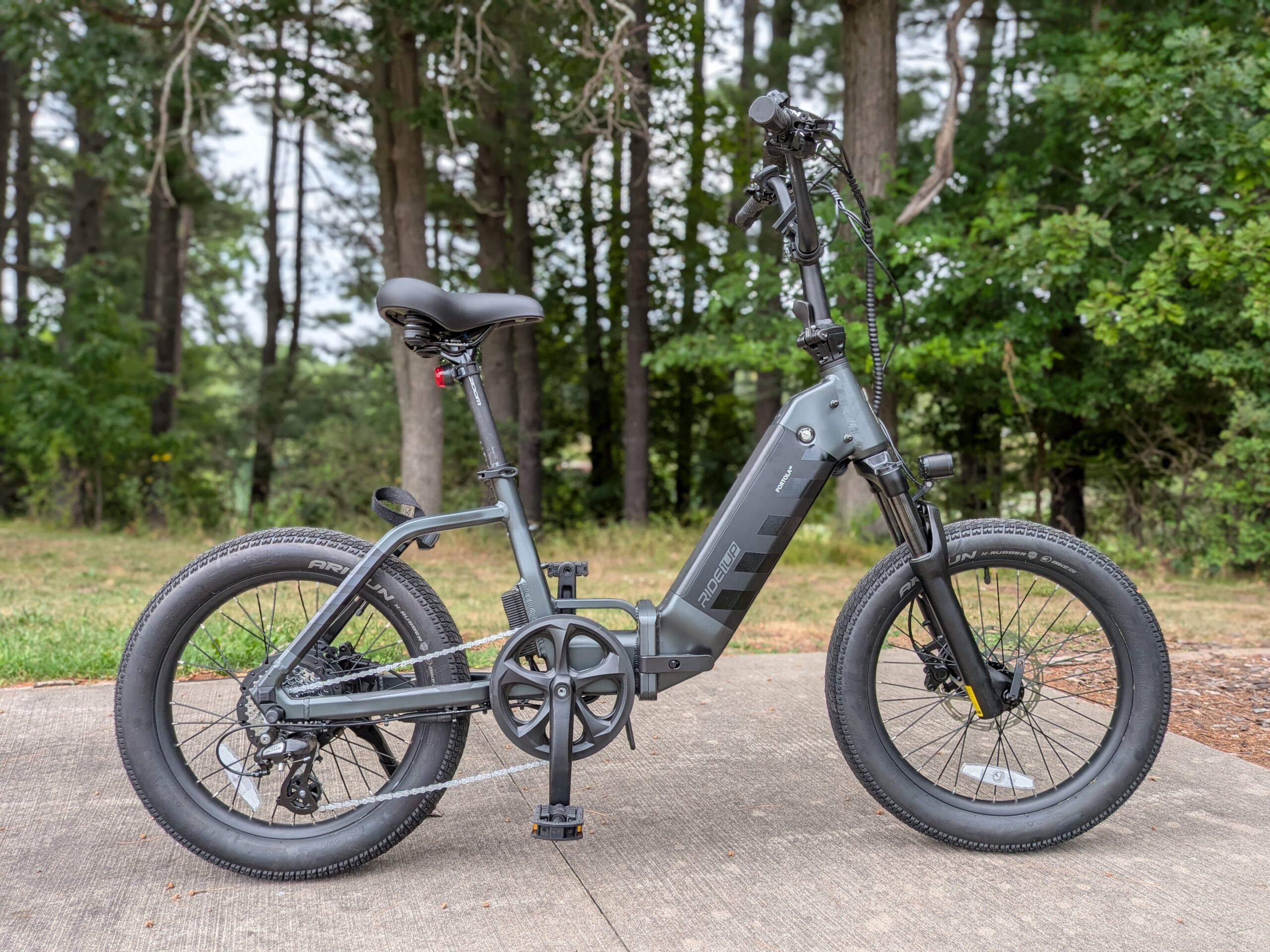
Not that long ago, a folding ebike under $1,000 meant a list of compromises you simply agreed to live with. A cadence sensor. A washed-out monochrome display. A rear rack that could handle about as much as a backpack, if you got one at all. That was the deal. Times have changed. Ride1Up has been building its name on direct-to-consumer pricing since 2018, and the original Portola was one of the better value folders we have thrown a leg over. This second generation raises the spec sheet without raising the price, and it arrives in four configurations starting at $895.
This Portola 02 review covers every component, how the bike folds, how it fits riders at both ends of the height range, and what happened when we ran it through our throttle, sensor, and hill climb testing. We were especially curious how an ebike this affordable would handle our climb. Let’s get into it.
Ebike Escape is reader supported. If you buy through the links below we may earn a small commission at no extra cost to you, which helps fund more hands-on testing. Thanks for the support.
Ride1Up Portola 02 Video Review
Our video walks through the full component tour, the display and its advanced settings menu, the folding process step by step, and first-person riding footage at every pedal assist level. If you want to hear how quiet this motor actually is, that comes through better on video than it does in writing.
Four Configurations, Two Builds
There are two builds on offer, and the difference is not the ride — it is the equipment. Both share the same frame, the same 750W motor, the same battery options, and the same dual sensor system.
The Lite skips the welded rear rack, the alloy fenders, and the integrated rear lighting. In its place you get a rechargeable light that clamps to the seat post. Step up to the full Portola 02 and you pick up hardened alloy fenders, the 150 lb welded rack, and a rear brake light with turn signals built in.
| Build | Battery | Price |
|---|---|---|
| Portola 02 Lite | 10Ah | $895 |
| Portola 02 Lite | 15Ah | $995 |
| Portola 02 | 10Ah | $995 |
| Portola 02 | 15Ah | $1,095 |
Four colorways are available across the lineup: Copper, Cloud White, Galaxy Gray, and Azure Blue.


Standout Features
A 750W Motor That Actually Stays Quiet
Ride1Up advertises this AKM hub motor as silent, and marketing language like that usually deserves a raised eyebrow. Not this time. Riding at speed we had to listen deliberately to pick the motor out at all, and on the hill climb it stayed quiet the whole way up. It is one of the quieter hub drives we have tested at any price. Output is rated at 750W with 90Nm of torque, and we saw a peak of 1,119W on the display during throttle testing.
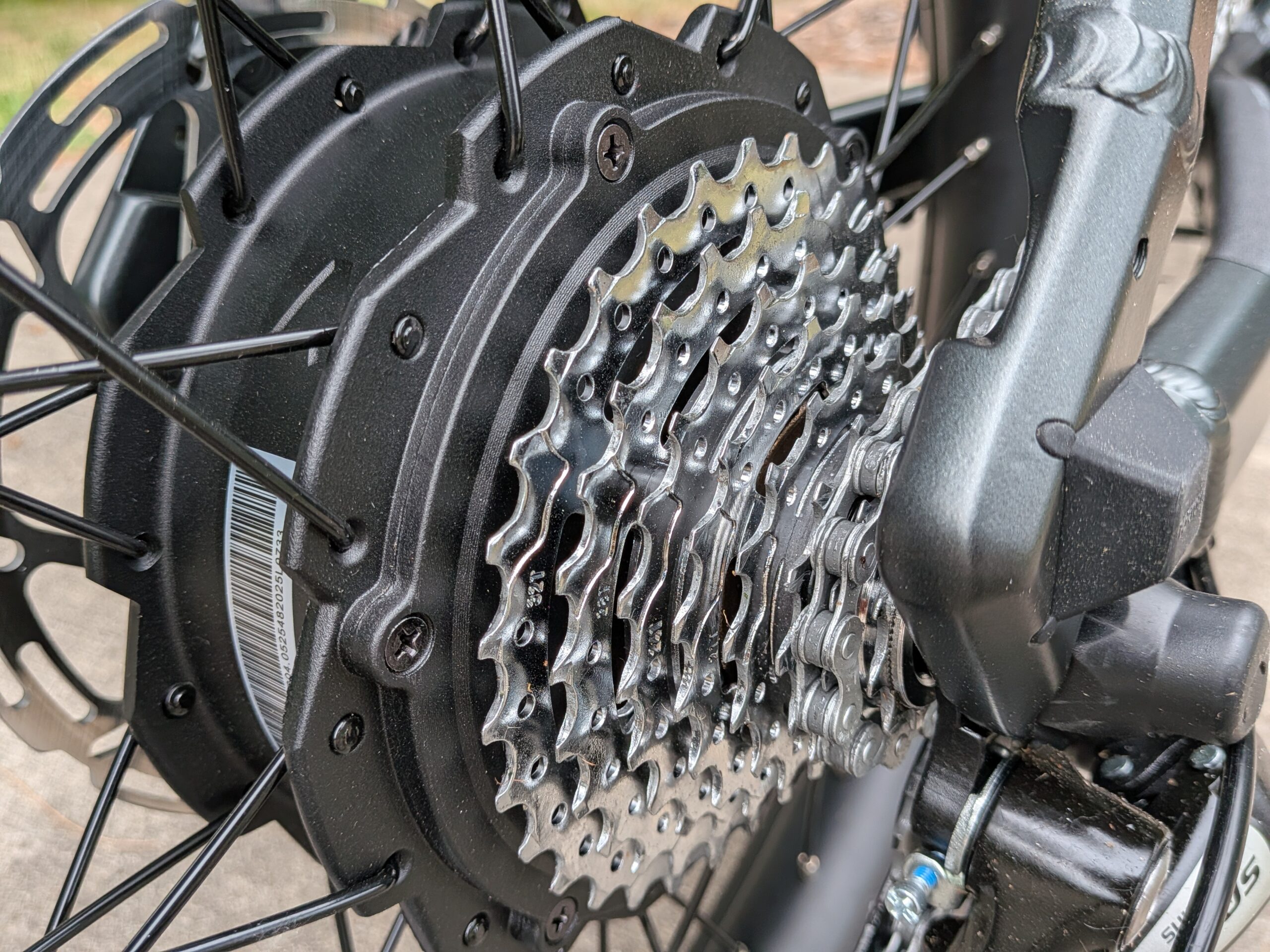
Intui-Drive: Pick Your Sensor, Then Tune It
Here is where this bike separates itself from most of what sits under $1,000. Ride1Up’s Intui-Drive system pairs MIVICE torque and cadence sensors with a 12-MOSFET MIVICE CANbus controller, and you choose which sensor drives the bike from inside the settings menu. A small T or C in the top left corner of the display tells you which one is active.
Both are worth having, but they serve different riders. Torque sensing measures how hard you push and rewards effort with power, which produces a ride that feels like your own legs got stronger. Cadence sensing measures only whether the cranks are turning and hands you a set amount of power regardless. If you want to pedal lightly and still move quickly, cadence is your friend.
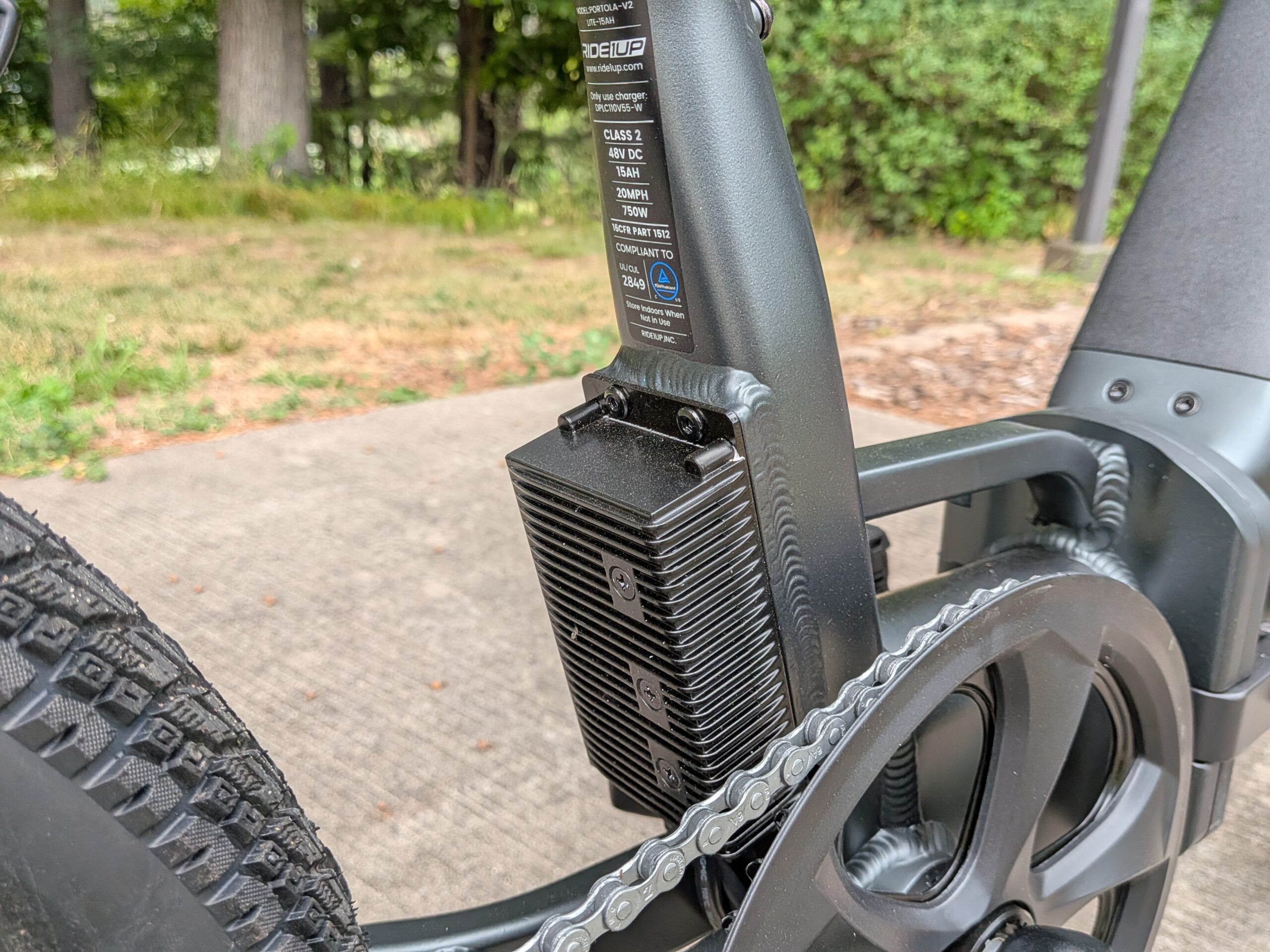
What matters more than having both is being able to tune both. You can set the torque ratio and the amp output per assist level, independently, using the turn signal buttons to dial the percentages. That mattered a great deal during testing, and we get into exactly why below.
The 3.5″ Color Display
Screens at this price are usually the first place a brand saves money. This one is bright, easy to read in direct sun, and it flips into a dark mode when you turn the lights on. You get current speed, a live motor wattage bar, battery capacity, and estimated range at each of the five assist levels: eco, tour, sport, turbo, and boost. Press the center button and you cycle through time spent in each assist level, trip, total trip, average speed, max speed, and calories.


Hold pedal assist up and down together and you are into the advanced menu: units, screen brightness, calorie reset, trip reset, auto sleep, a password lock, Apple Find My, torque ratio per level, amp output per level, class selection between 1, 2, and 3, ebike info, and the sensor swap. Lights come on by holding pedal assist up; walk mode engages by holding it down. There is also a USB-C port under the display for topping off a phone.
Battery, Charging, and Range
The larger option is a 48V 15Ah Reention Flamingo pack using LG 21700 cells, IPX6 rated and TUV certified to UL 2271. It loads from the top of the downtube, which is a genuinely better arrangement than the sliding designs that require you to fold the bike to remove. Ride1Up claims up to 60 miles on the 15Ah. We have not run a dedicated range test on this bike, but we have put similar 14–15Ah packs through range testing on other bikes at this weight in low pedal assist, and 60 miles is consistent with what those packs deliver under those conditions. Of course, range depends heavily on rider weight, terrain, tire pressure, and how much time you spend outside eco and tour, so treat it as a reasonable ceiling rather than a guarantee. Scale it down proportionally and the 10Ah lands somewhere around 40 miles under the same conditions.


The included 2A charger fills the 15Ah pack from empty in roughly seven and a half hours, or about five for the 10Ah. You can charge on or off the bike. Also in the box: a Ride1Up beanie, the owner’s manual and assembly instructions, a genuinely decent Allen key set, maintenance grease, and a rear reflector.
Brakes, Drivetrain, and Rolling Stock


Dual piston hydraulic brakes with 180mm rotors front and rear handle stopping, with motor cutoff sensors in the levers. They are branded Gemma, which is not a name that turns up often, but they held up through repeated hard stops. Shimano Altus RD-M310 runs the rear derailleur, paired with an 8-speed trigger shifter, a 48T alloy chainring, and an 11-32T freewheel. Altus is not exotic, but plenty of ebikes at this price ship with something a step below it.


Tires are 20″ x 3″ Chaoyang Arisun units with a low-profile puncture resistant casing. Up front, a 100mm travel suspension fork with preload adjustment on one side and a hydraulic lockout on the other takes the edge off. Basic, yes, and you would absolutely notice its absence. The front wheel is on a quick release, and there are four mounting points up front for an optional rack.
Cargo, Accessories, and the Connect+ System


Buy the rack-equipped Portola 02 and the welded rear rack carries up to 150 lbs, which is enough for a passenger, and that is why a passenger kit and a set of frame pegs exist in the lineup. Ride1Up’s Connect+ system lets a compatible basket, panniers, or a passenger seat snap on without tools. An optional Extendable Cargo Rack pushes it further, turning the platform into something closer to a small utility bike for oversized loads. That optionality is the most interesting thing about this frame: a folder that also hauls is not a common combination at this price.
Frame and Fit
Riders from 4’10″ to 6’4″ are the stated range, and that holds up better than the number usually does. At 6’ with a 32″ inseam our seat post was not close to its maximum height, which means taller riders still have room. At 5’5″ the fit worked as well. Standover sits at 16.5″. That said, 20″ wheeled folders tend to suit shorter riders better as a category, and this one is no exception. We could make it work at 6’, but it is worth being honest that this is not a bike designed around tall riders first.


The handlebars are the biggest change from the first generation. Instead of the T-style bar that most folders use, you get a high-riser bar. Your arms sit at more of a downward angle rather than parallel to the ground, in a riding position that stays upright and comfortable but feels different from what you may expect from this category. The saddle, for what it is worth, is better than average at this price.
Folding the Portola 02


Folding runs through the pedals, then the stem, then the main downtube hinge, with a strap that holds everything together and a small stand that keeps the folded bike upright. Ride1Up routes the cables into the frame from underneath, which keeps them clear of the fold. It goes in a trunk or behind a seat, and you skip the expense of an ebike-rated hitch rack entirely.
Set your weight expectations accordingly, though. Ride1Up lists 59 lbs, but on our scale, the 15Ah Lite came in at 66.14 lbs with the battery installed, and 57.36 lbs with the battery out. Pulling the battery before you lift is the practical workaround, and it saves you nearly nine pounds. This is a full-powered ebike with a large battery, and folding makes it easier to store and transport, not easier to lift.
Ride1Up Portola 02 Specifications
| Component | Spec |
|---|---|
| Motor | 750W AKM rear hub, 90Nm torque |
| Controller | 12-MOSFET MIVICE external IPX6 CANbus |
| PAS sensor | Ride1Up Intui-Drive dual torque and cadence (MIVICE) |
| Battery | 48V 10Ah or 15Ah Reention Flamingo, LG 21700 cells, IPX6, TUV certified to UL 2271 |
| Charger | 2A (7.5 hrs for 15Ah, 5 hrs for 10Ah) |
| Claimed range | Up to 60 miles (15Ah) |
| Display | Ride1Up 3.5″ color, iOS Find My, USB-C charging |
| Class | 1, 2, or 3 selectable — up to 28 mph assisted |
| Throttle | Left hand thumb throttle |
| Brakes | Dual piston hydraulic, electric cutoff sensors, 180mm rotors |
| Derailleur | Shimano Altus RD-M310 |
| Shifter | Shimano Altus 8-speed trigger |
| Gearing | 48T alloy chainring, 11-32T freewheel, KMC 8-speed chain |
| Fork | 100mm travel, hydraulic lockout, 100mm dropout |
| Tires | 20″ x 3″ Chaoyang Arisun low-tread puncture resistant |
| Rims | 20″ double walled |
| Spokes | Stainless steel, 13G rear, 12G front |
| Handlebar | BMX style, 31.8mm clamp, 6° sweep, 170mm rise, 650mm width |
| Folding stem | 12° rise, 285mm length, 31.8mm bar clamp |
| Seat post | Zoom 31.6mm x 350mm |
| Front light | 100 lux, runs off the main battery |
| Rear light | Portola 02: brake light with integrated turn signals. Lite: rechargeable seat post mounted |
| Fenders | Hardened alloy (Portola 02 only) |
| Rear rack | 150 lb rated with extended cargo options (Portola 02 only) |
| Pedals | Folding |
| Extras | Water bottle bosses, bell, folding pedals, rear kickstand |
Geometry and Dimensions
| Measurement | Portola 02 |
|---|---|
| Bike weight | 66.14 lbs measured with battery (15Ah Lite); 57.36 lbs without battery. Ride1Up claims 59 lbs |
| Weight capacity | 342 lbs |
| Rider height range | 4’10″ – 6’4″ |
| Maximum seat height | 39″ (990mm) |
| Minimum seat height | 30.5″ (774mm) |
| Stand-over height | 16.5″ (419mm) |
| Wheelbase | 44.75″ (1136mm) |
| Downtube length | 23.9″ (608mm) |
| Headtube length | 6″ (155mm) |
| Seat tube length | 14.5″ (368mm) |
| Chainstay length | 16.75″ (425mm) |
| Fork length | 23.75″ (603mm) |
| Head tube angle | 70° |
| Seat tube angle | 74° |
| Stack | 33.5″ (838mm) |
| Handlebar reach | 16″ (420mm) |
| Total length | 66.2″ (1676mm) |
| Handlebar height | 44.4″ (1130mm) |
| Folded dimensions | 19″ x 29.5″ x 33″ |
Real World Performance Testing
Throttle
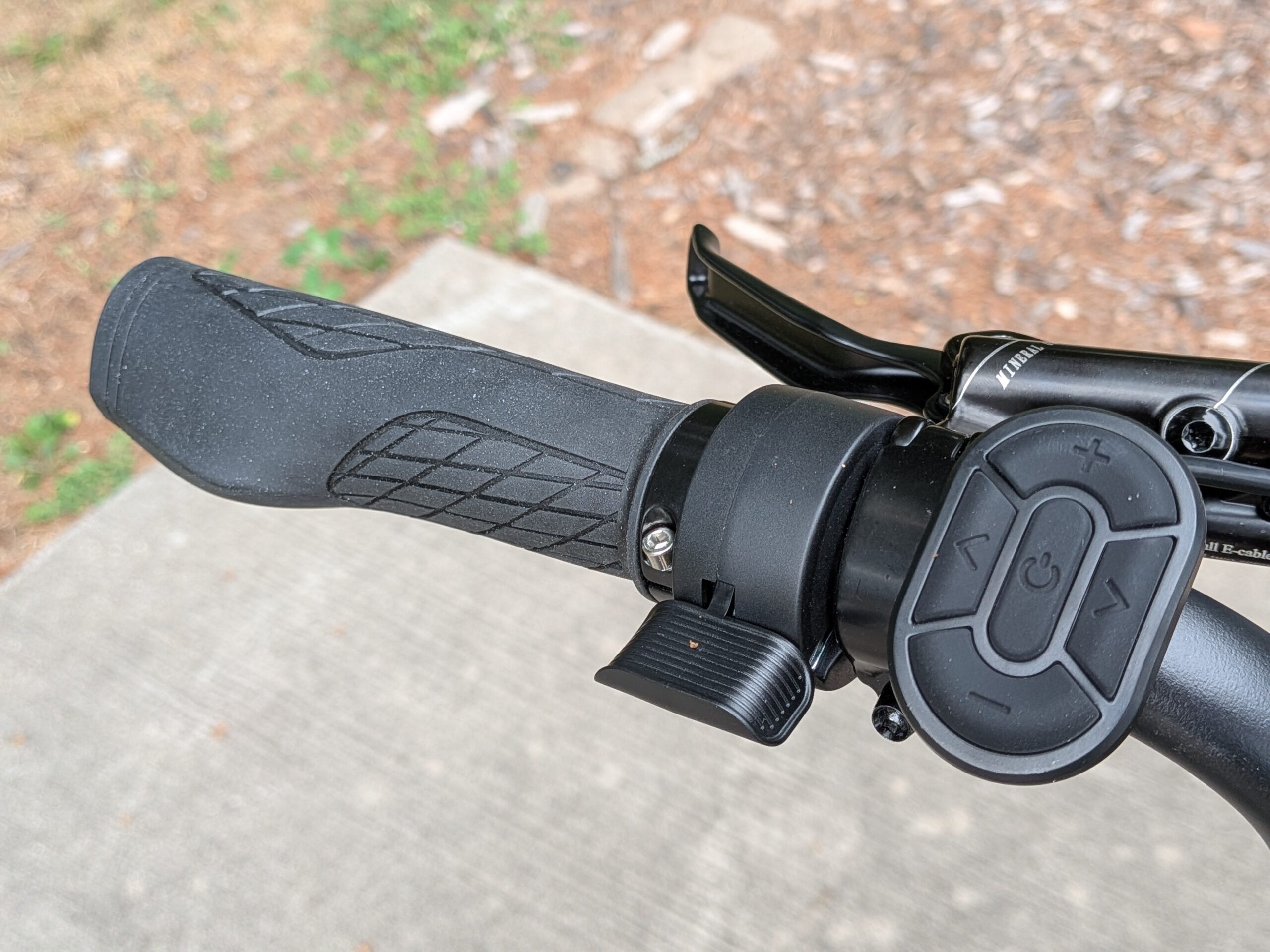
Pedal assist can be switched off entirely and the left-hand thumb throttle still works, which is not universal. From a standing start we hit 20 mph and the display showed a maximum of 1,119W as the motor came up to speed. Modulation is decent. Feather the throttle and you can hold roughly 200 to 400W to get rolling from a stop. It is not the all-or-nothing behavior you sometimes get on inexpensive builds, unless you slam the throttle down immediately. You do have to hold your thumb in position to stay there. What you cannot do is cap throttle output per assist level. Some riders will not care. If you were hoping to limit throttle power for a less experienced rider, that option is not in the menu.
Torque Sensor
Response is close to immediate. In eco we saw the motor contributing around 50W while spinning easily, climbing toward 100W with more leg pressure, which is exactly what eco should do. That restraint comes from the stock torque ratio of 15% in eco and 25% in tour. Cruising at 8 mph in second gear took almost nothing; shifting up to fifth and pushing harder got us to 15 mph. Tour moved us to roughly 300W at 13 mph with the same easy cadence, not a dramatic step up from eco, just a little more of everything. Sport read about 200W while spinning easily at 12 to 13 mph, put 16 to 17 mph within reach with modest effort, and delivered 20 mph when we pushed. The wattage stayed under 300W for most of that, which says something about how efficiently this bike uses power.
Turbo produced just over 300W while cruising at 16 mph, around 21 mph in sixth gear with moderate effort, and 24 mph when we really committed. Push hard and 400 to 500W comes easily, with over 1,000W available when you lean on it.
Boost is where the bike shows its ceiling. Spinning easily we saw around 500W and Class 2 speeds arriving with no effort at all, with the display reading in the high 400s to 600W. Adding leg pressure through eighth gear took us to 25, 26, then 27.7 mph with the motor reading 1,034W. Mid-20s on this bike is genuinely achievable without wearing yourself out, which is not something we say about every folder.
Cadence Sensor
The stock cadence tuning is aggressive. Amp output ships at 50, 65, 80, then 100 for turbo and boost, and starting in eco we were immediately getting 517W at 22 mph while barely turning the cranks. For a lot of riders that is too much, too soon. This is where the customization pays off. We dropped the amp output to 15, 30, 50, 75, and 100 and the whole bike changed character. Eco settled into a steady 158W and a relaxed 10 mph, and it holds that wattage regardless of what your legs do. Tour held 316W. Sport delivered 528W and speeds in the high teens. Turbo sat at 844W and 22 mph, and boost pulled the full peak, reaching 27 to 28 mph while we contributed almost nothing.
For what it is worth, the torque sensor is our preference on this bike. Full peak power is not out of reach with it, and the ride feels better connected. But if you want guaranteed power without earning it, cadence mode is right there. One practical note: switching sensors is not a thing you do mid-ride. Treat it as set-and-forget. Pick your sensor, dial in your settings, and ride.
Hill Climb

On throttle alone the Portola 02 dropped from 13 to 12 to 11 and settled at a minimum of 9 mph, and for a bike starting at $895 that is a strong result. The motor stayed quiet the whole way up.
On the torque sensor the picture is more nuanced, and it illustrates what torque ratio actually controls. In tour there was not much relief and we were pushing hard. Sport asked for a decent amount of effort. Turbo left us at about 5 mph in first gear. Boost brought clear relief — same maximum available power as turbo, but far easier to reach — and we climbed at around 6 mph pulling just under 500W, rising toward 900W when we pushed harder.
The takeaway: this motor lacks the extra punch of the higher peak wattage drives, but it climbs, and it will be plenty for the majority of riders. If a hill is giving you trouble, feathering the throttle alongside your pedaling solves it immediately.
Braking
Coming down from 20 mph the dual piston hydraulics stopped us without complaint, and we could lock up the rear tire on demand. Gemma is not a brand that turns up often, but these felt consistent through repeated stops.
Portola 02 vs. Lectric XP4
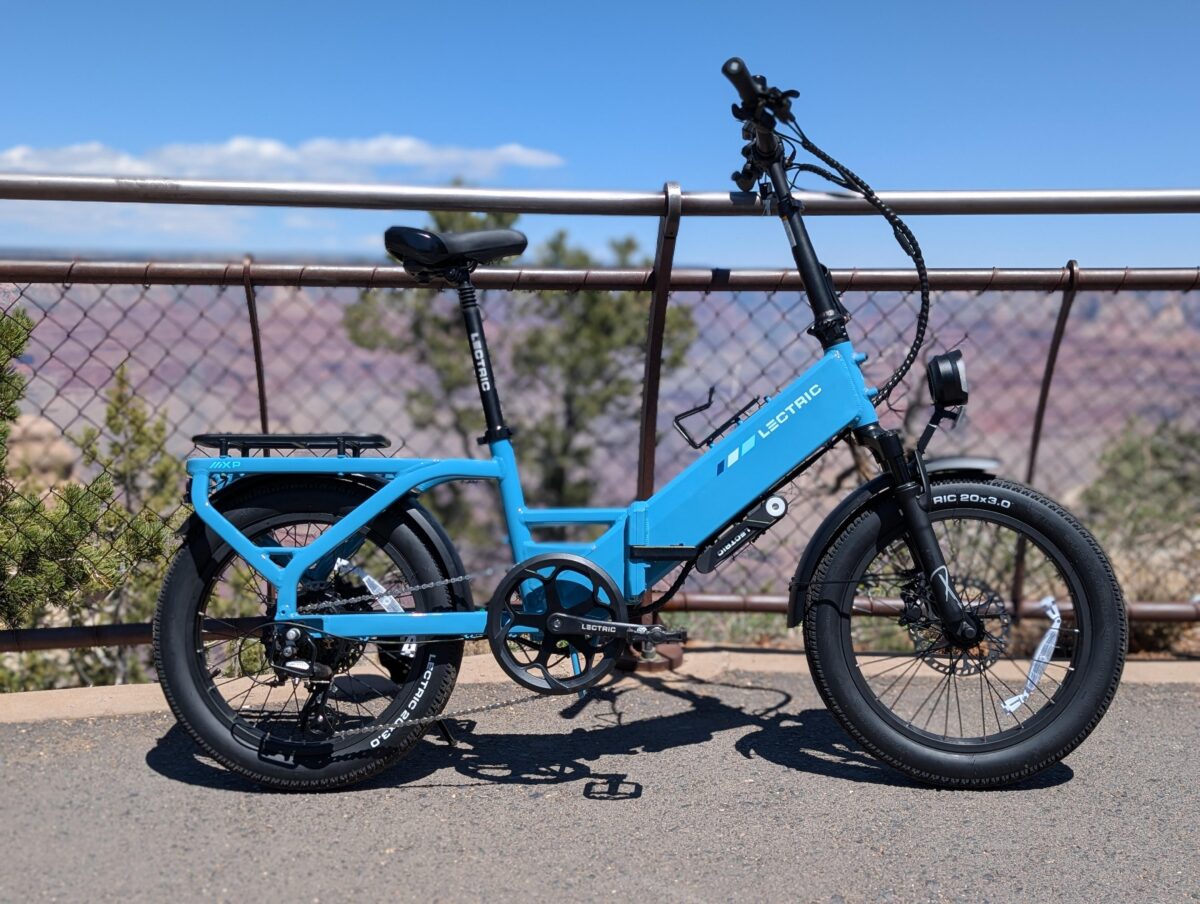
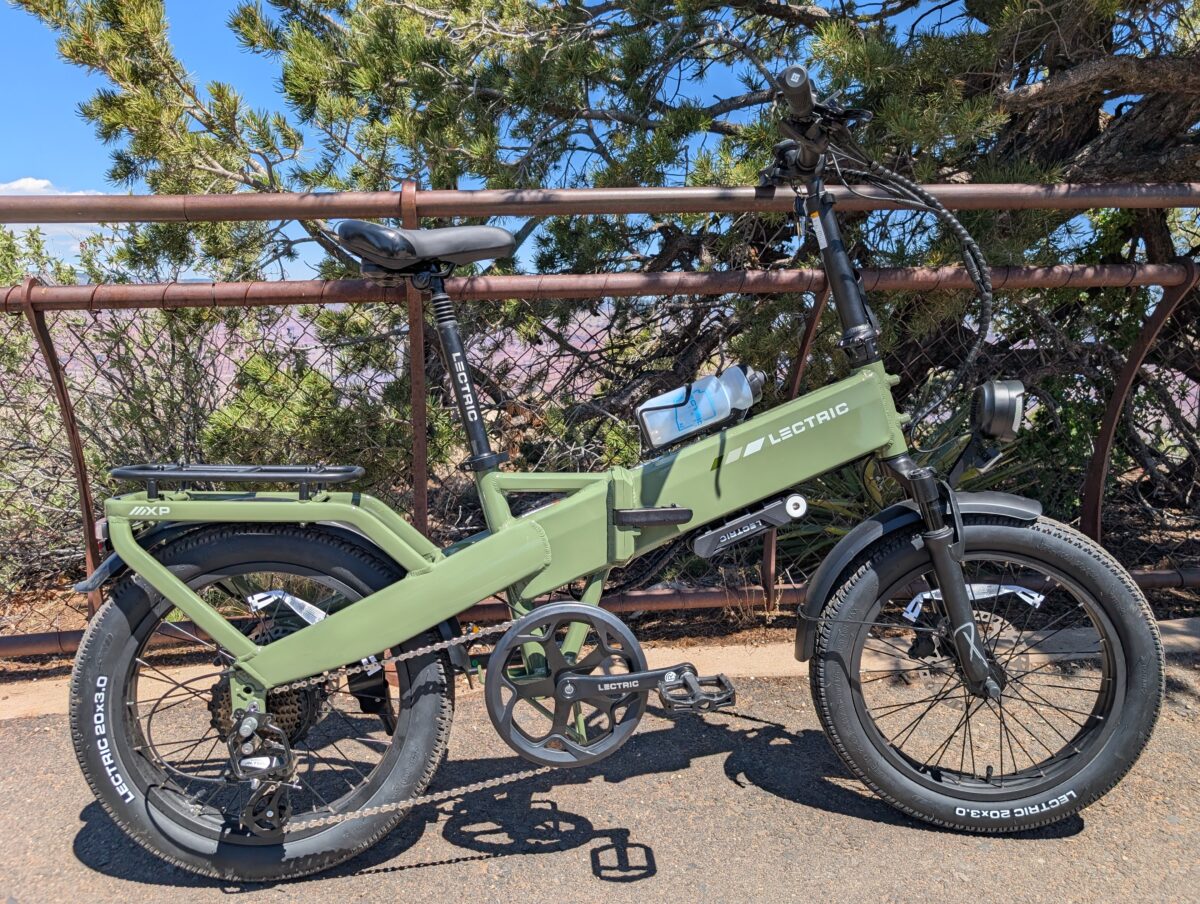
The obvious comparison, and the one worth making, because the base Lectric XP4 500W sits at $999 against the $995 rack-and-fender Portola 02. Ride1Up wins on motor output. You get 750W and 90Nm across every Portola 02 configuration, where the $999 XP4 runs a 500W M24 Stealth hub (55Nm) — you have to step up to the $1,299 XP4 750W to beat the Portola on paper, mainly in regard to the 17.5Ah battery. Weight is closer than the spec sheets suggest. Ride1Up lists 59 lbs, but we measured 66.14 lbs on the 15Ah Lite against the 68.5 lbs we recorded for the XP4, so the Portola’s advantage is a couple of pounds. Neither of these is a bike you want to be lifting often.
Both bikes have a torque sensor, so that is not the differentiator it would have been a year ago. What the Portola 02 adds is choice: you can switch to a cadence sensor and tune torque ratio and amp output per assist level. The XP4’s PWR+ torque sensor is excellent and smoother out of the box, but it is not configurable the way this is. Lectric wins on assembly and on dealer scale. The XP4 arrives essentially ready to ride with no tools, where the Portola needs you to mount the stem yourself. Lectric also has the larger service footprint and the longer track record with sheer volume of bikes on the road. You also have the choice of a step-thru or step-over frame with the XP4.
For most riders comparing these two at around $1,000, the Portola 02 is the better bike on paper and the more capable one on a hill. The XP4 is the easier first ebike to own. We will put together a dedicated head-to-head comparison shortly — in the meantime, our best folding ebikes roundup covers where both land against the rest of the field.
Final Thoughts
The folding ebike space is one of the most competitive segments in all of ebikes, especially right around this price. Ride1Up did not try to win it by cutting somewhere quiet and hoping nobody would notice. Looks are subjective, but this is one of the better-looking folders under $1,000. The cables run through the frame, the battery integrates cleanly into the top of the downtube, and the color options are a real step up from the first generation. Underneath that, the parts you actually feel — the motor, the brakes, the sensor tuning — are all a notch above where this price usually lands. You can tell Ride1Up spent real time choosing the MIVICE sensor and controller components and dialing them in, because the pedal assist is extremely smooth.
So which one should you buy? Spending $100 for an additional 5Ah is straightforward math, which puts the real decision between the $995 Lite with the 15Ah battery and the $1,095 Portola 02 with the same battery plus fenders, the welded rack, and the integrated taillight with turn signals. Most riders want fenders and a rack. Our bet is the top configuration ends up being Ride1Up’s best seller.
If you are shopping folding ebikes right now, this belongs on your short list — and it is a strong candidate for our best affordable electric bikes list as well.
Thinking about picking one up? Using our link below costs you nothing extra and helps fund more hands-on reviews like this one.
