

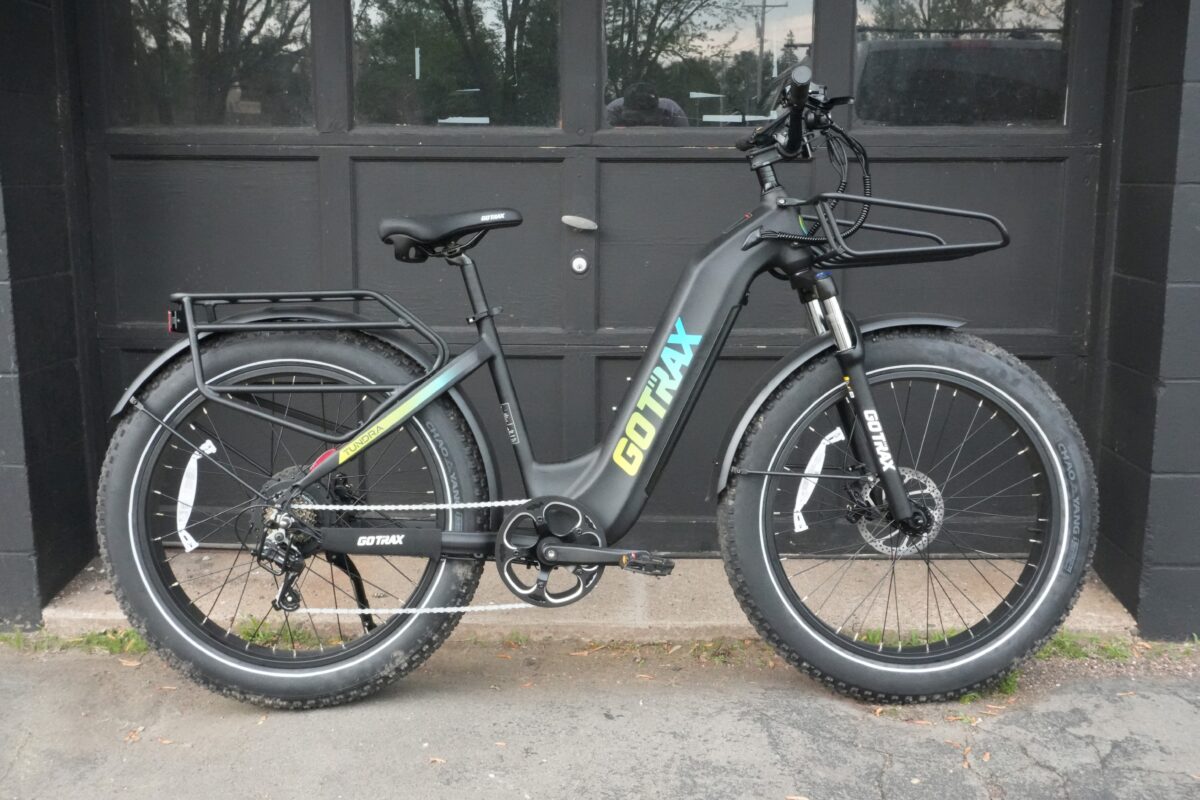
Plenty of brands in the fat tire space chase the flashiest spec sheet they can advertise, and just as many lean entirely on a low sticker price. GoTrax has built its name on the budget friendly options, with a deep lineup of affordable scooters and electric bikes. The Tundra is a different swing. It sits as one of their more premium options at $1,499, with the money going where most riders look first: a 750W Bafang motor, a large 48V 20Ah battery, and a torque sensor for a natural pedal feel.
Does the higher price tag translate into a quality riding experience? That is what we set out to answer. We start with the Tundra’s standout features and its frame and fit, then lay out the full spec sheet. From there we get into a full round of real-world performance testing and line the bike up against a key competitor. We close with the pros, cons, and who it is for, so by the end you will know whether it deserves a spot in your garage.
If we have helped you decide the Tundra is right for you, buying through our affiliate link helps us create more reviews like this. It is also a great way to check current pricing on Gotrax’s site. Thank you for your support.
GoTrax Tundra Video Review
Our full video review takes you up close on every component and walks through the display and its settings, then puts you behind the handlebars with first-person riding footage from each of our performance tests. We also cover frame design and fit, with riders of different heights on the bike, plus third-person footage so you can see how the Tundra looks and moves out on the road.
Standout Features of the GoTrax Tundra
These are the choices that make the Tundra worth a closer look at its price.
750W Bafang Rear Hub Motor
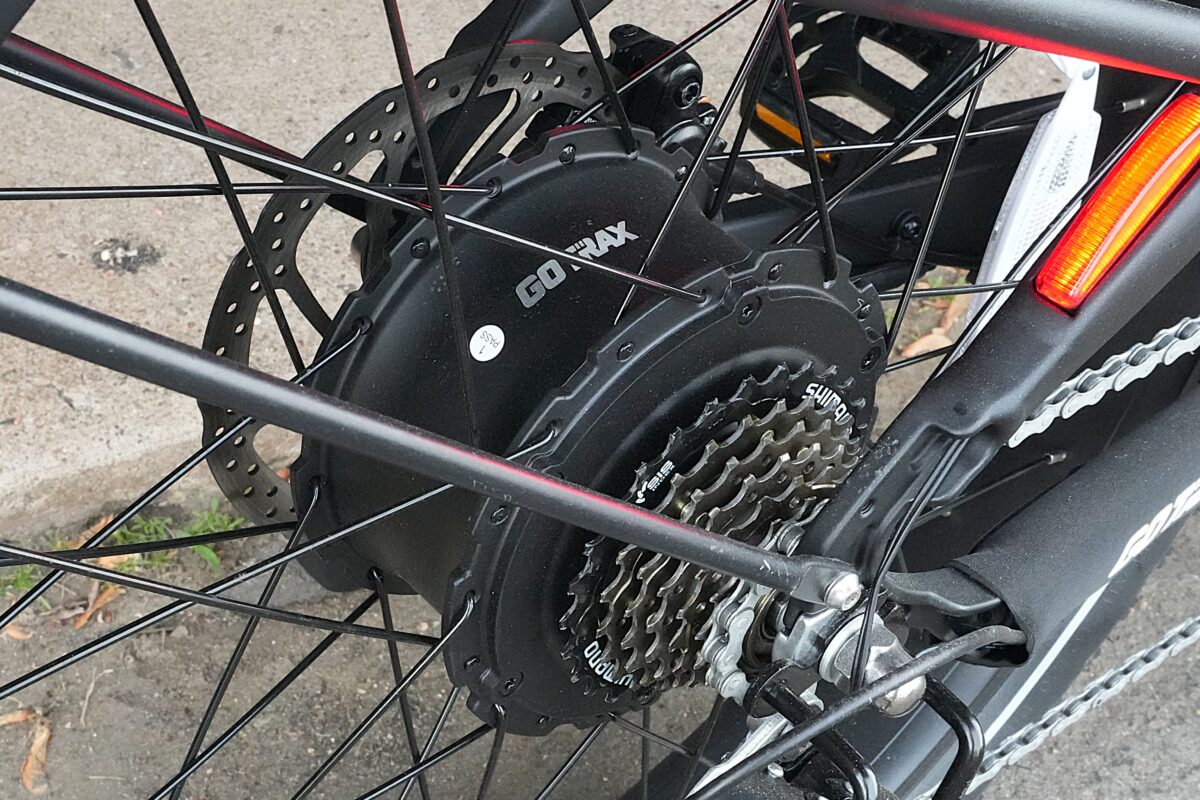
Carrying GoTrax branding but sourced from Bafang, the rear hub motor is rated at 750W. Bafang is a well-known maker of ebike components with a solid reputation for reliability, so seeing one of their motors at the heart of the Tundra is reassuring.
Large 48V 20Ah Battery
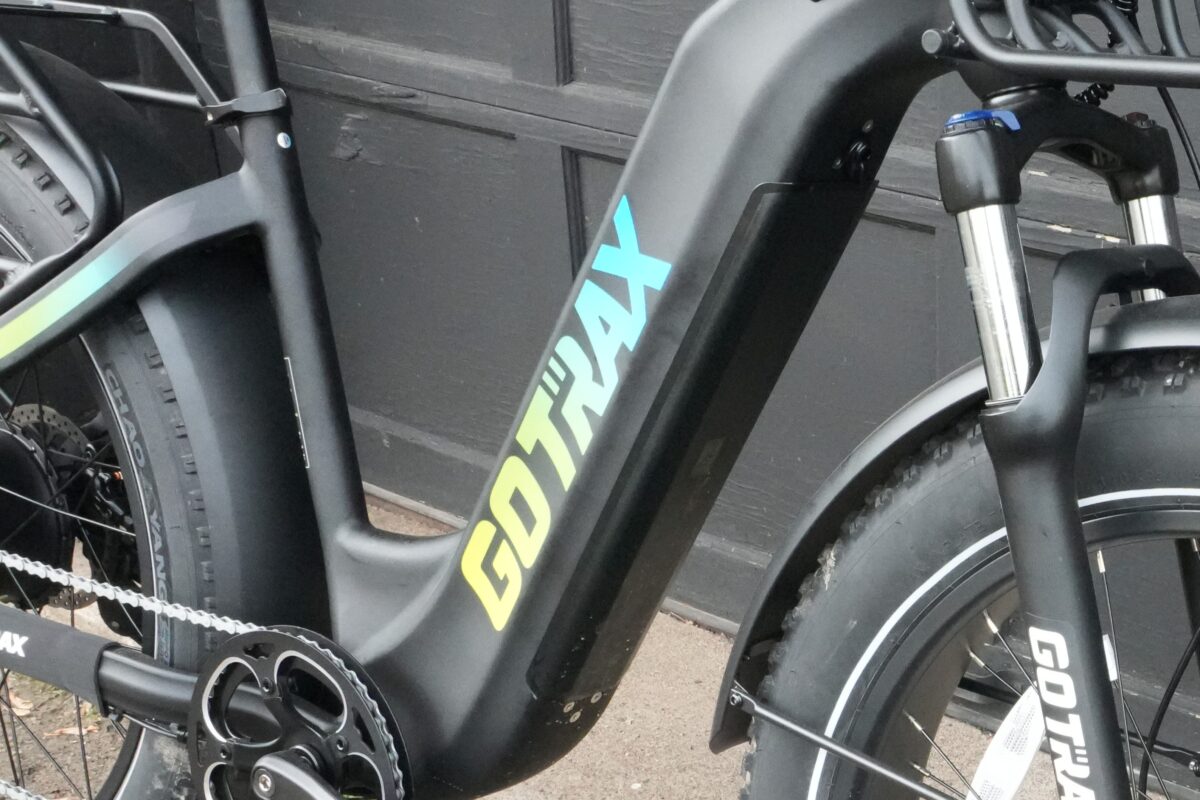
At 48V and 20Ah(960 Wh), the battery is large for a fat tire bike at this price point, and that capacity backs an advertised range of up to 74 miles. How close you get depends on the terrain and how hard you lean on the motor, with the lower assist levels stretching it furthest. It pairs with a 3-amp charger for a full top-up in roughly six to seven hours. The battery is certified to UL 2271 and the bike to UL 2849, which is welcome peace of mind on any ebike.
Torque Sensor
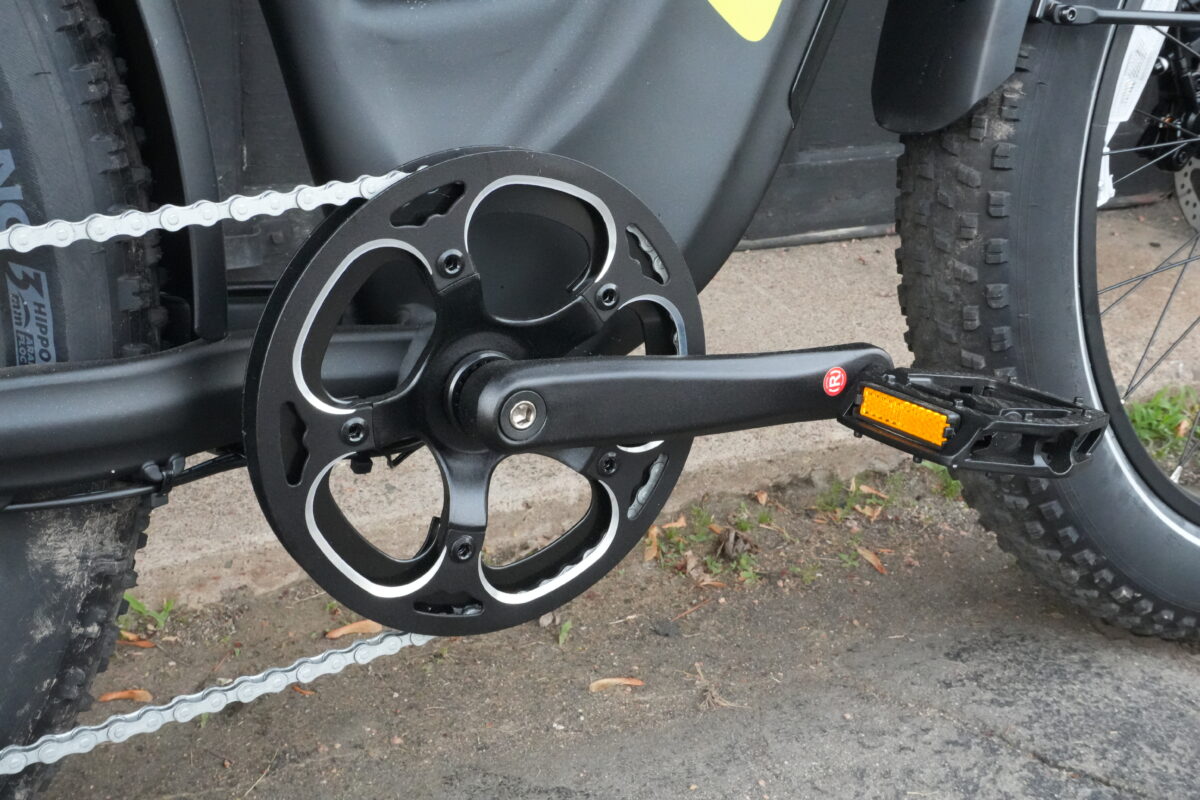
Rather than the cadence sensor often found at this price, the Tundra uses a torque sensor that reads how hard you press on the pedals and meters the motor to match. The practical payoff is a more natural, connected feel, where the bike responds to your effort instead of simply switching power on when the cranks turn.
Fat Tires and Front Suspension
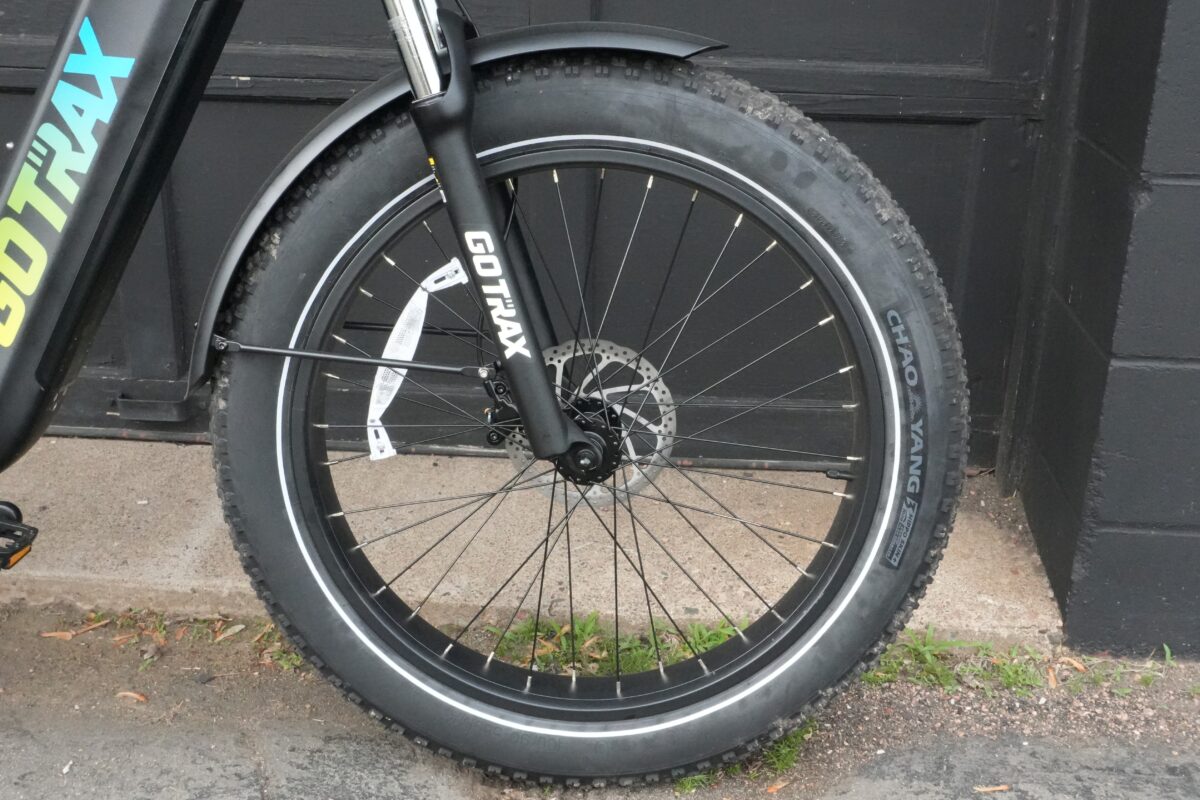
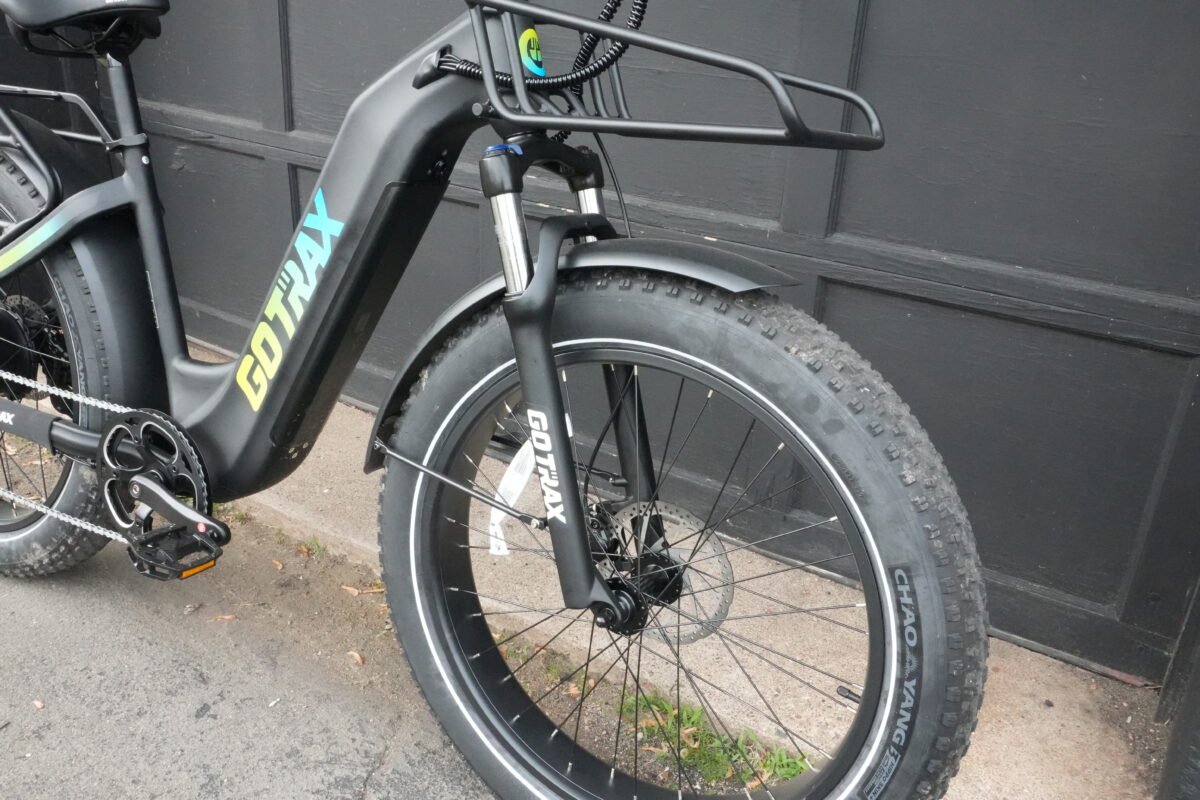
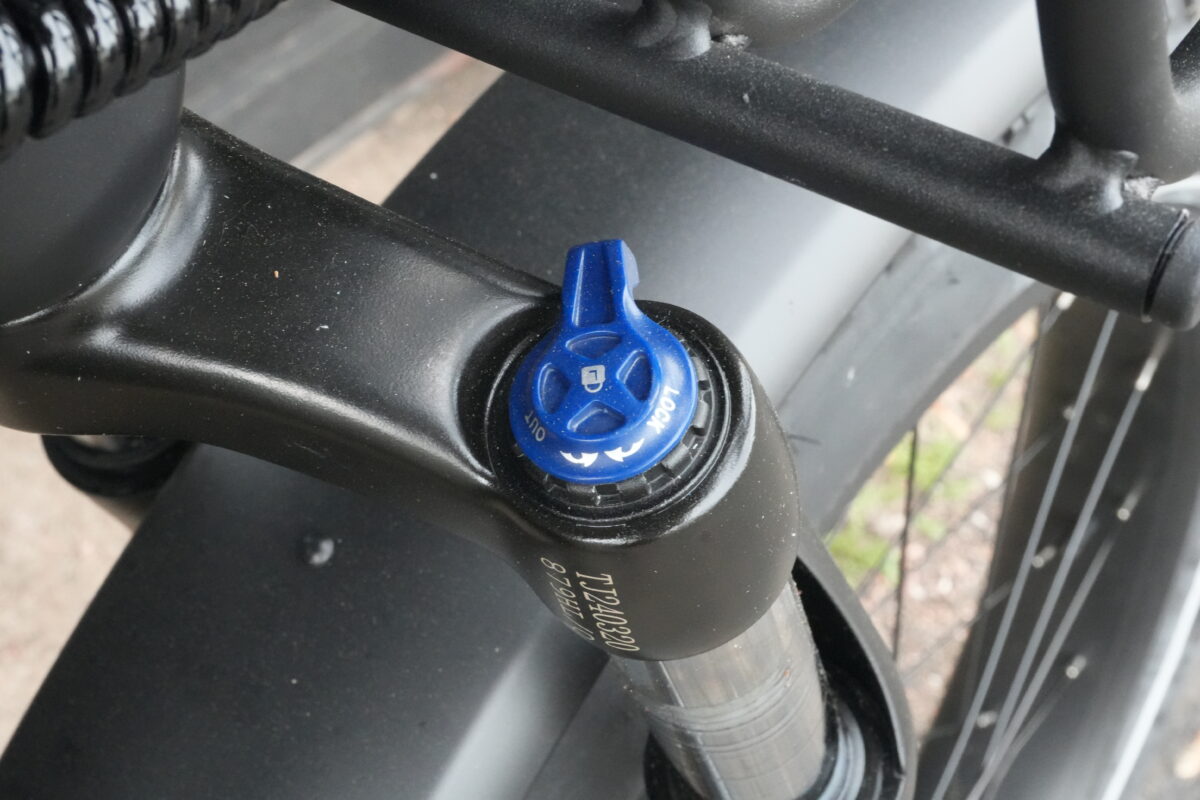
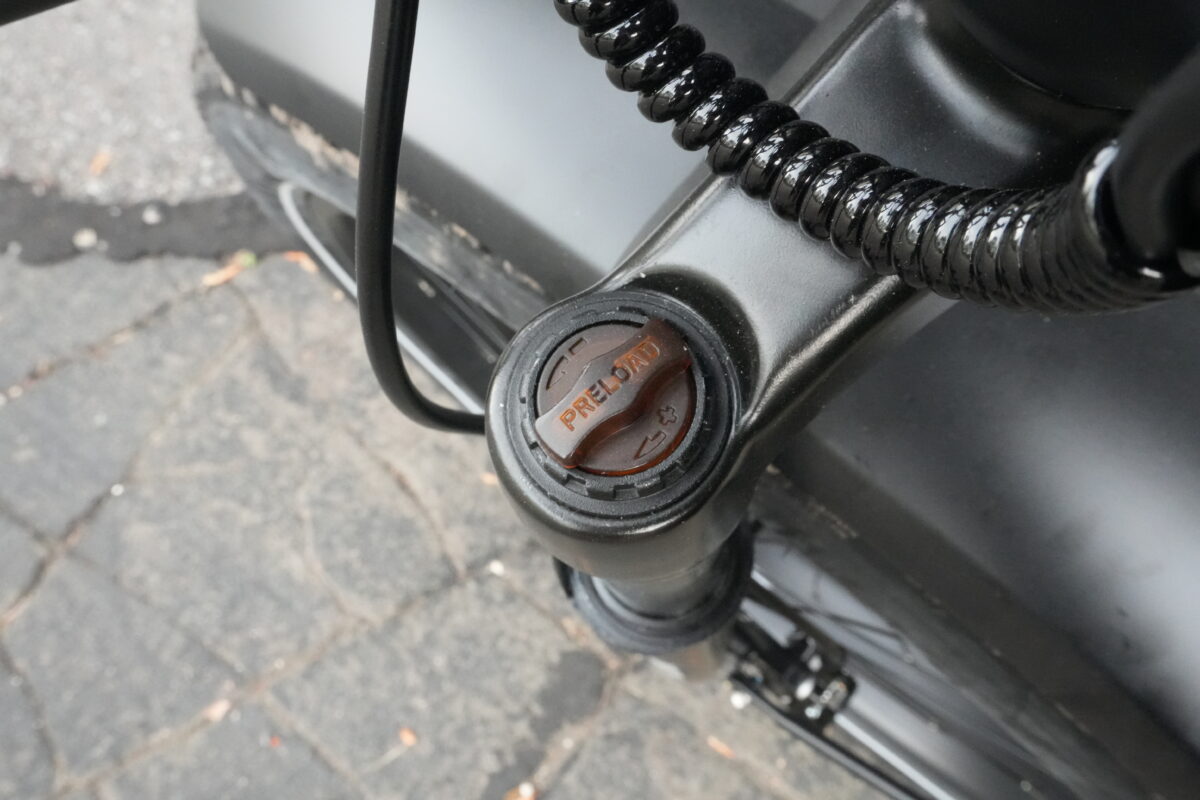
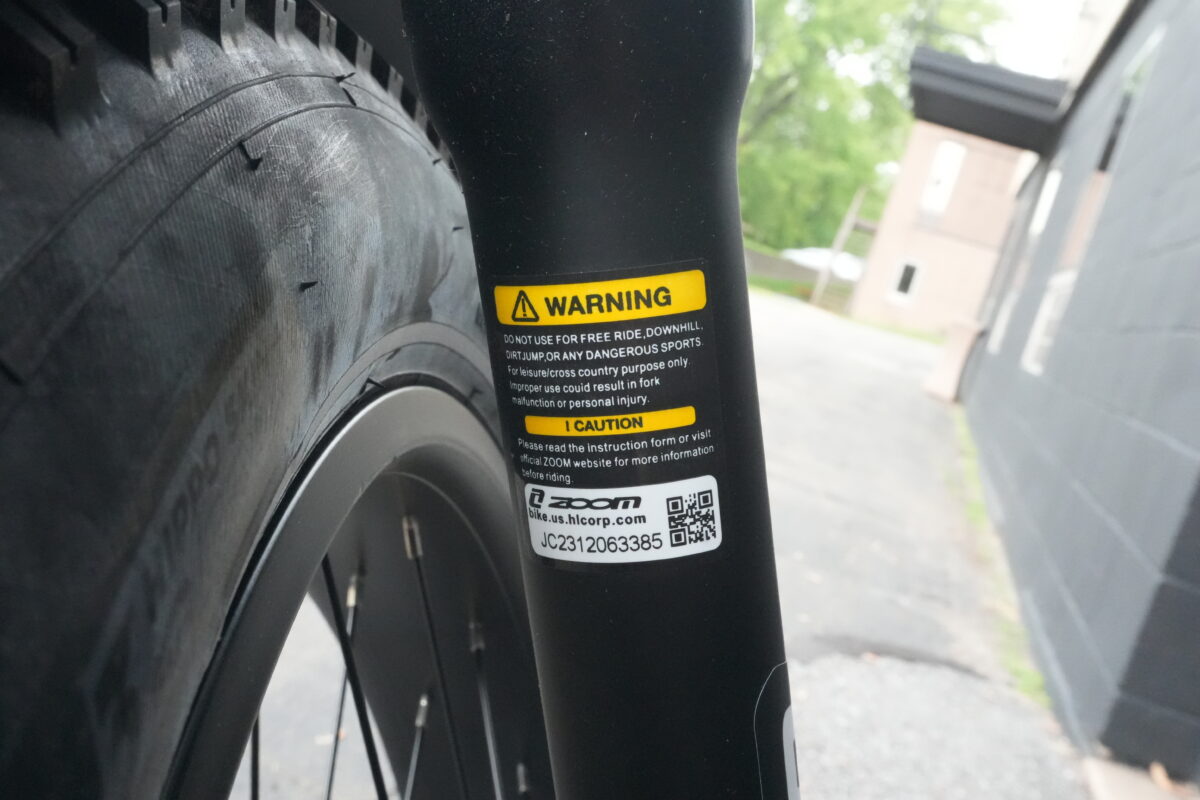
26 x 4-inch Chaoyang Hippo Skin Plus tires give the Tundra its grounded, go-anywhere character, with an all-terrain tread and a reflective strip on the sidewall for visibility. Up front is a Zoom suspension fork that adds a little extra cushion along with preload adjustment and a lockout. GoTrax does not list the travel on their website, but we measured it at around 60 mm.
Integrated Lighting and Included Accessories
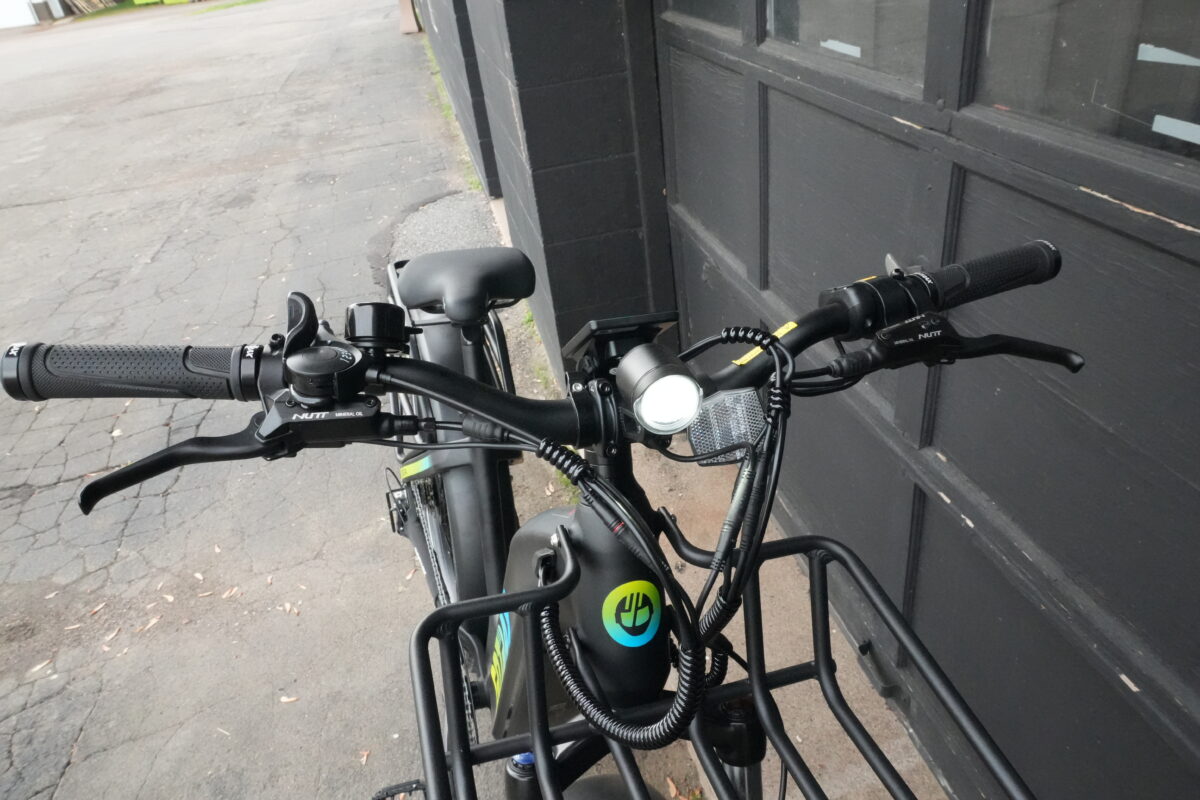
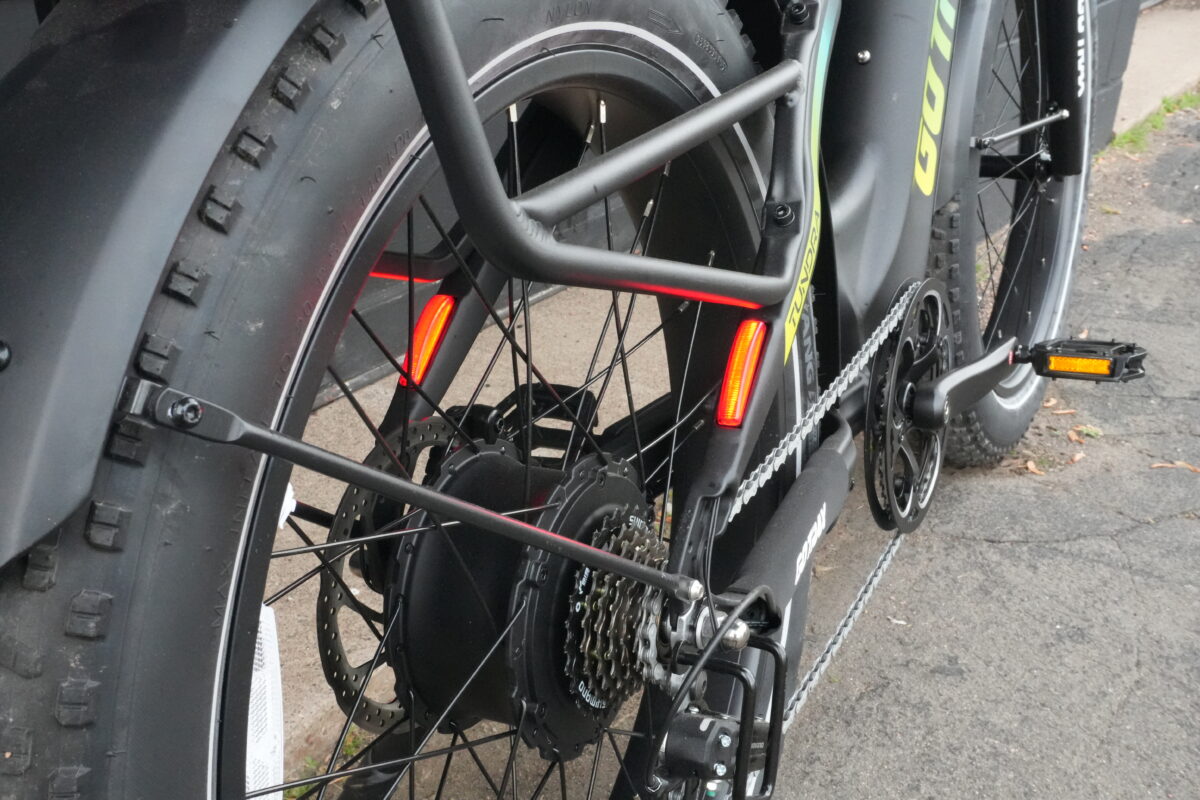
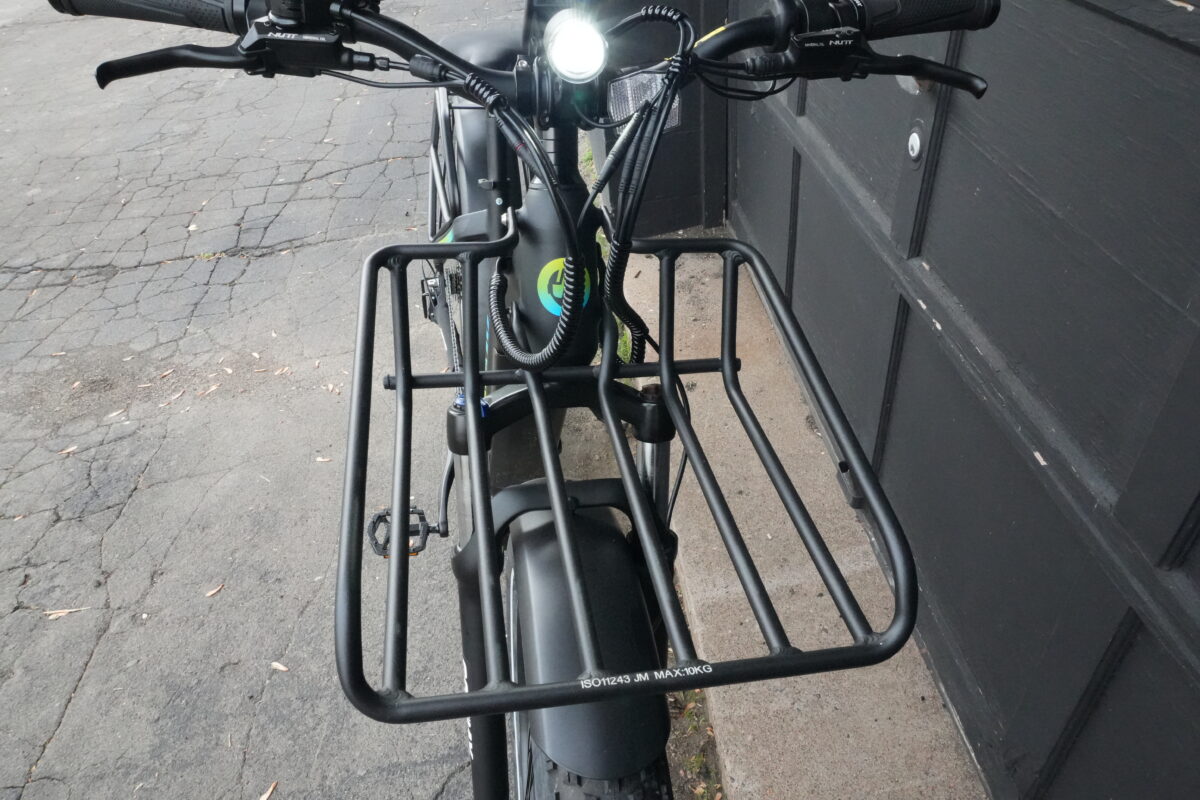
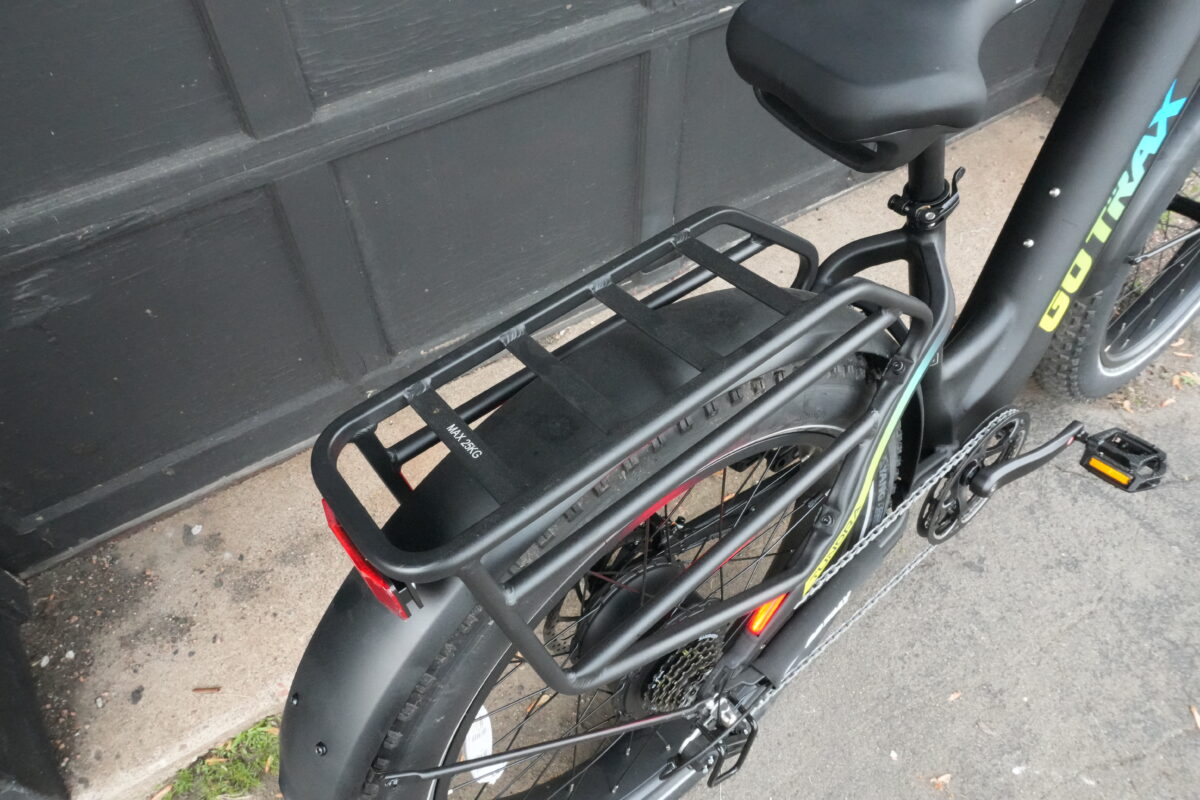
Many people buy fat tire bikes as a do-anything option. The Tundra ships with a front rack rated for 22 pounds, a rear rack rated for 55 pounds, and full-coverage alloy fenders. They send a couple other extras including a bottle cage, a phone mount, and the tools you need for setup. It arrives roughly 90% percent assembled, with straightforward final steps. A bright front headlight and two taillights integrated into the seat stays all run off the main battery, so there is nothing extra to charge, and the taillights brighten when you pull the brake levers.
Frame, Sizing, and Options
Climbing aboard, the first thing you notice is presence. It is a big, sturdy aluminum frame built around those fat tires, and the fixed stem and handlebars deliver a more active riding position. The step-thru we tested makes getting on and off easy, and a step-over frame is available for riders who prefer it. A grab handle tucked under the saddle is a small convenience. Both frames come in two finishes: a muted gray, or a black with vibrant gradient graphics.
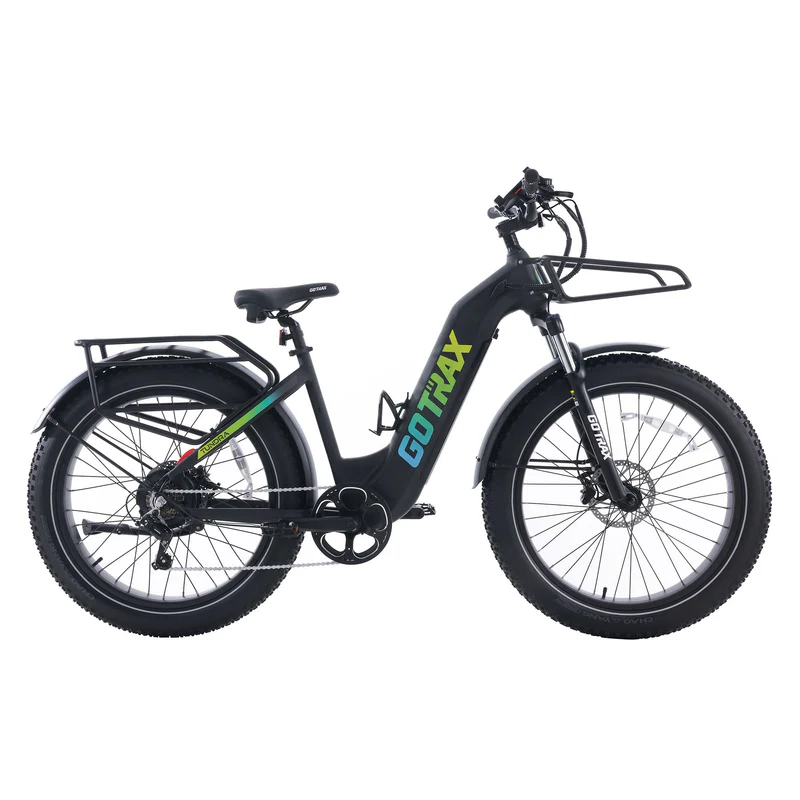
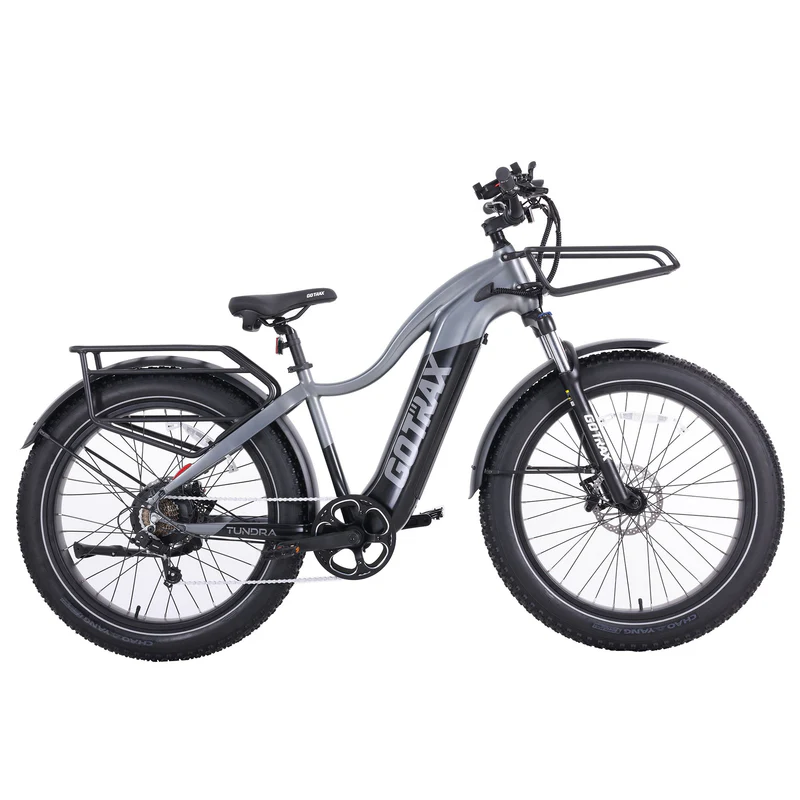
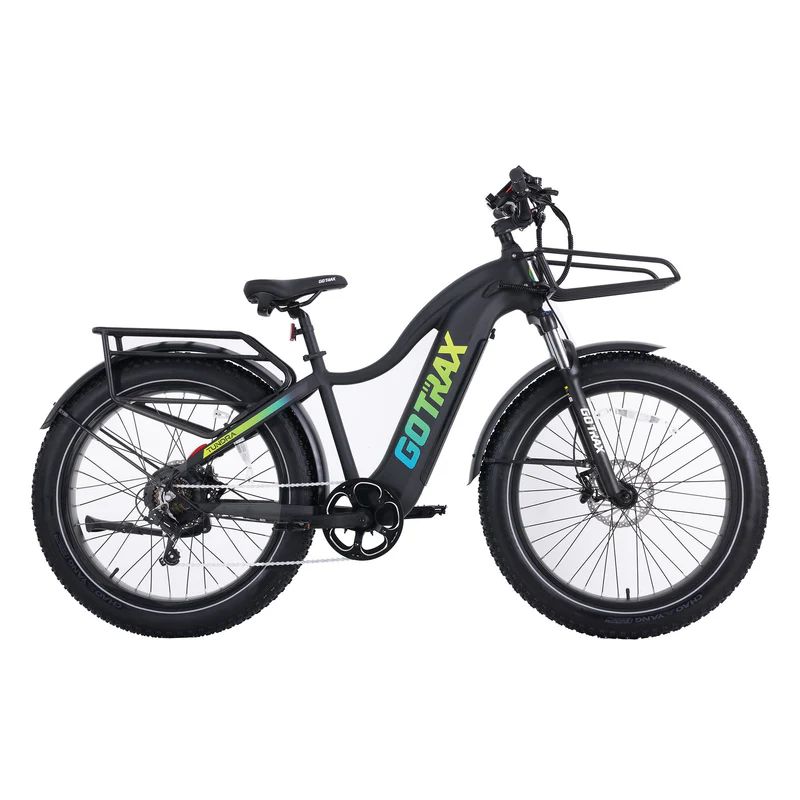
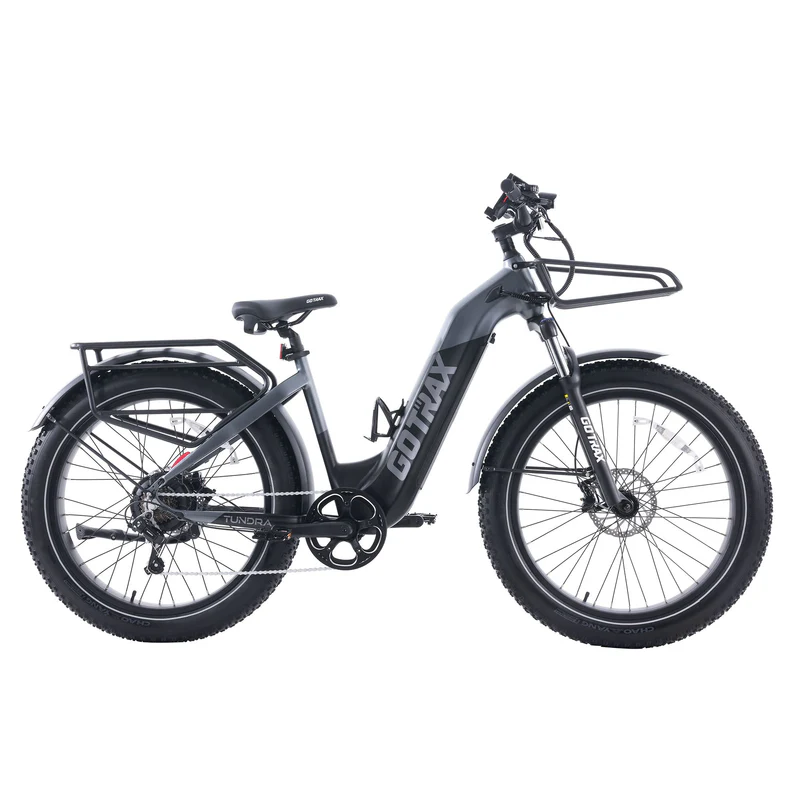
Fit is accommodating across a wide range of riders, with GoTrax listing both frame styles for the same 5’0″ to 6’4″ height range. We checked it with both a taller and a shorter rider. Our 6’1″ rider (33-inch inseam) had no trouble getting full leg extension, with a couple of inches still to spare before the minimum insertion point, and our 5’4″ rider settled in comfortably too, so that range holds up in practice. As with most fat tire bikes, this one runs heavy, and you feel that weight when riding and handling it. The geometry breakdown is below.
| Category | Gotrax Tundra |
|---|---|
| Total Weight | 82 lb (our scale, with accessories + battery) | 78.1 lb advertised |
| Payload Capacity | 300 lb |
| Rider Height Range | 5'0" – 6'4" |
| Standover Height | Step-Thru: 19" | Step-Over: 27.2" |
GoTrax Tundra Full Specifications
For a full breakdown of what makes up the GoTrax Tundra, see the spec sheet below.
| Component | Gotrax Tundra |
|---|---|
| Price | $1,499 |
| Type | Fat tire / all-terrain ebike |
| Class | 2/3 |
| Weight Capacity | 300 lb |
| Top Speed | 28 mph |
| Motor | Bafang 750W rear hub |
| Battery | 48V 20Ah (960Wh) |
| Claimed Range | Up to 74 mi |
| Charger | 54.6V 3.0A (≈6–7 hr full charge) |
| Display | Center-mounted color LCD |
| Sensor | Torque sensor |
| Throttle | Thumb throttle (left side) |
| UL Certifications | Certified to UL 2849 (electronics), UL 2271 (battery) |
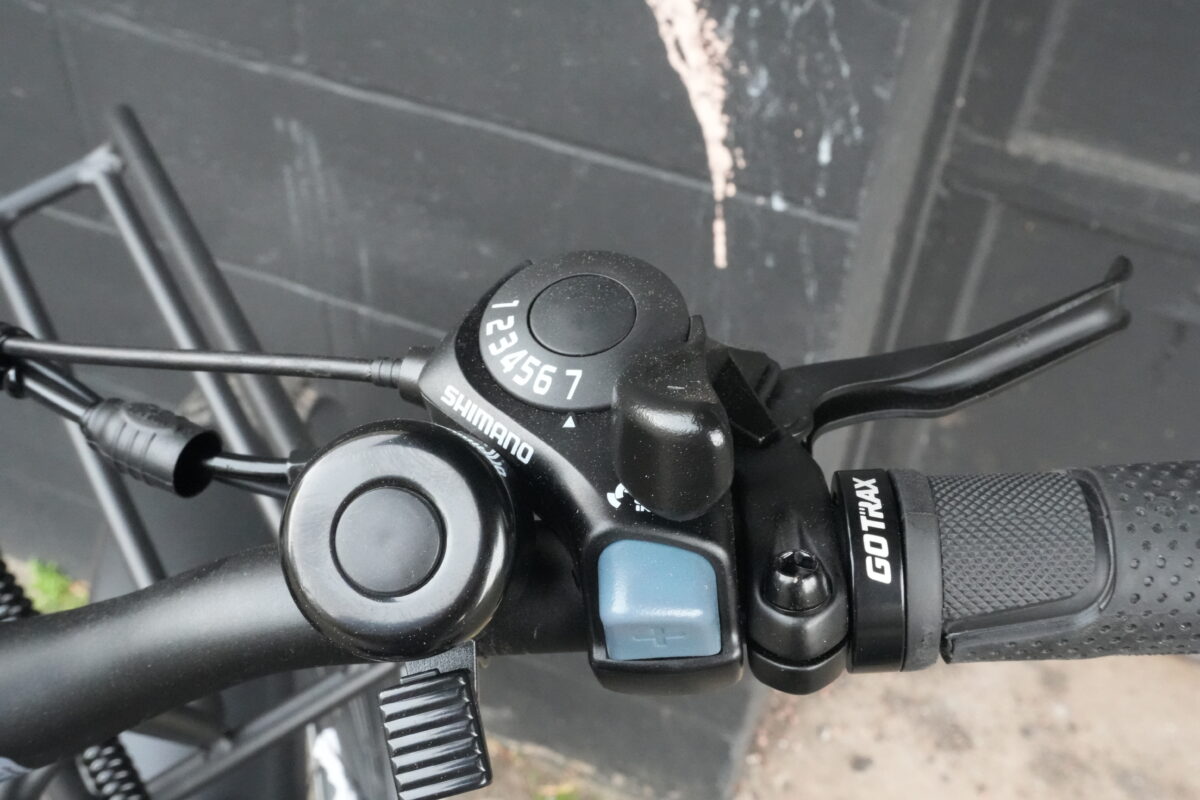
| Shifter | Shimano 7-speed SIS index thumb shifter |
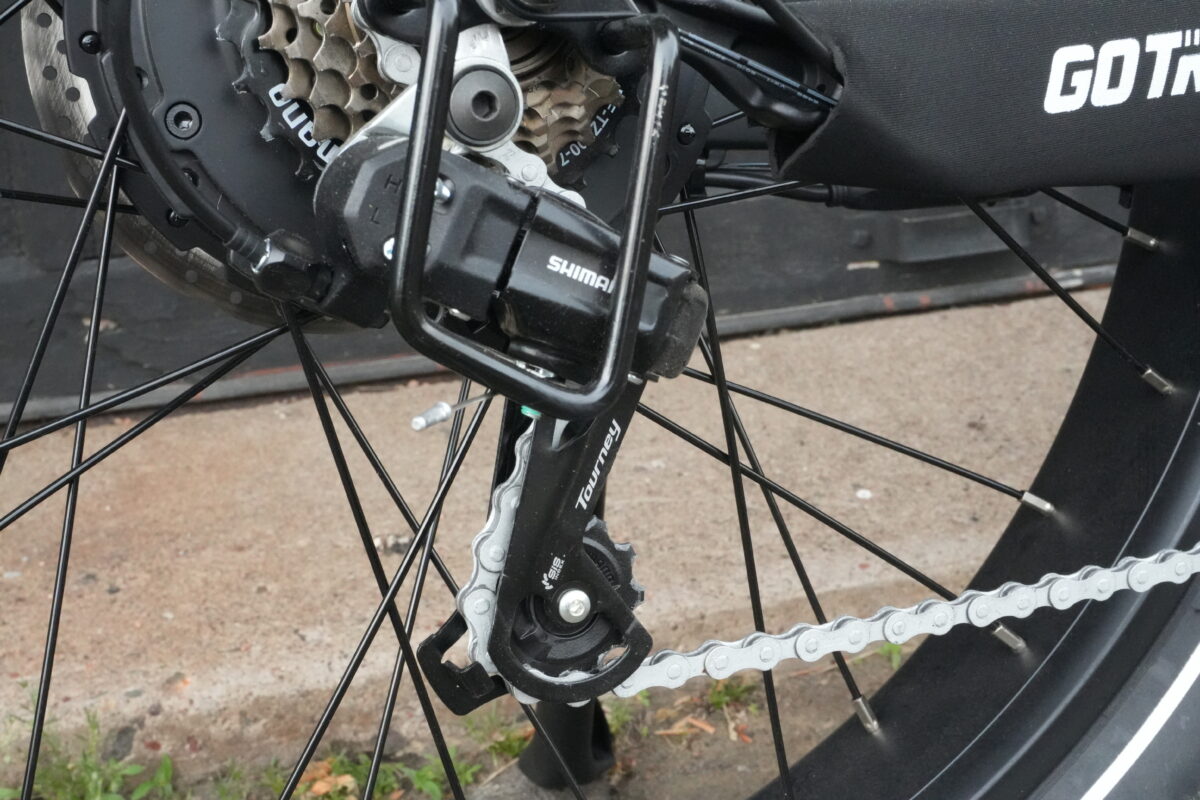
| Derailleur | Shimano Tourney |
| Chainring | 48T, double-walled |
| Cassette | 11–28T |
| Brakes | NUTT 2-piston hydraulic disc |
| Levers | NUTT hydraulic, with motor cutoff |
| Rotors | 180mm |
| Frame | Aluminum |
| Fork | Zoom suspension, ~60 mm travel (measured), lockout + preload |
| Axle | Bolt-on front |
| Tires | Chaoyang Hippo Skin Plus, 26" x 4", 3mm, all-terrain tread, reflective sidewall |
| Handlebars | Straight |
| Grips | GoTrax lock-on rubber |
| Stem | Fixed, with spacers |
| Saddle | GoTrax branded, with grab handle |
| Pedals | Alloy, with reflectors |
| Fenders | Alloy, full rear coverage (included) |
| Rear Rack | Included (55 lb capacity) |
| Kickstand | Rear-mounted, wide foot |
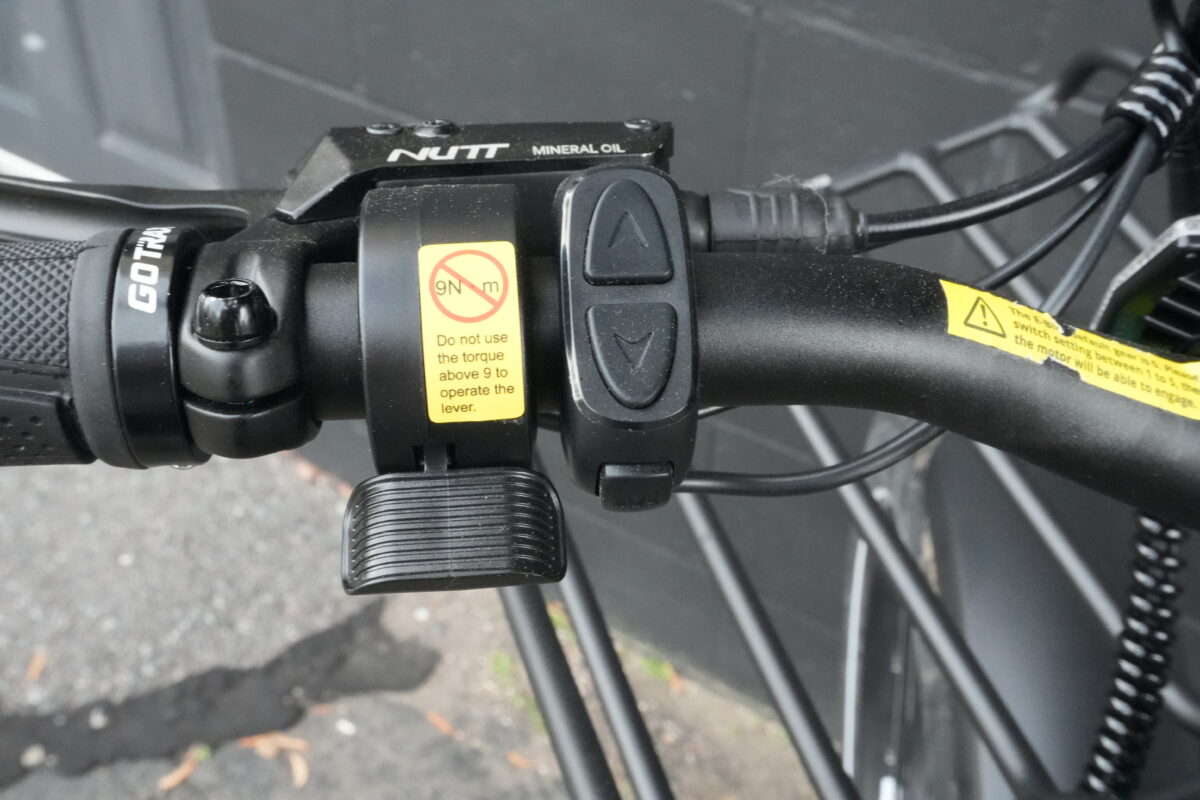
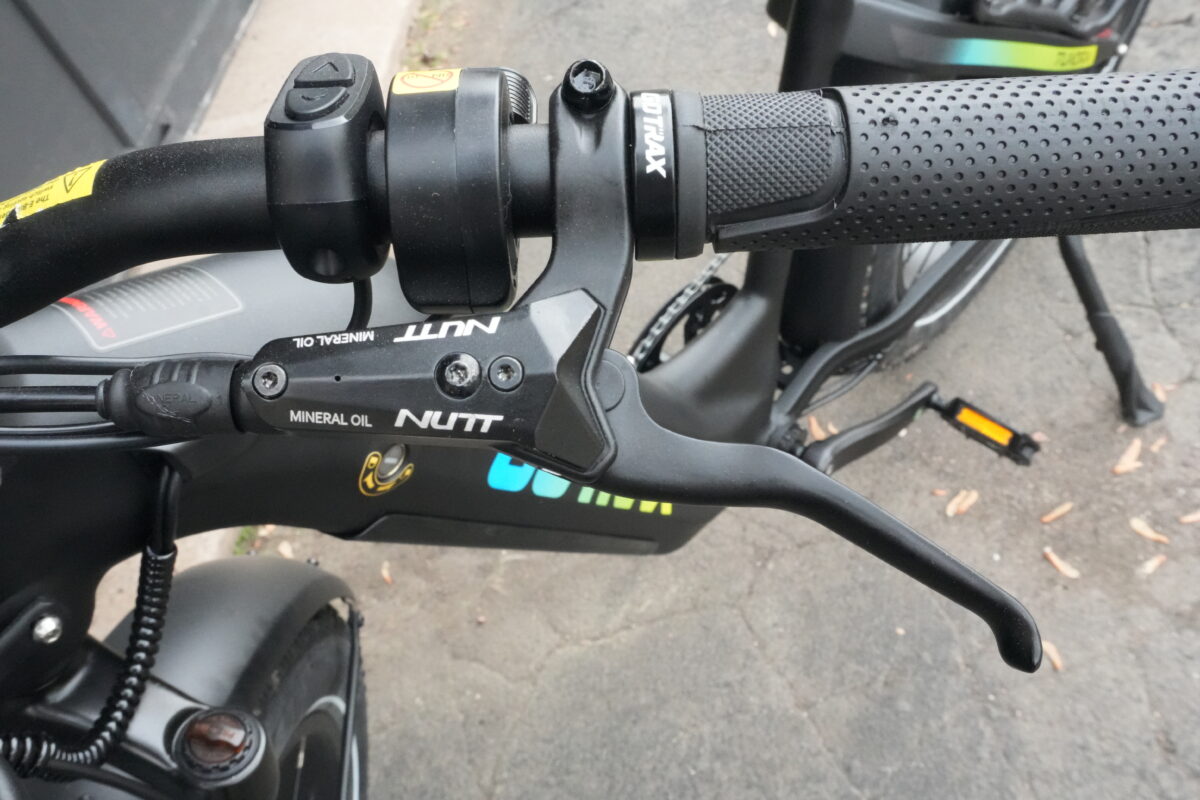
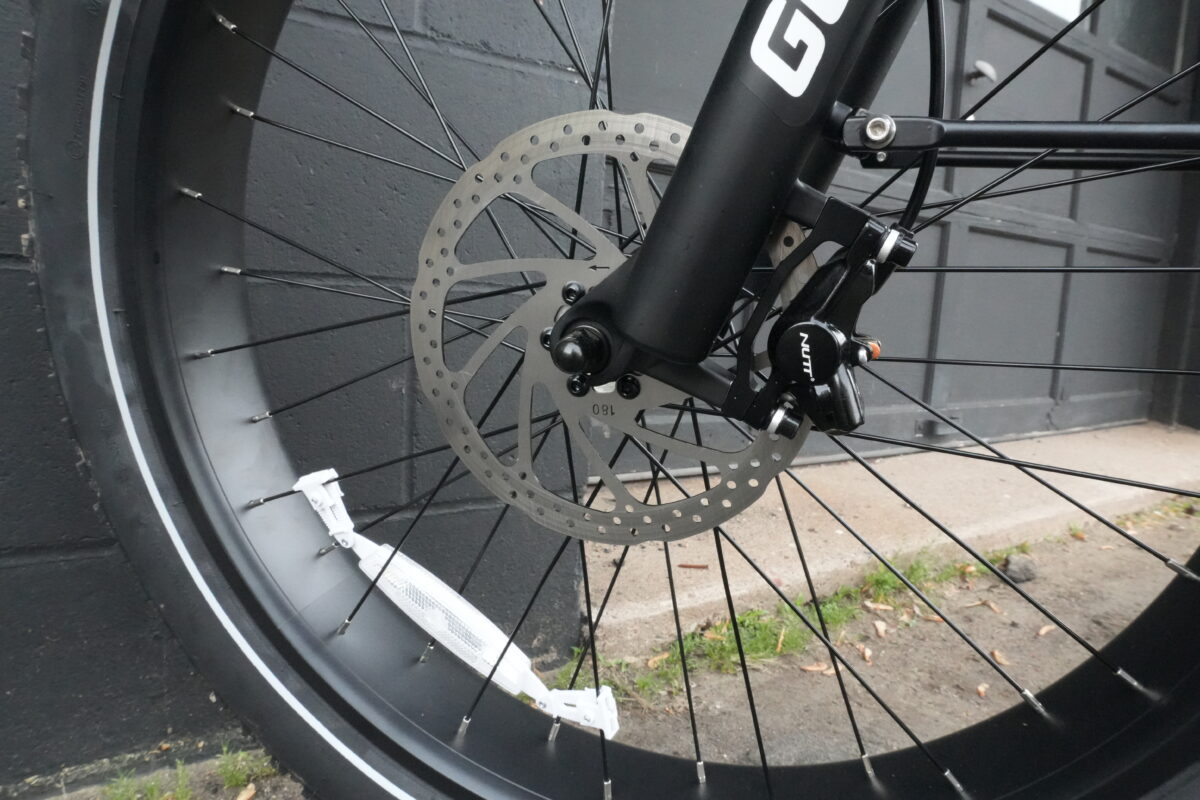
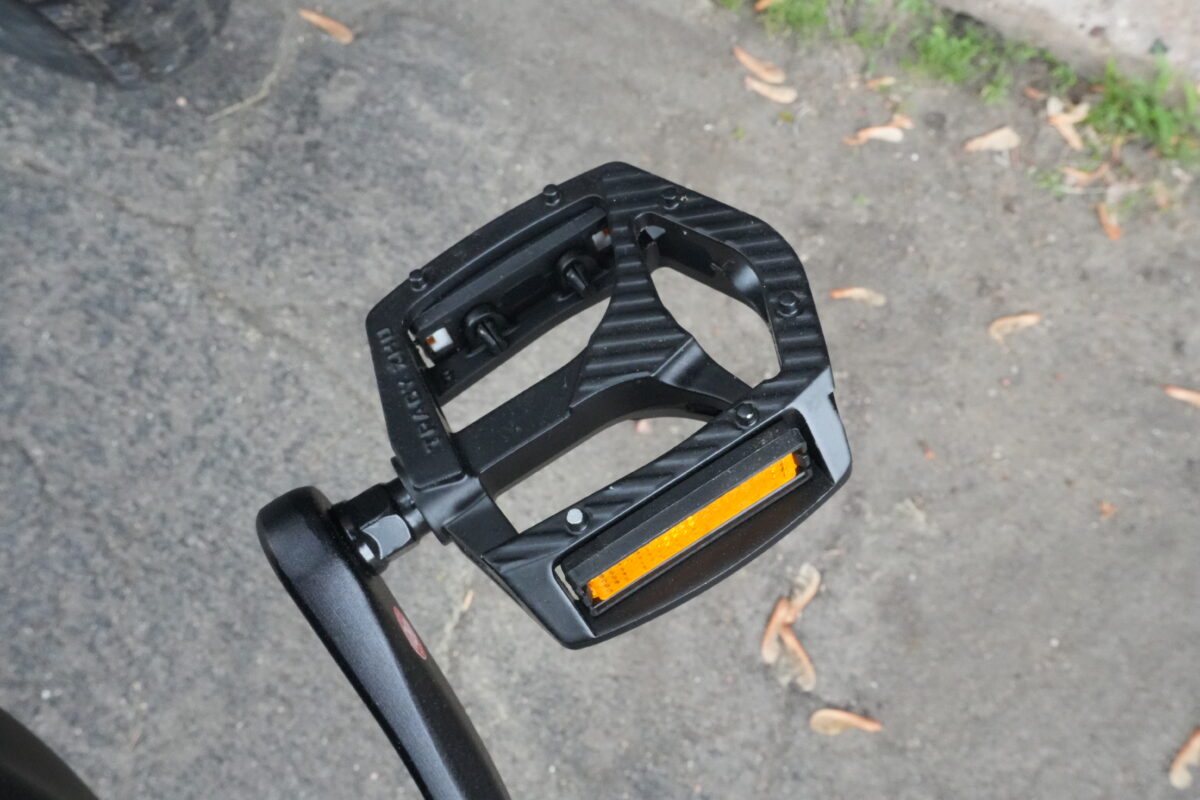
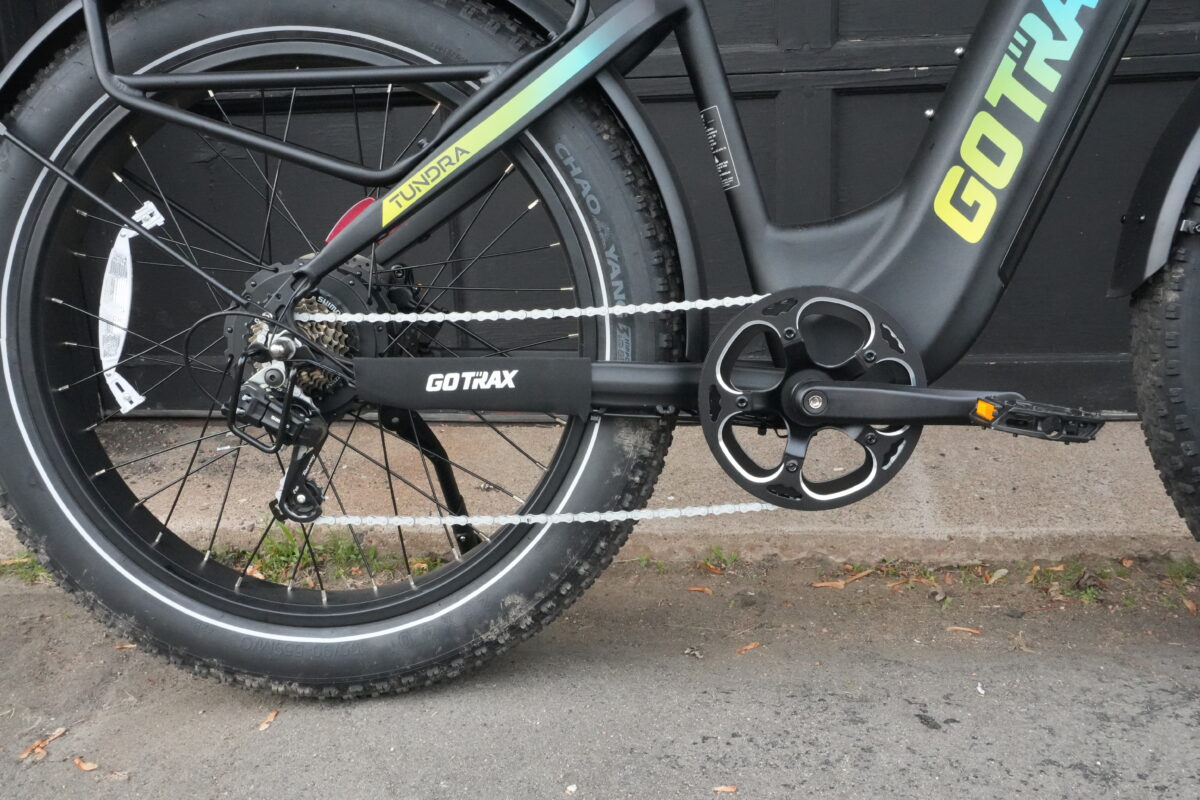
(48T Chainring, 11-28T Cassette)
Real-World Performance Testing | GoTrax Tundra
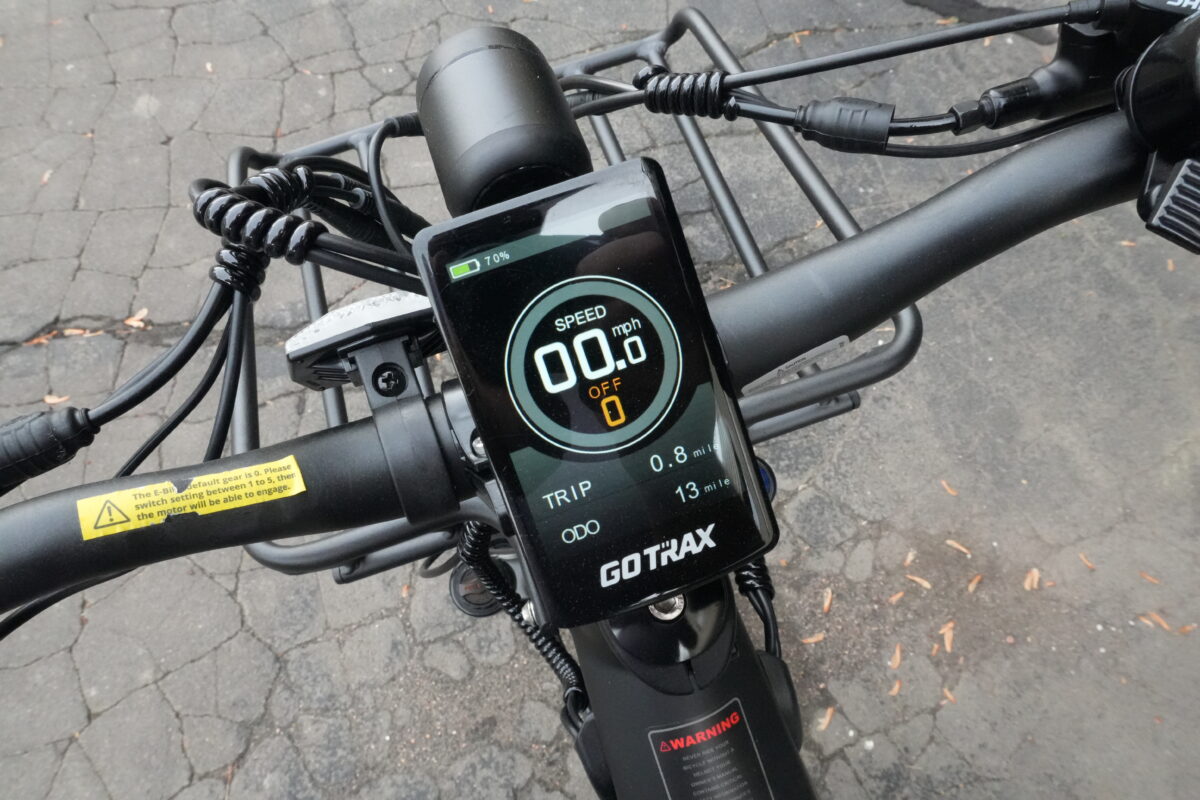
For all of our testing we had a 200 pound rider aboard, starting at about 93 percent battery, with the max speed enabled. The Tundra’s throttle is capped at 20 mph per Class 2 regulation, while pedal assist can reach 27.9 mph Class 3 speeds. You can set the max pedaling speed anywhere between 10.5 to 27.9 mph.
Throttle Acceleration
Hitting the thumb throttle from a stop produced a strong takeoff, climbing to the max 20 mph throttle speed in 8 seconds. The throttle delivers the same power in every assist level, so the takeoff feels virtually identical no matter which level you are in.
Pedal Assist
With the torque sensor, the motor engages after about half a crank and responds to how hard you pedal. Each assist level sets how much power it adds rather than capping your speed, so the figures below run from light pedaling to a firmer push:
- Level 1: around 11 mph with easy pedaling, closer to 17 with a harder push
- Level 2: near 15 mph at a relaxed effort, 18 to 19 when we lean in
- Level 3: 16 to 17 mph easy, 20 to 21 with a stronger push
- Level 4: about 20 mph while simply spinning the pedals, close to a cadence-sensor feel but still sensitive to pedal pressure
- Level 5: past 25 mph with almost no effort, and 27 to 28 with a solid push
Hill Climb
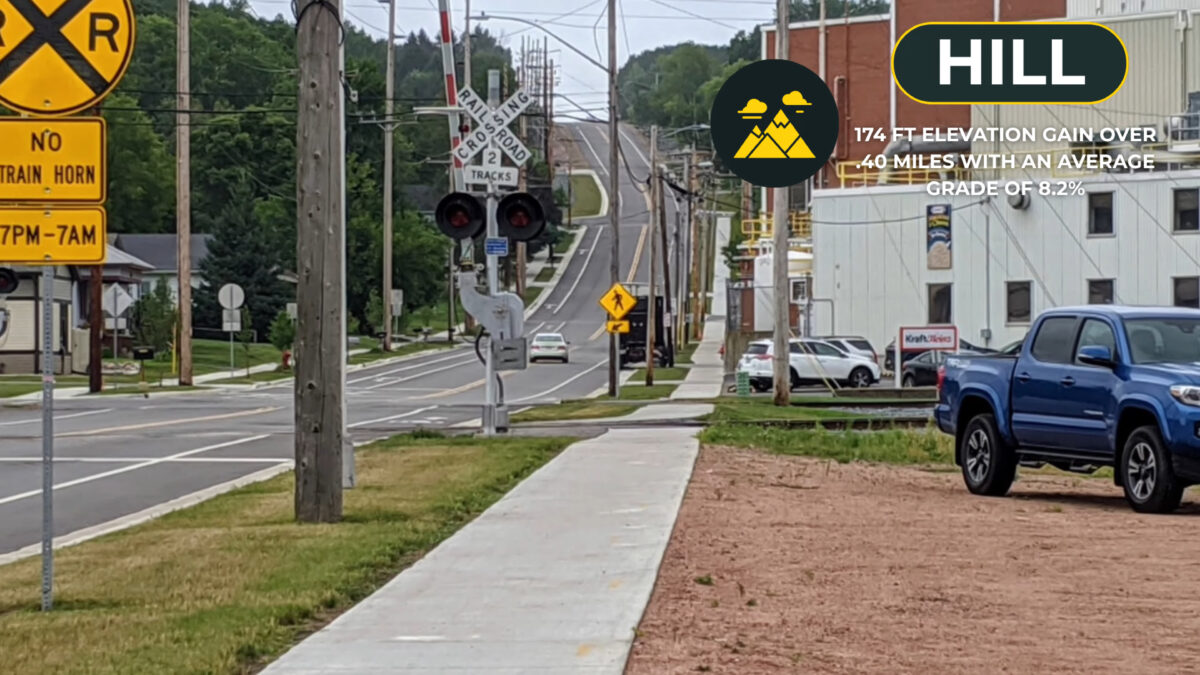
On the throttle-only climb up our test hill, we slowed to around 10 to 11 mph and held there. Climbing under pedal assist, we started in a low gear in level one and worked up through the 7-speed drivetrain as our legs loaded, bumping assist levels as the burn set in. We held 8 mph in level one, climbed into the low teens through levels two and three, and reached the mid-teens in levels four and five as the hill rounded out. Bringing in extra motor power through the torque sensor was easy throughout.
Ride Feel
On the road, there is no hiding the heft. The Tundra rides like a big boat: planted and stable, but not the most nimble. Off road is where the fat tire build earns its keep. This is not a setup for downhill or technical riding, but the bike found plenty of traction on gravel and dirt, and we could feel the fork working as we rolled down a bumpy, grassy hill.
Braking Performance
On a downhill test from around 28 mph, the brakes brought plenty of stopping power, enough to lock up the rear tire, so the power is there. A bike this heavy still takes a while to haul down to a full stop, though. We could also clearly hear the brakes during the test, and they had not been broken in yet, so some of that noise might fade with use.
GoTrax Tundra vs Lectric XPeak 2
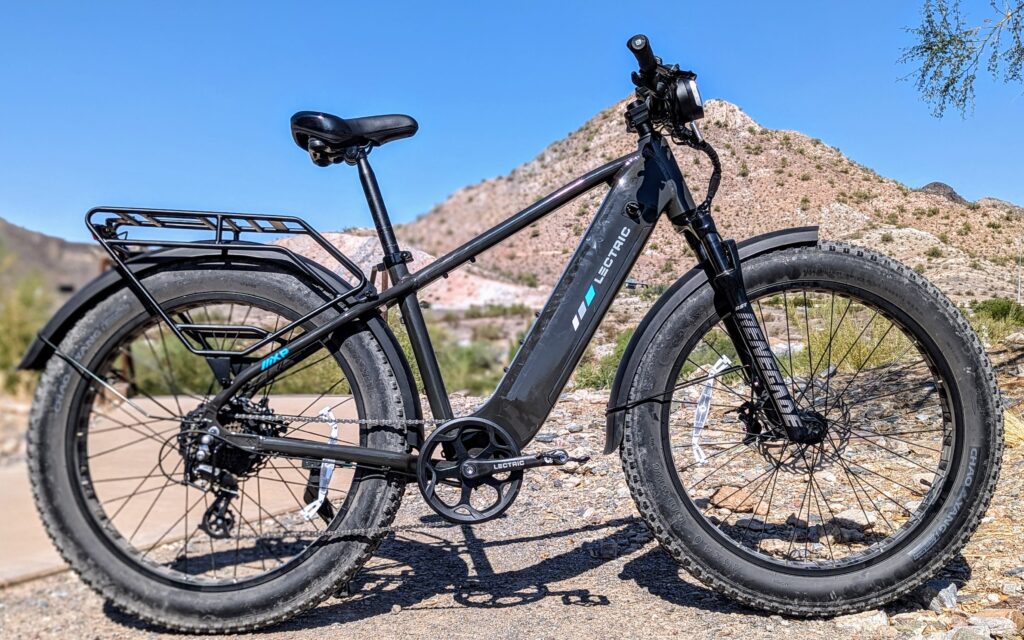
The natural cross-shop here is the Lectric XPeak 2, and you can spend a little less or a little more for it depending on the battery you choose. It starts at $1,399 with a 15Ah pack good for up to 60 miles and runs $1,599 with a 20Ah pack rated for up to 80 miles. What stands out is how many of its components turn up on pricier ebikes. The RST Renegade suspension fork is an expensive piece on its own, and the XPeak pairs it with an 8-speed Shimano Altus drivetrain, a larger 203 mm front rotor, and a thru-axle front wheel. A pogo-style suspension seatpost is a welcome comfort bonus as well. Its torque sensor is highly responsive and easy to draw power from, with a torque multiplier setting that makes tapping the motor easier still. The frame is hydroformed and eMTB safety tested to ISO 4210-10. It is a touch more powerful as well, and it comes from a well-established direct-to-consumer brand with a strong reputation for customer care.
Where the Tundra earns its place is value and utility. It undercuts the equivalent 20Ah XPeak by about $100 while matching it on battery capacity. Both bikes ship with a rear rack, but only the Tundra adds a front one. Its tail lights also brighten when you brake, and its 3A charger tops the battery off an hour or two faster than the 2A unit on the Lectric. For rougher terrain or more intense riding, though, the XPeak is the clear pick: its eMTB-rated frame and stronger fork are built for it. So if you want that capability and the higher-end components, the Lectric earns its premium. If you want strong battery capacity and more included utility for the money, the Tundra makes a strong case.
You can read our full Lectric XPeak 2 review for the complete picture.
GoTrax Tundra Pros and Cons
Final Thoughts on the GoTrax Tundra
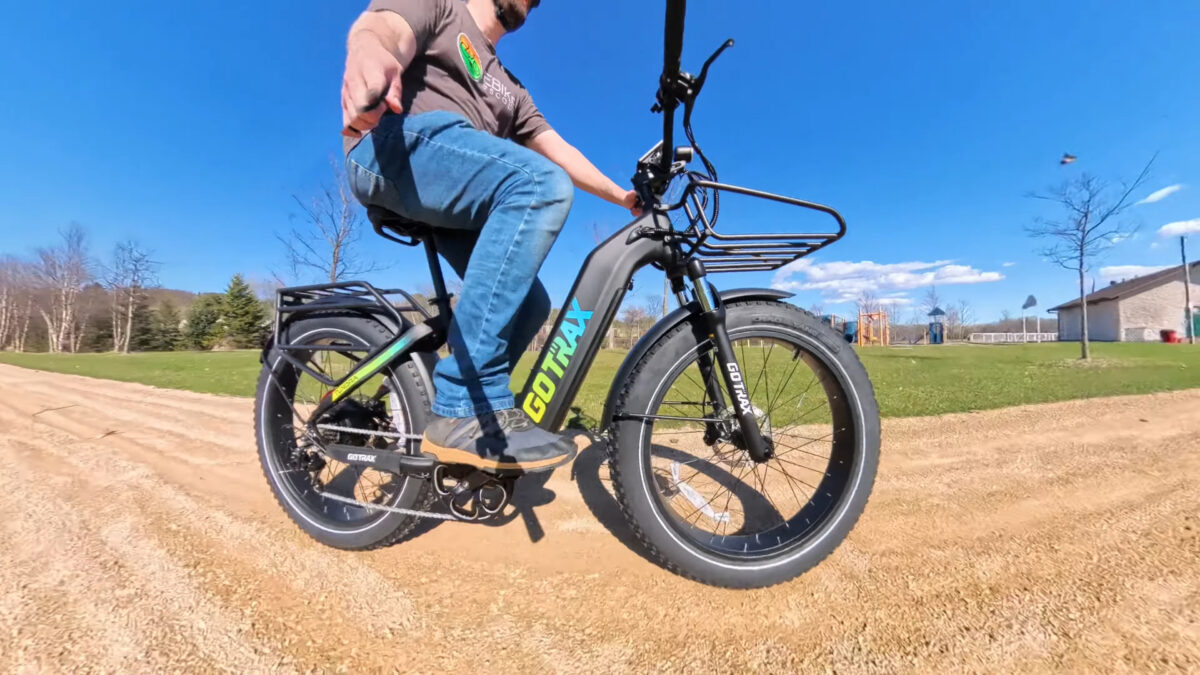
For a budget friendly brand, this is a deliberate reach upmarket for GoTrax. They clearly invested in a large 20Ah battery, a name-brand Bafang motor, and a torque sensor that covers the basic wants of most riders: a lot of range and power paired with a natural pedal feel. There are compromises on the mechanical side, and while it is not built for technical trails, it is at home on pavement, gravel, and fire roads alike. If you want a powerful fat tire bike with serious battery capacity and useful commuter gear included out of the box, and you do not mind a heavy machine, the Tundra delivers a lot for $1,499.
If we helped you make a decision, using our affiliate link when you buy is a great way to support the channel at no extra cost to you. We appreciate it.
