

Marker vs Aventure 3, and Tracer vs Pace 5 & Level 4 — a full brand and model breakdown, with our hands-on testing.
Two brands, two very different stories. Aventon has spent years becoming one of the most recognizable names in the ebike world, with a torque sensor and a polished app on nearly every model and a dealer network that stretches past 1,800 shops. Monarc is brand new — its first bikes rolled out in the summer of 2026 — but it arrives with the backing of Lectric, the best-selling ebike brand in the country, and a spec sheet that punches well above its price.
If you are cross-shopping these two, you have probably noticed the matchups line up almost perfectly. Monarc’s fat-tire Marker squares off against the Aventon Aventure 3, and Monarc’s city-focused Tracer lands right between the Aventon Pace 5 cruiser and the Level 4 commuter. We have spent real time on all of these bikes and put each through our full set of tests. This guide starts with how the two brands differ where it counts — support, warranty, range, tech, and fit — then goes bike by bike with what our riding actually showed. Let’s get into it.
Ebike Escape is supported by readers like you. If one of these bikes ends up being your next ride, buying through our links — Monarc or Aventon (Aventure 3, Pace 5, Level 4) — helps the channel at no extra cost to you. Shopping a local dealer instead? Email us your receipt and we can still get credit.
The Short Version
Pressed for time? Here is where each brand earns its keep.
Choose Aventon if you want the safety net of a physical bike shop for test rides, assembly, and warranty work; the most polished app in the category with deep ride tuning; mature 4G security with GPS tracking and a locking rear wheel; regenerative braking on the newest models; and the option to dial in your fit with real size choices. It is the proven, established pick.
Choose Monarc if you want the most hardware for your money — two batteries standard, four-piston brakes, a big color touchscreen — plus the longest warranty in the class at five years, and you are comfortable buying direct from a new brand that has Lectric’s support infrastructure behind it.
The rest of this article is about why those trade-offs exist, and which of the specific bikes is right for you.
Monarc vs Aventon: The Brand Differences That Actually Matter
Before the spec sheets, understand who you are buying from. The two companies take opposite approaches to almost everything except the goal of getting you on a capable ebike for under two grand.
How You Buy and Get Support
This is the biggest philosophical split. Aventon runs an omnichannel model: you can order online, but you can also walk into one of 1,800-plus dealers to test ride before you buy, have the bike professionally assembled, and bring it back to a local shop when something needs service or warranty work. For a lot of riders — especially first-timers, or anyone who does not want to wrench on their own bike — that in-person safety net is worth real money, and it is the first thing we mention when someone asks why Aventon costs a little more than a pure direct-to-consumer brand.
Monarc is direct-to-consumer only. There is no local shop; the bike ships to your door and you handle final assembly. Two things soften that. First, the company behind it: Monarc is backed by Lectric, and it staffed its support department with the very team that built Lectric’s — a group with a strong reputation for looking after riders. Second, the assembly is made about as painless as direct-to-consumer gets, with a through-axle front wheel, quick-release pedals, and an included torque wrench so you can tighten everything to spec. If you want to see exactly what shows up at your door, here is our Monarc unboxing:
Still, if hands-on local help matters to you, Aventon keeps the edge here. If you are comfortable troubleshooting over the phone and doing basic setup yourself, Monarc’s approach works fine.
Warranty
Monarc wins this one outright. Every Monarc ships with a five-year warranty, which is close to unheard of in a category where one to two years is the norm. Aventon offers a solid two-year standard warranty covering the frame, fork, motor, battery, and electronics, and you can extend frame coverage to a lifetime by registering within 90 days. Two years is respectable and better than a lot of direct-to-consumer brands. Five years is simply in another tier. The honest asterisk, which we will come back to, is that a warranty is only as good as the company standing behind it — and Monarc is new enough that it has not had to prove that yet.
Batteries and Range
Here is where Monarc’s value pitch gets loud. Every Monarc bike comes with two batteries in the box, plus a fast charger. That is not an upsell or a special edition — it is the standard build. Each pack is a 48V, 15Ah LG-cell battery, for 30Ah of total capacity, and the practical upshot is huge: run them back to back on a big day, or keep a spare topped off and ready by the door. The included 5-amp charger fills a single pack from empty in about three hours, roughly twice as fast as the 2-amp bricks these bikes usually ship with. There is even an on-screen setting to cap charging at 80% to prolong battery life, which is rare at any price.
Aventon ships a single battery on these models, though it has a smart trick of its own: its 36V packs are cross-compatible across much of the lineup, so an “Aventon household” with more than one bike can share batteries between them. It is genuinely useful standardization. But if raw out-of-the-box range is what you care about, two batteries beats one, and Monarc hands you the second pack for free.
App and Smart Tech
Aventon’s app is one of the best in the business, full stop. It is where you use Ride Tune to independently set the max torque, assistance, and pedal response for each assist level, and it handles GPS ride tracking, remote motor lock, and over-the-air firmware updates that genuinely add features over time — during our recent testing, Aventon rolled out new options between when we started a review and when we finished. Pair that with Aventon’s ACU-based 4G smart security — real-time GPS tracking, geofencing, an anti-theft alarm, a locking rear wheel that drives a physical pin into the wheel, and remote lock or shutdown — and you have a mature, proven connected ecosystem. Two honest caveats: the 4G service is free for the first year and then runs about $20 a year, and these deeper settings live in the app rather than on the bike itself.
Monarc’s answer is a large 3.5-inch color touchscreen with on-screen ride customization (including that per-level motor tuning and the 80% charge cap), a display lock, dark mode, and over-the-air updates, plus a growing accessory ecosystem — a rear-vehicle detection radar, tire-pressure monitors, and a smart helmet that talk to the display. Two honest catches. First, Monarc’s companion app is not out yet; it is slated for late summer 2026, with turn-by-turn navigation following after that, and we have not been able to test the Bluetooth accessories that pair to it. Second, the touchscreen is disabled while you ride (a safety and wet-weather measure), so you use the handlebar buttons to change assist on the move. As of this writing, Aventon’s app and connected security are the more mature, present-day option. Monarc is clearly building toward a connected system; Aventon has already shipped and refined one.
Motors and Ride Feel
One thing our testing made clear: on flat ground, all of these bikes get to 28 mph with surprising ease — even on the torque sensor, which rewards how hard you pedal. Monarc’s Bafang hub motor peaks higher on paper (1,638W and 85 Nm) than Aventon’s (1,188W to 1,440W depending on model), and Monarc did a nice job keeping motor noise down for the power on tap. But peak wattage is not the whole story; weight, gearing, and tuning all shape how a bike actually accelerates and climbs, and every one of these bikes has plenty of punch for real-world riding.
Both brands also ship a torque sensor and a cadence sensor, and here is a fair knock on both: out of the box, each brand’s cadence sensor delivers too much power too easily, spiking you toward top speed with barely any effort. On both brands, we would steer most riders to the torque sensor, which feels more natural and is the one you can fine-tune.
Fit and Sizing
Aventon offers actual size choices on several models — typically a Regular and a Large, often across two frame styles — so you can match the bike to your height rather than hoping a single size works. Monarc takes a wide “one-size-fits-most” approach, offering a High-Step and a Step-Thru frame each with a generous fit window (down to 5’2”). We put a range of riders on the Monarc bikes and they fit most of them well, but if you are notably short, Aventon’s discrete sizes make it easier to nail your fit — and a Monarc can feel like a big bike.
Displays
Quick thread that runs through every matchup: Monarc’s 3.5-inch touchscreen is simply bigger and more modern than the smaller color LCDs Aventon uses, and it is easy to read and center-mounted. Aventon’s displays are functional and pack in nerdy ride data, but they are smaller and, like most LCDs, can glare in direct sun.
Monarc Marker vs Aventon Aventure 3
Both are rugged, fat-tire, do-anything machines that land at $1,999, and both aim at the rider who wants one bike for commutes, gravel, and weekend escapes. This is the closest matchup of the bunch.
| Monarc Marker | Aventon Aventure 3 | |
|---|---|---|
| Price | $1,999 (reg. $2,228) | $1,999 |
| Motor | Bafang B750 rear hub, 750W / 1,638W peak, 85 Nm | 750W rear hub / 1,188W peak, torque sensor |
| System | 48V | 36V |
| Battery | Two 720Wh (48V, 15Ah) LG packs | One 733Wh (36V, 20Ah) LG pack |
| Claimed range | Up to 120 mi (~60/pack) | Up to 65 mi |
| Fork | 80mm Gneiss reverse-arch (lockout + preload) | 80mm Zoom suspension (lockout) |
| Seatpost | Rigid, 2-bolt | Suspension seatpost |
| Brakes | 4-piston hydraulic, 203/180mm rotors | Tektro hydraulic disc, 180mm |
| Drivetrain | Shimano Cues, 9-speed | Shimano Altus, 8-speed |
| Display | 3.5” color touchscreen | Color LCD (smaller) |
| Smart security | Display lock, accessory ecosystem; app coming late ’26 | 4G/GPS, geofencing, alarm, rear-wheel lock, Ride Tune |
| Weight | ~87 lb | ~76 lb |
| Payload | 420 lb gross | 400 lb |
| Sizing | 2 frame styles, one fit window each | 2 frame styles × 2 sizes |
| Warranty | 5 years | 2 years |
| Extras included | MIK rear rack w/ MOLLE panel, fenders, integrated lights + turn signals, 2nd battery, fast charger, slime-filled tires | Metal fenders, MIK rear rack, front-rack mounts, integrated lights, ACU |
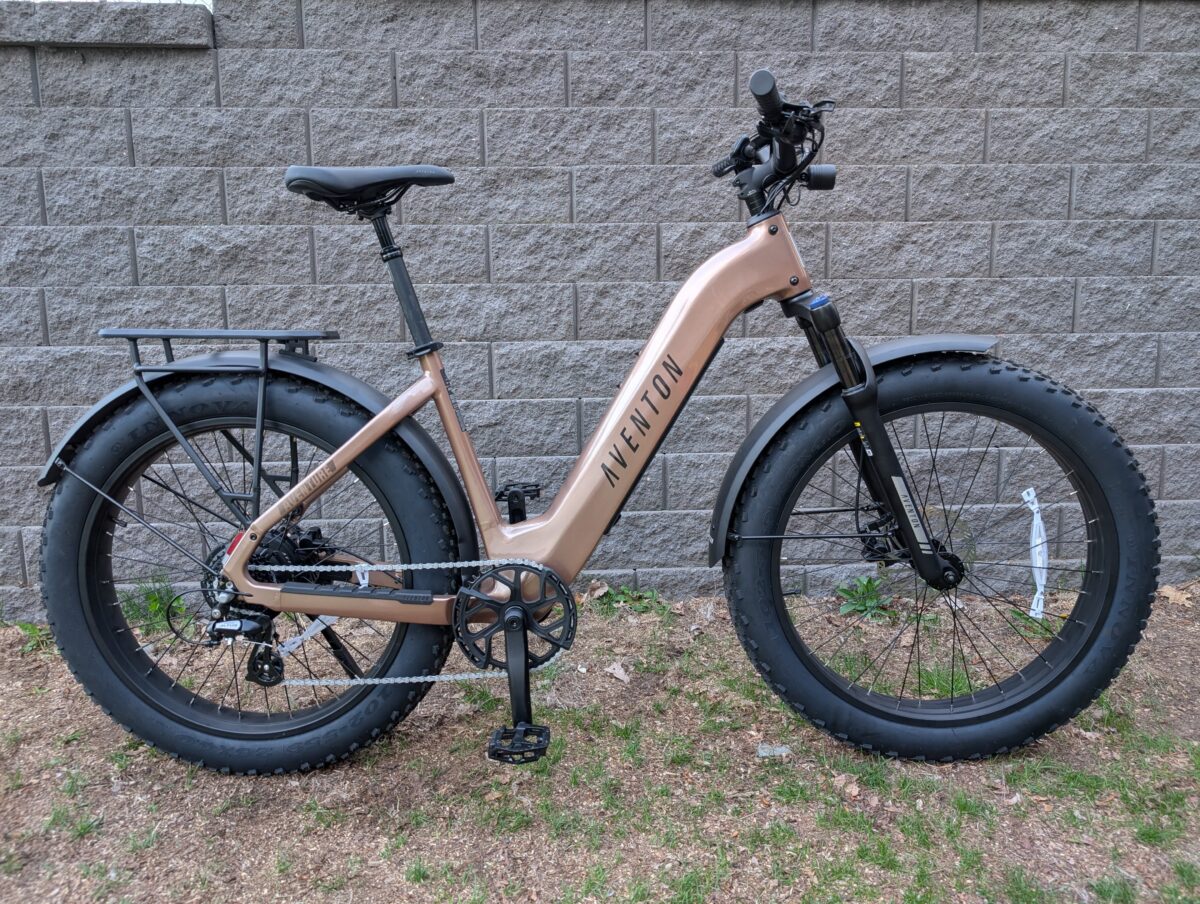
How they ride. Both are legitimately capable fat-tire bikes. On the Marker, we took it well past the fire-road stuff — single track, crushed gravel, and a genuinely nasty rocky climb. That final climb was a deliberately brutal, well-above-average stress test, and only on a second run at it did the Marker briefly flash a motor-temperature warning — it still kept going and reached the top once we aired the tires down for traction. The Aventure 3 is not built for tight single track, but it is a fantastic do-anything machine, and its 4-inch tires plus the suspension fork and suspension seatpost soak up rough ground beautifully.
Where the Marker pulls ahead. The headline is range and value: two batteries and up to 120 miles versus the Aventure 3‘s single pack and up to 65. On top of that you get a stronger peak (1,638W and 85 Nm), meatier four-piston brakes on a big 203mm front rotor, a nine-speed drivetrain, a bigger touchscreen, and Monarc’s five-year warranty. It also arrives more ready to haul, with a MIK-compatible rear rack that has a built-in MOLLE panel for strapping down gear, plus tires pre-filled with slime to fend off flats.
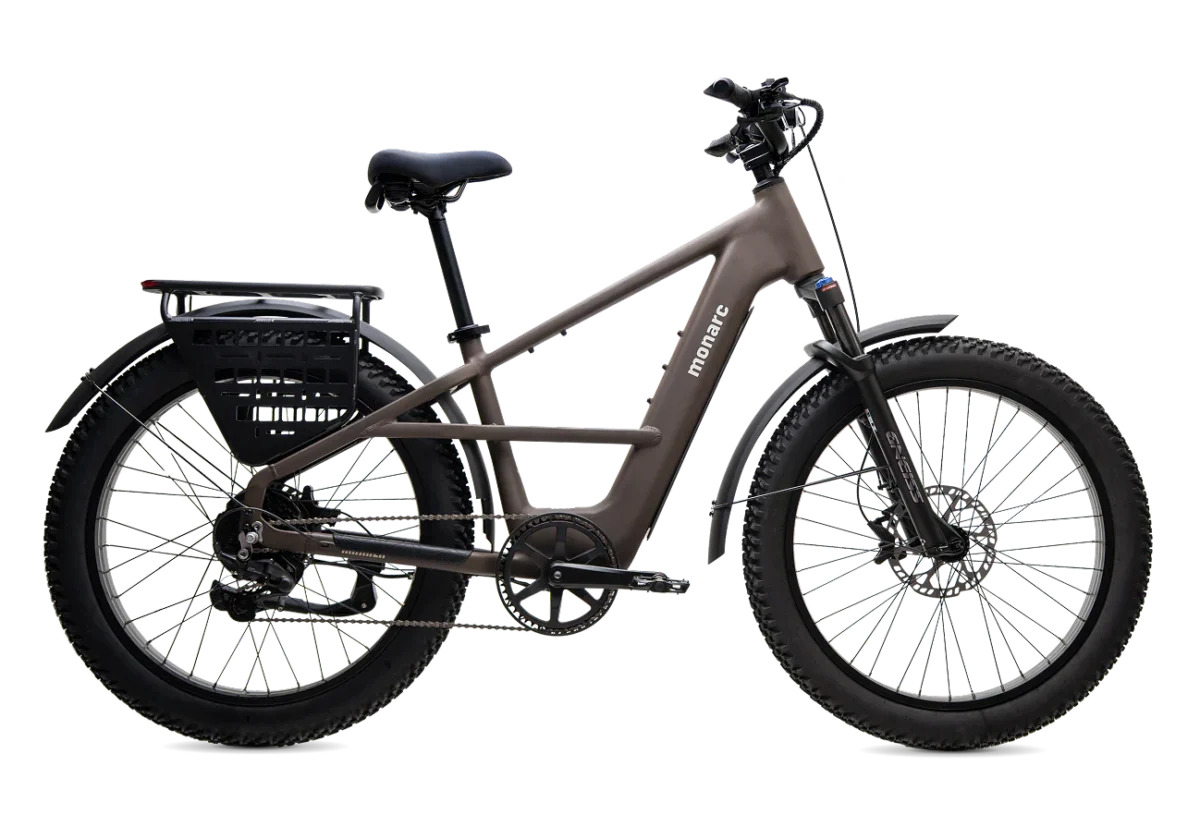
Where the Aventure 3 answers back. This is a known quantity, and that counts for a lot in a fat-tire bike you will load up and ride hard. It is a solid 11 pounds lighter than the Marker, which makes it noticeably easier to lift or load onto a rack — a real consideration in an 80-plus-pound class of bike. It brings Aventon’s mature ACU security — GPS tracking, geofencing, an alarm, and a locking rear wheel — that Monarc can’t fully match until its app lands, plus a suspension seatpost the Marker lacks. It comes in true size options for a dialed fit, and it has years of owner feedback and a dealer network behind it. If you might want a mid-drive instead, Aventon also offers the Aventure M, which Monarc has no answer for.
Who should buy which. Go Marker if you want maximum range, the strongest component sheet at $1,999, the longest warranty, and serious off-road capability — and you are comfortable buying direct. Go Aventure 3 if you value proven reliability, the mature app and 4G anti-theft, a suspension seatpost, a lighter bike, precise sizing, and a local shop to lean on. Dig into the details in our Aventon Aventure 3 review, and see how both stack up against the field in our best fat tire ebikes guide.
Check price: Monarc Marker · Aventon Aventure 3
Monarc Tracer vs Aventon Pace 5 & Level 4
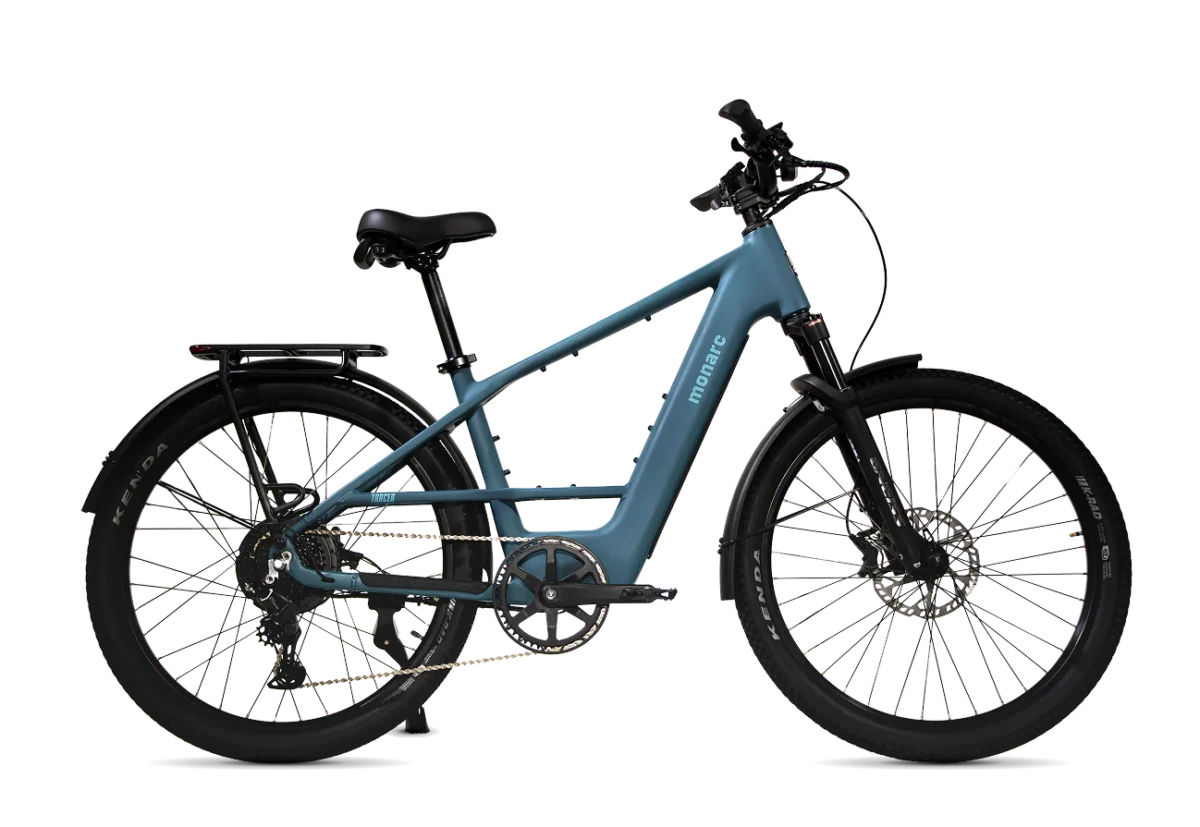
The Tracer is Monarc’s city bike, but it splits the difference between a comfort cruiser and a commuter — Monarc pitches it as an “SUV” style ebike that is happy on pavement and light unpaved paths alike, and in our testing it is the more nimble, more street-friendly of the two Monarc bikes (our pick of the pair for most riders). That puts it squarely between two Aventon models: the Pace 5 cruiser and the Level 4 commuter. Here is how all three line up.
| Monarc Tracer | Aventon Pace 5 REC | Aventon Level 4 | |
|---|---|---|---|
| Price | $1,899 (reg. $2,128) | $1,799 | ~$1,999 (REC) / $2,799 (ADV) |
| Best described as | City / SUV crossover | Comfort cruiser | Commuter |
| Motor | 750W / 1,638W peak, 85 Nm | 750W / 1,440W Boost, 80 Nm | Same as Pace (REC); mid-drive 100 Nm (ADV) |
| Battery | Two 720Wh packs | One 733Wh pack | One 733Wh pack |
| Claimed range | Up to 130 mi (~65/pack) | Up to 75 mi | Up to ~110 mi eco (ADV) |
| Fork | 80mm suspension | Rigid alloy (none) | Suspension fork |
| Seatpost | Rigid | Rigid | Suspension seatpost |
| Brakes | 4-piston hydraulic, 203/180mm | Tektro hydraulic (2-piston), 180mm | Tektro hydraulic, 180mm |
| Drivetrain | Shimano Cues, 9-speed | Shimano Altus, 8-speed | Shimano (ADV: electronic + auto shift) |
| Regen braking | No | Yes | Yes |
| Display | 3.5” touchscreen | Color LCD | Color LCD |
| Smart security | Display lock; app coming late ’26 | Keyless, e-wheel lock, 4G/GPS, alarm, geofencing | Same 4G suite |
| Rack / fenders | Both included | Neither included | Both included |
| Sizing | 2 frame styles, one fit window each | Step-thru only, 2 sizes | 2 frame styles × 2 sizes (XL on ADV) |
| Weight | ~73 lb (HS) / 71 lb (ST) | ~60+ lb | ~71 lb (REC) / ~61 lb (ADV) |
| Warranty | 5 years | 2 years | 2 years |
Where the Tracer pulls ahead. Same value story as the Marker, tuned for the city. Two batteries mean up to 130 miles of range — nearly double what either Aventon offers on a single pack — and you get the stronger 1,638W peak, four-piston brakes, a nine-speed drivetrain, and the big touchscreen. Two details stood out in testing. First, the Tracer includes an 80mm suspension fork as standard, and it works well for the price; that matters most against the Pace 5, which has no suspension at all. Second, its Kenda checkerboard tires gave us real confidence dipping onto light trails and gravel, more than a strictly street tire would. It also undercuts the Level 4 REC on price while still bundling two batteries, a rack, and fenders.
Where the Pace 5 answers back. The Pace 5 REC is a comfort-first cruiser and does that job beautifully, with swept-back bars, an adjustable stem, and a wide saddle. Its ace is tech: the mature app with Ride Tune, plus a genuinely class-leading security package — a keyless battery, an electronic rear-wheel lock, 4G GPS tracking, an alarm, and geofencing. It also brings regenerative coasting and braking, which the Tracer doesn’t have, and clever touches like cruise control and a hold mode. Its honest weaknesses are the ones we flagged in our review: no suspension fork and no suspension seatpost on a comfort bike, so the Tracer’s fork is a real ride-quality point in its favor unless you add a suspension seatpost. At $1,799 it is also the cheapest entry here, and it is the lightest by a good margin.
Where the Level 4 answers back. The Level 4 REC is the more direct commuter rival, and it is the one Aventon that matches the Tracer’s comfort hardware: it adds a suspension fork and a suspension seatpost plus fenders and a rack out of the box, and it shares the Pace’s app, 4G security, and regen. If you want to step up, the Level 4 ADV swaps in a 100 Nm mid-drive motor with genuinely excellent electronic and automatic shifting — the smoothest auto-shifting derailleur system we have tested — for a more premium, better-balanced ride at $2,799. Monarc has no mid-drive answer to that. The trade-off is price: the Level 4 costs more than the Tracer while still giving you one battery to Monarc’s two.
Who should buy which. The Tracer is the value and range champion, and the pick if you want suspension, a big touchscreen, and the longest warranty in a do-it-all city bike. The Pace 5 is for riders who prioritize upright cruiser comfort, the best app and security, regen, and the lowest price. The Level 4 is for commuters who want suspension plus commuter accessories handled for them — and, in ADV trim, a premium mid-drive with automatic shifting. Compare them all against the field in our best commuter ebikes roundup.
Check price: Monarc Tracer · Aventon Pace 5 · Aventon Level 4
So, Which Brand Should You Buy?
There is no single winner here, because the two brands genuinely optimize for different buyers.
Aventon is the safer, more proven choice. You get a real dealer network for test rides and service, the most polished app in the category, mature 4G anti-theft with a locking rear wheel, regenerative braking on the newest models, tailored sizing, and years of owner feedback confirming the bikes hold up. The costs of admission are a shorter (still good) two-year warranty, a single battery, and a small annual fee to keep the 4G features live after year one.
Monarc is the value and hardware play. For the same money — or less — you get two batteries and dramatically more range, richer components like four-piston brakes and a nine-speed drivetrain, a bigger touchscreen, and a five-year warranty that nobody else in this price range touches. The honest asterisks are the ones we keep coming back to: it is a brand-new company without a long-term reliability record, there is no local shop to lean on, and its app and connected accessories are still a few months out. Lectric’s backing meaningfully de-risks the “new brand” concern, but the open question — the thing Monarc still has to prove — is whether it will deliver on that support and stand behind that five-year warranty over time.
If you want to hand your money to a known quantity with a shop down the road, go Aventon. If you want the most bike for the money and a warranty that outlasts everyone else — and buying direct doesn’t scare you — Monarc makes a genuinely compelling case. You can browse all of our Aventon reviews and Lectric reviews (Monarc’s parent) to go deeper, and see where each lands on our top ebike brands page.
Monarc vs Aventon FAQ
Is Monarc a good ebike brand?
Monarc is brand new as of 2026, so it doesn’t have a long-term track record yet. What it does have is a strong spec-for-the-dollar package — two batteries, four-piston brakes, a nine-speed drivetrain, a touchscreen — a five-year warranty, and the backing of Lectric, one of the best-selling ebike brands in the U.S. In our testing the bikes performed well and felt more premium than their price suggests. That makes it a credible newcomer, but Aventon remains the more proven choice.
Is Monarc owned by Lectric?
Monarc is a separate, Minnesota-based brand that is backed by Lectric and even staffed its customer-support team with people from Lectric. Practically, that means Monarc benefits from Lectric’s manufacturing scale and support experience while running its own bikes, branding, and team.
Does Monarc have an app like Aventon?
Not yet. Monarc’s companion app is scheduled to arrive in late summer 2026, with turn-by-turn navigation following afterward. The bikes ship with a 3.5-inch touchscreen and support smart accessories now, but Aventon’s app and 4G security are the more mature option today.
Which has better range, Monarc or Aventon?
Monarc, out of the box, because every bike includes two batteries — up to 120 miles on the Marker and up to 130 on the Tracer. Comparable Aventon models ship with a single battery (up to 65–75 miles). Both brands use cross-compatible batteries — Aventon’s swap across much of its lineup, and Monarc’s two packs are interchangeable too — but only Monarc includes that second battery in the box.
Can I test ride a Monarc before buying?
Generally no — Monarc is direct-to-consumer and ships to your door. Aventon, by contrast, has a network of more than 1,800 dealers where you can test ride, get the bike assembled, and handle service in person. If a test ride matters to you, that is a point in Aventon’s favor.
Does the Monarc warranty really beat Aventon’s?
On paper, yes. Monarc offers a five-year warranty, while Aventon’s standard coverage is two years (frame extendable to lifetime with registration). The caveat is that Monarc is new, so it hasn’t yet built the track record that makes a long warranty meaningful.
Ready to pull the trigger? Using our affiliate links to buy the Monarc Marker or Tracer, or the Aventon Aventure 3, Pace 5, or Level 4, supports Ebike Escape at no extra cost to you. Buying from a local Aventon dealer instead? Email us your receipt and we can still get credit. Thanks for the support, and happy riding.
