

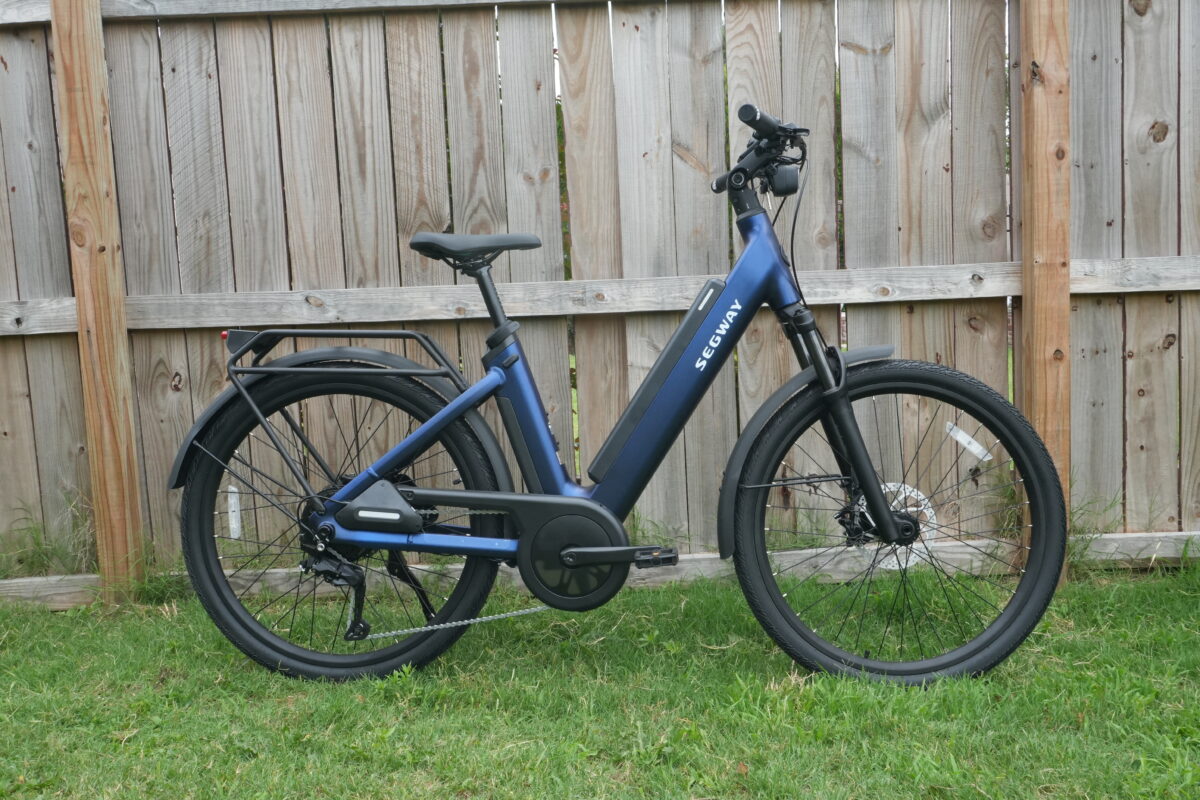
From self-balancing two wheelers, to kick scooters, Segway has dominated a large portion of the micromobility space for decades. The Segway Myon is the company’s take on the future of the daily commute, built from the ground up by their massive engineering team. It comes equipped with in-house tech, a connected security suite, and a spec list that promises an impressive package for any ebike, let alone one coming in at just $1,799. No doubt they have a big bag of tricks from years of experience, but does this all translate to a better ride?
To answer that, this article dives deep into the features that set it apart, details our findings from our test rides, and what you can expect from riding to ownership. You’ll also find a comparison to a close competitor and the pros and cons below to help you decide if the Segway Myon is the right fit for you.
If our review helps you decide on the Segway Myon, you can support our work for free by purchasing through our affiliate link. It really does make a difference, and we appreciate the support.
Segway Myon YouTube Review | See It In Action
Our full video review shows the details an article cannot, from an up-close look at every component to how the Myon fits riders of different heights. You will see the display and controls in action, a complete walk through the Segway app and its connected security features, and our first-person riding footage from the throttle tests, the pedal assist levels, and the hill climb. Hit play above to see the Myon in action.
Standout Features | Segway Myon
An In-House Motor With Adaptive Power
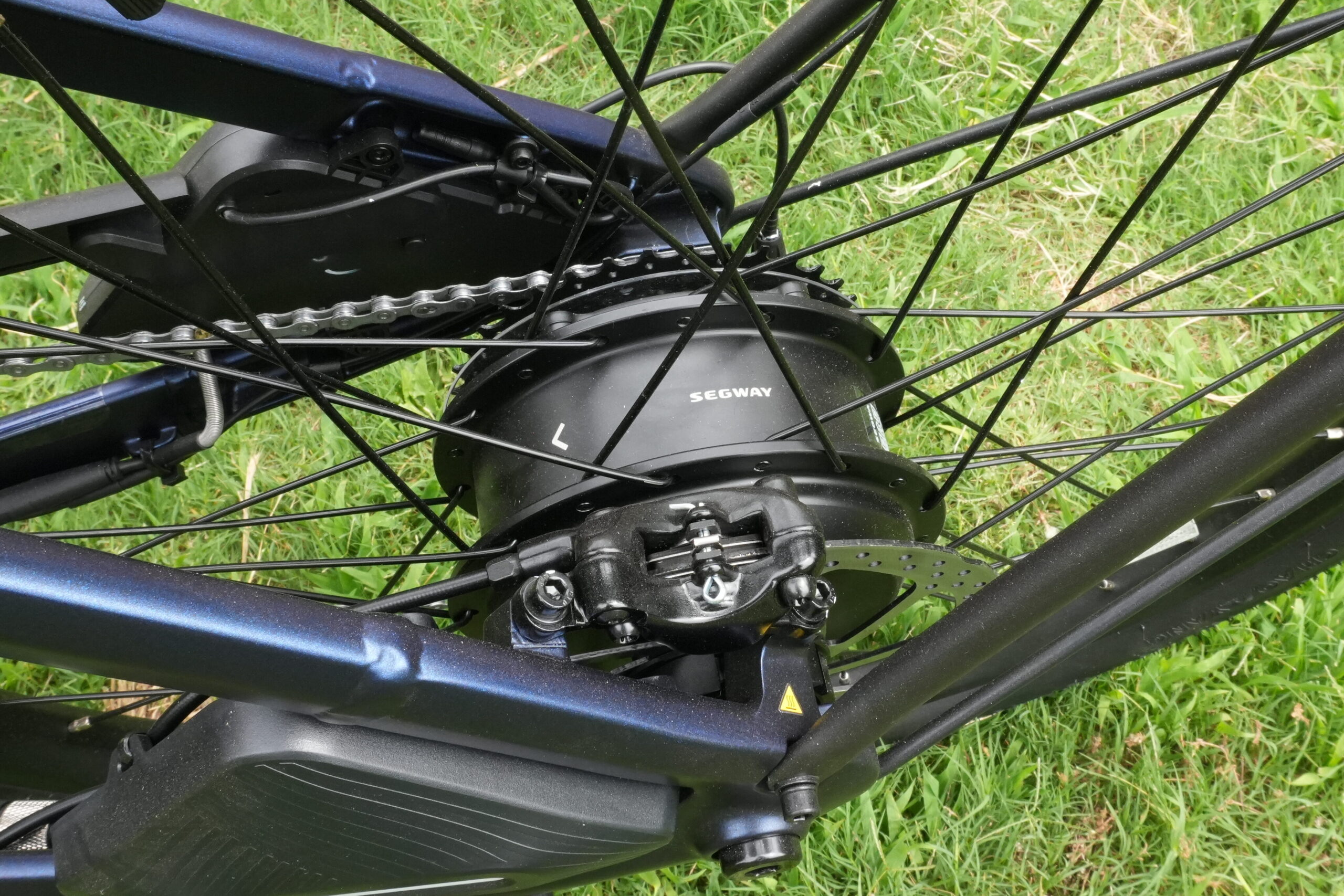
Segway developed the Myon’s rear hub motor in house, and it is built around a 1,500W peak output with up to 85 Nm of torque, which is plenty of muscle for a commuter. What makes it interesting is less the raw number and more how the bike uses it. A gyroscopic sensor reads the grade of whatever you are riding, and with adaptive power switched on, the motor dials things back to a more efficient output of around 500 watts on flat ground, then calls up its full strength the moment the road tilts uphill. The display even shows the exact grade you are climbing in real time. The goal is to spend the energy budget where it matters rather than run flat out all the time.
Electronic and Automatic Shifting
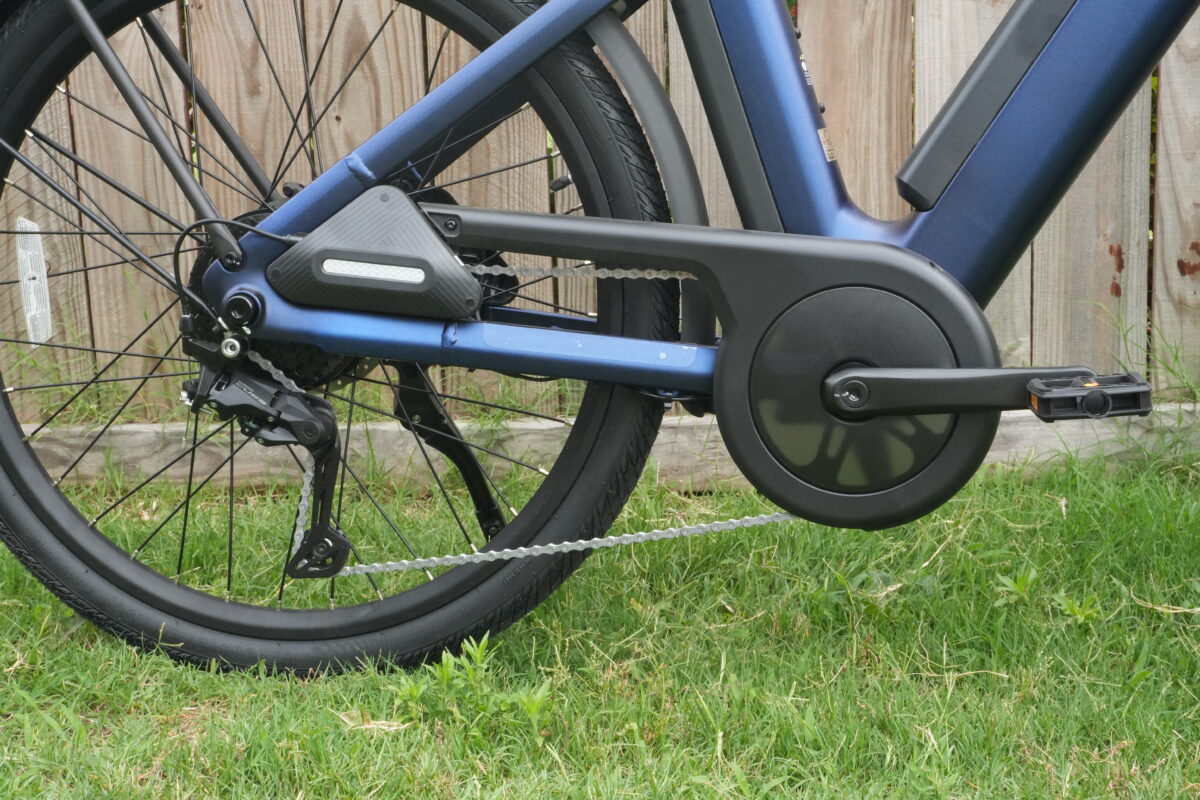
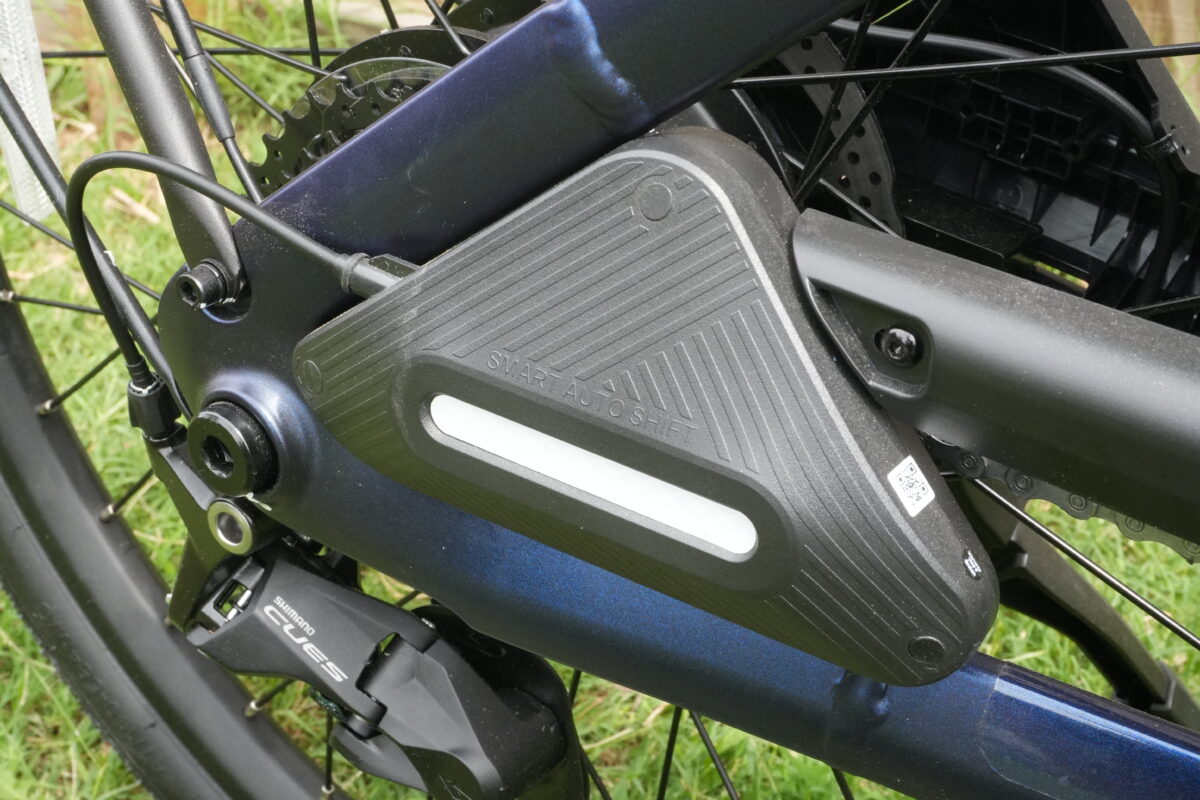
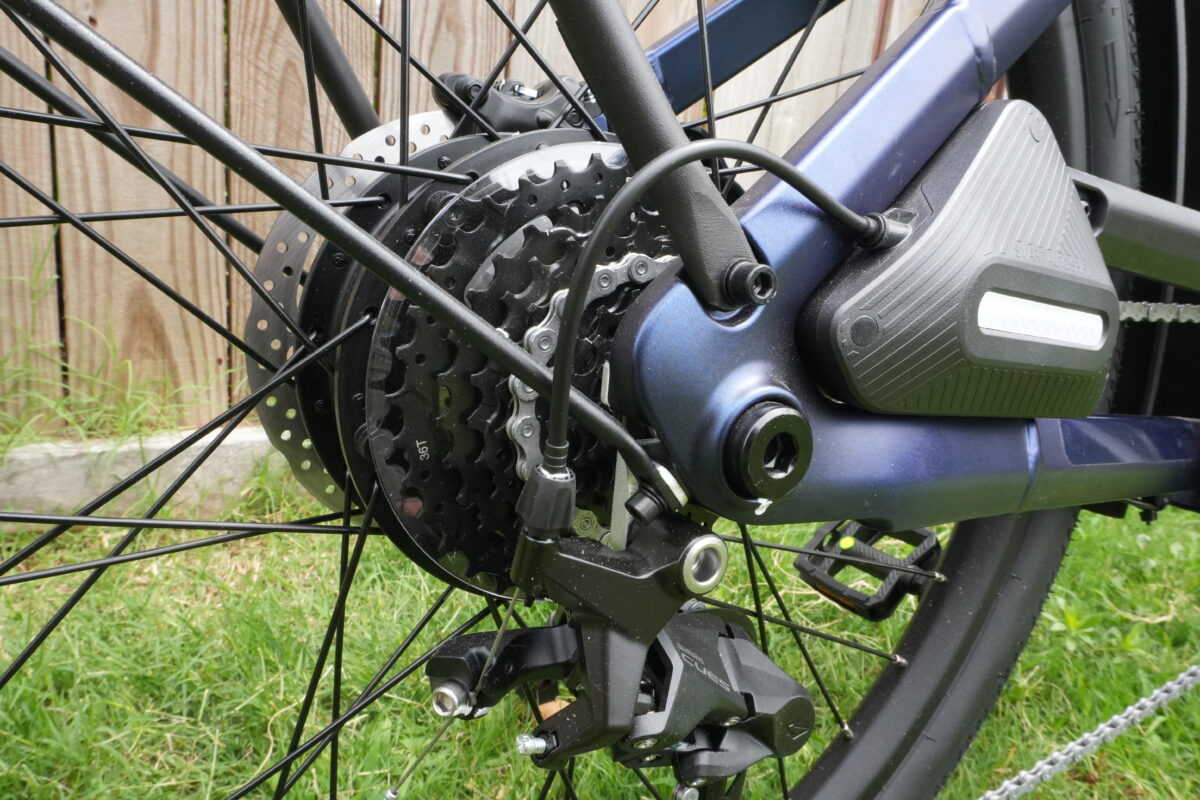
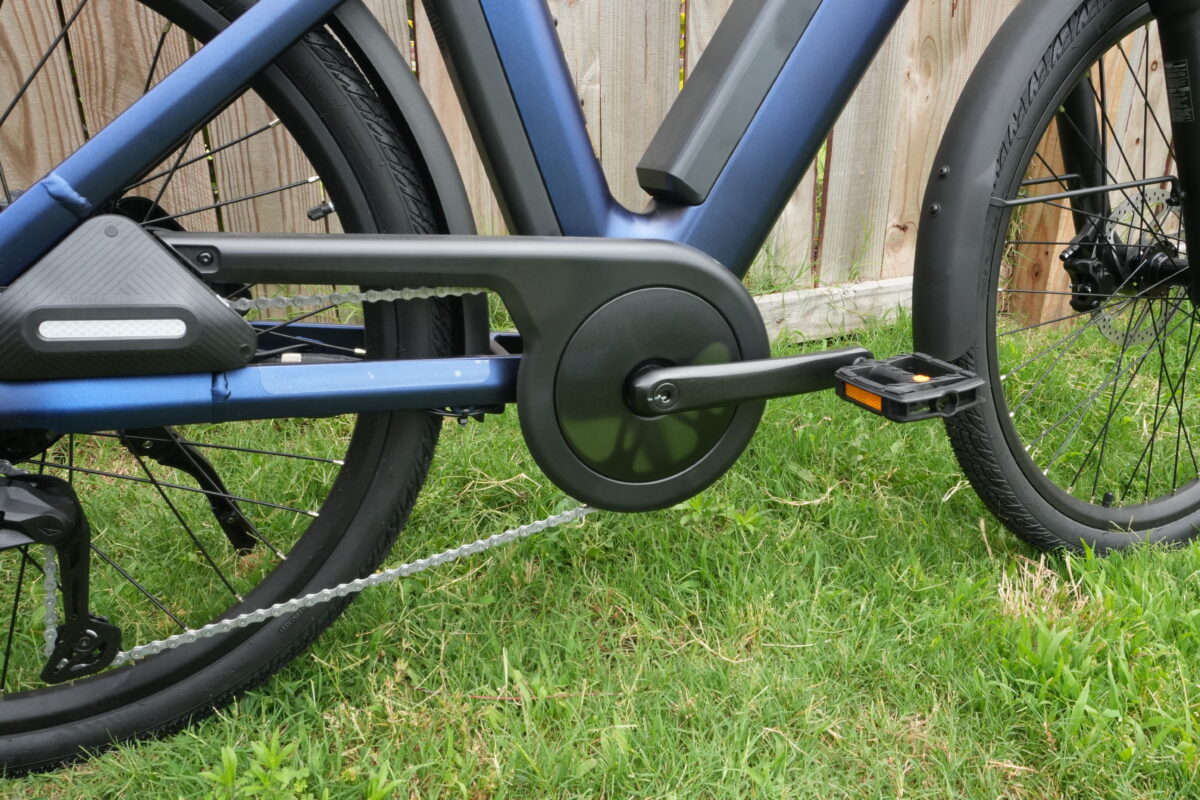
Gears are where the Myon quietly steps ahead of most commuters in its range. It runs electronic shifting built around a nine-speed Shimano CUES drivetrain, with an 11 to 39 tooth cassette and a 46-tooth chainring hidden behind a full chain guard. You change gears with a simple up and down toggle, and the bike holds a requested shift until you are actually pedaling. The bigger news arrived after launch thanks to an over-the-air update that added automatic shifting. Switching between manual and automatic takes nothing more than pushing in on the shifter toggle, and once automatic is running, that same toggle sets your preferred pedaling cadence rather than your gear. The one tradeoff is that you cannot manually override automatic mode while it is active, though flipping back to manual is a single tap away.
Connected Security
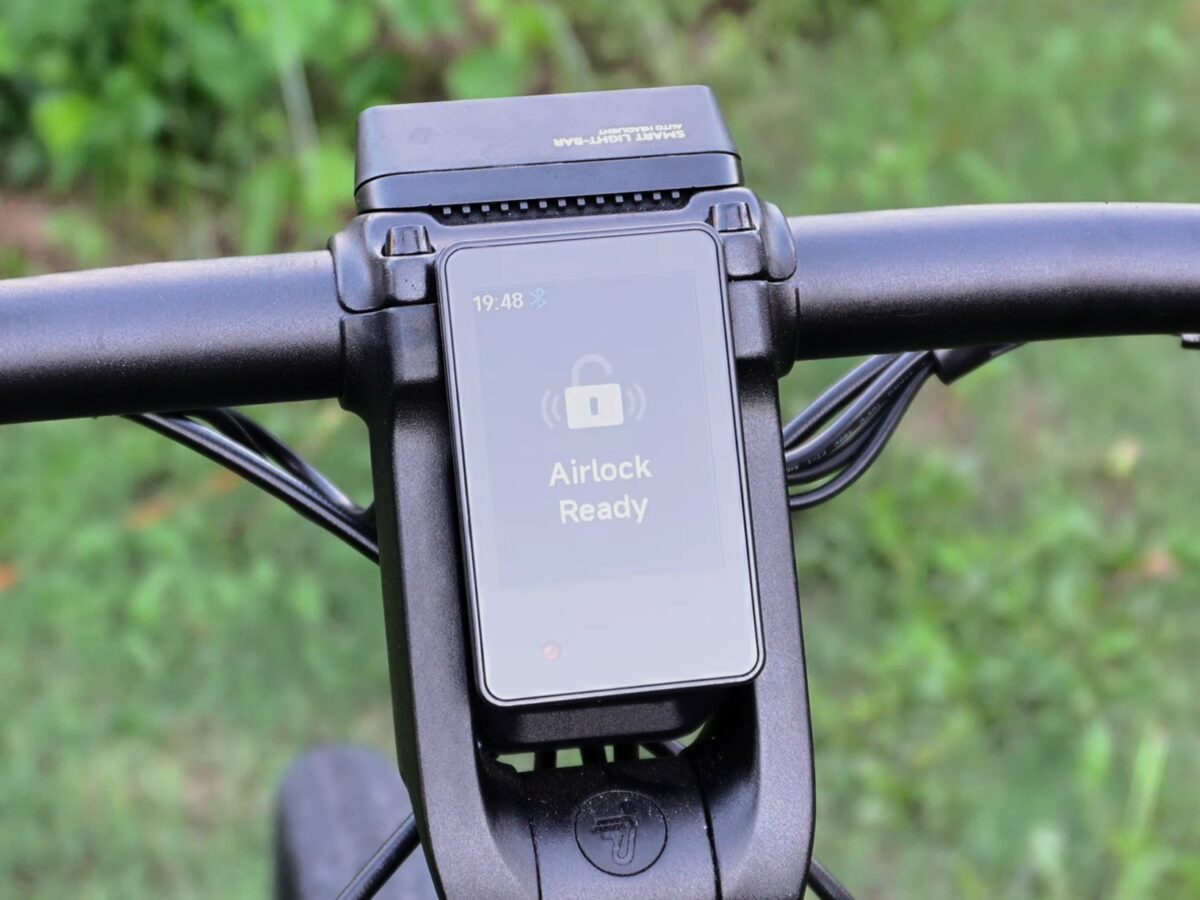
Security is where Segway leans hardest on its scooter background, and it helps to know which pieces are included and which carry an ongoing cost. The good news is that the core of the Myon’s security does not depend on a subscription at all.
- Airlock proximity unlock: Using your phone’s Bluetooth, the bike unlocks as you come within a meter or two and locks again when you power down and walk away, so there is no NFC card to carry or passcode to remember. You can still set a passcode as a backup if you prefer.
- Rear hub lock and alarm: The rear hub automatically locks with Airlock, on shutdown, or manually through the app, while a loud alarm and phone notifications greet anyone who tries to move it. It will not stop someone from lifting the whole bike, so a chain lock is still smart for long stays, but it keeps thieves from simply riding off.
- Apple Find My: Location tracking that works within the Apple ecosystem at no cost.
- Over-the-air updates: Firmware improvements, which could include big new features like the automatic shifting added after launch, arrive through the app.
The cloud-connected extras are the only part that eventually costs money.
- IoT subscription, about $20 per year: Segway includes the first year free, then charges roughly $20 annually, close to two dollars a month. It covers live GPS tracking, remote locking, alerts for unexpected movement, and remote battery monitoring and full-charge notifications.
That pricing sits right in line with the market standard, and because Airlock, the alarm, and Apple Find My all work without it, you are not forced into the subscription just to keep the bike secure.
Controls, Display, and the Segway App
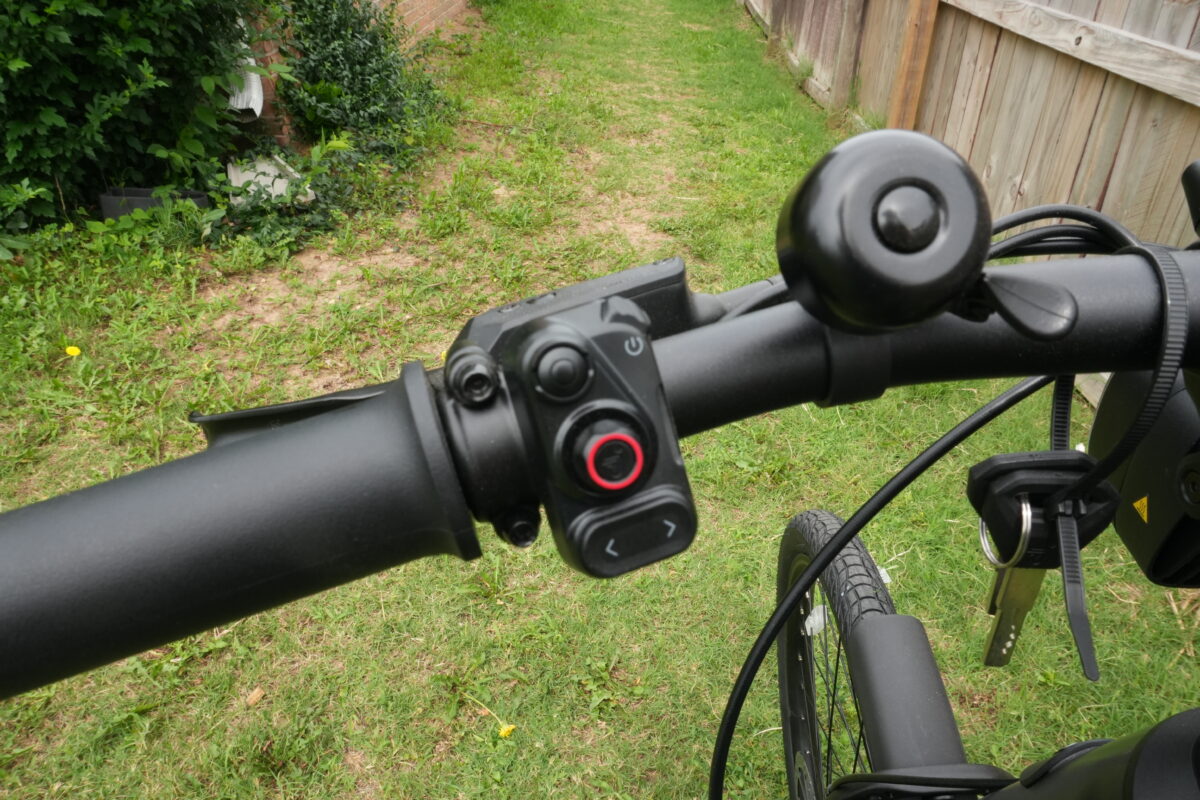
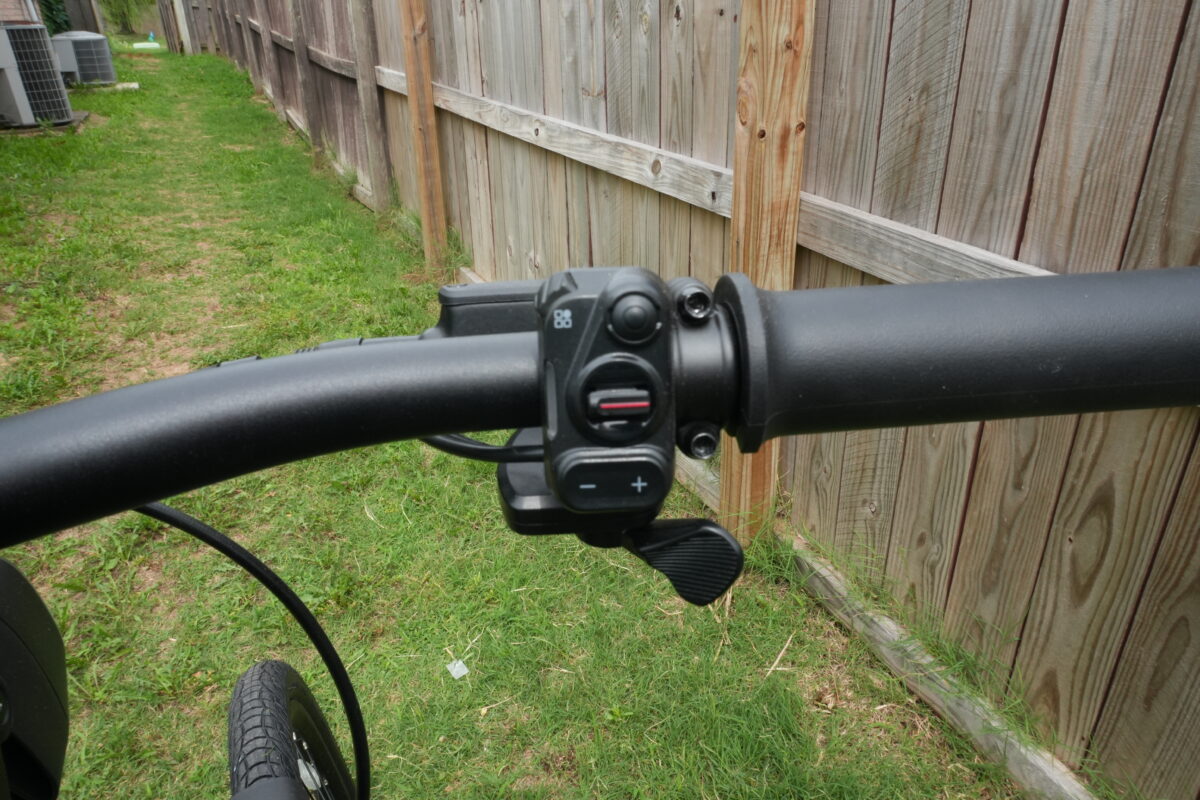
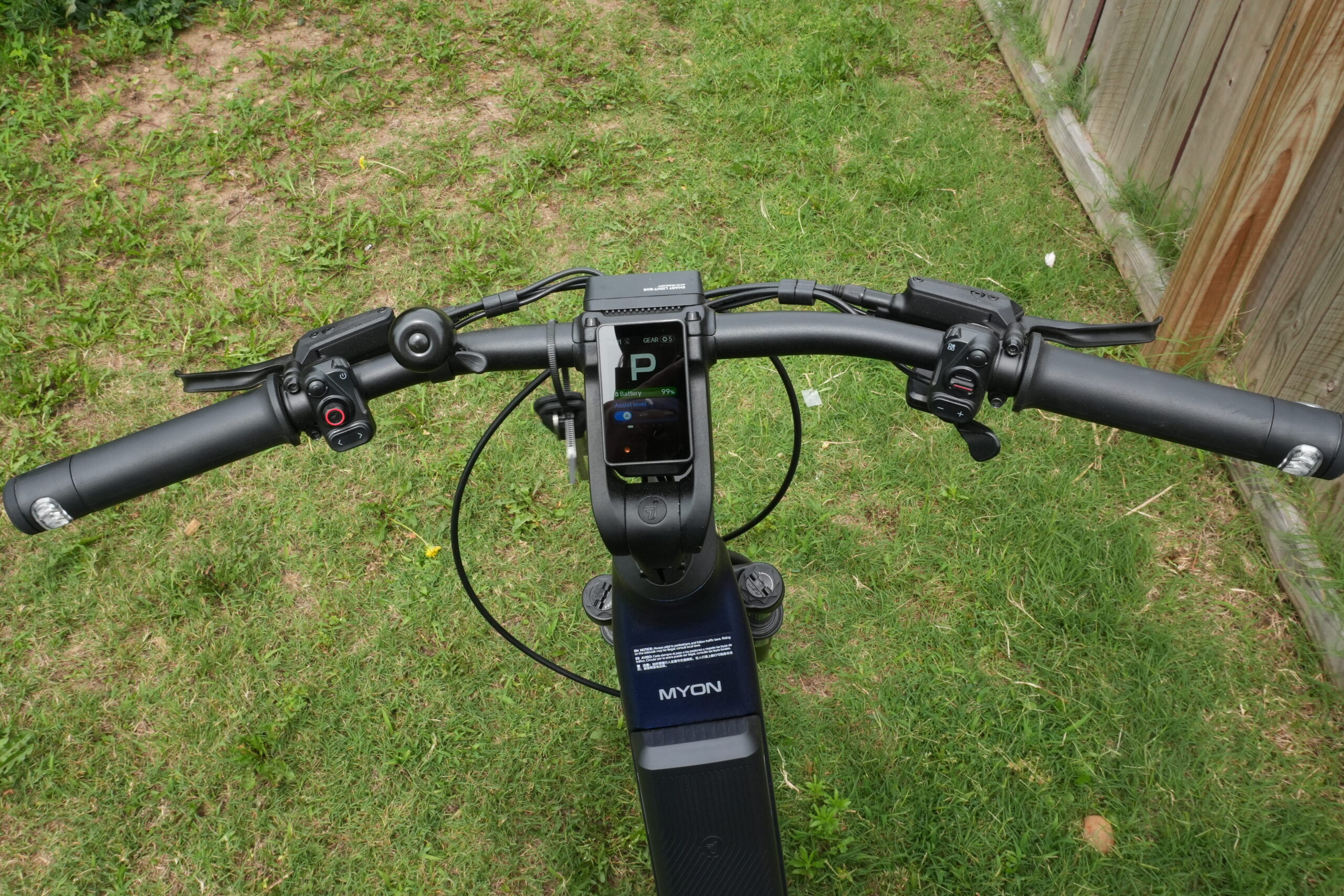
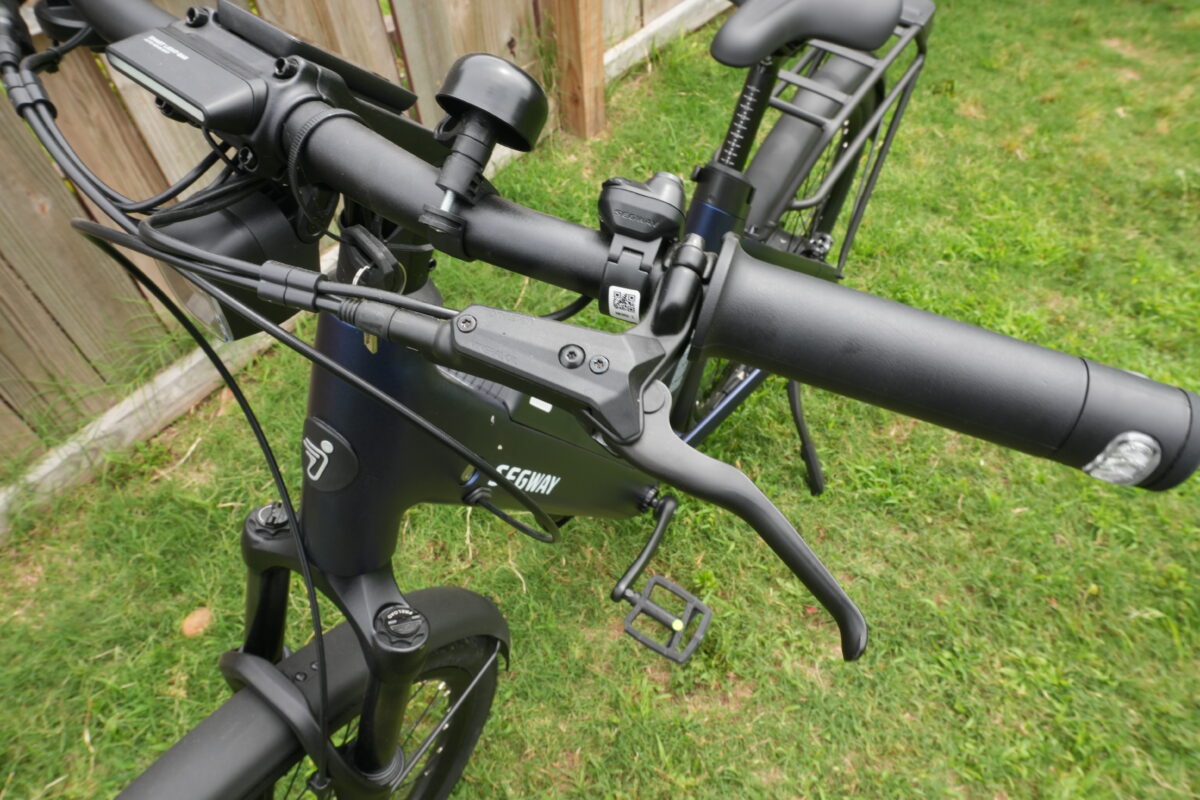
The cockpit is busy in the way a tech-forward bike tends to be, and it stays well organized once you learn it. A full-color display sits front and center with scrollable pages covering everything from trip data, turn-by-turn directions, music control from your phone, and a settings page. On the right pad, plus and minus buttons cycle pedal assist levels and an up and down toggle controls the electronic and automatic shifting. The left pad holds the turn signal buttons and a game-style joystick to navigate the display. Both control pads carry small lights that flash when the optional rearview radar spots a vehicle coming up on that side.
Managing this much technology puts the Segway app somewhere between helpful and required. You can ride in a limited trial mode without it, but the app is how you run firmware updates, enable adaptive power, tune pedal assist sensitivity, and reach the connected security features. You will want to bind both the bike and the battery, since pairing the battery is what surfaces real-time charge status, charging notifications, battery temperature, and charge-cycle history on your phone. The app is deep, and it can feel like a maze at first. With a little time the features you actually care about become easy to reach.
A Commuter-Ready Package
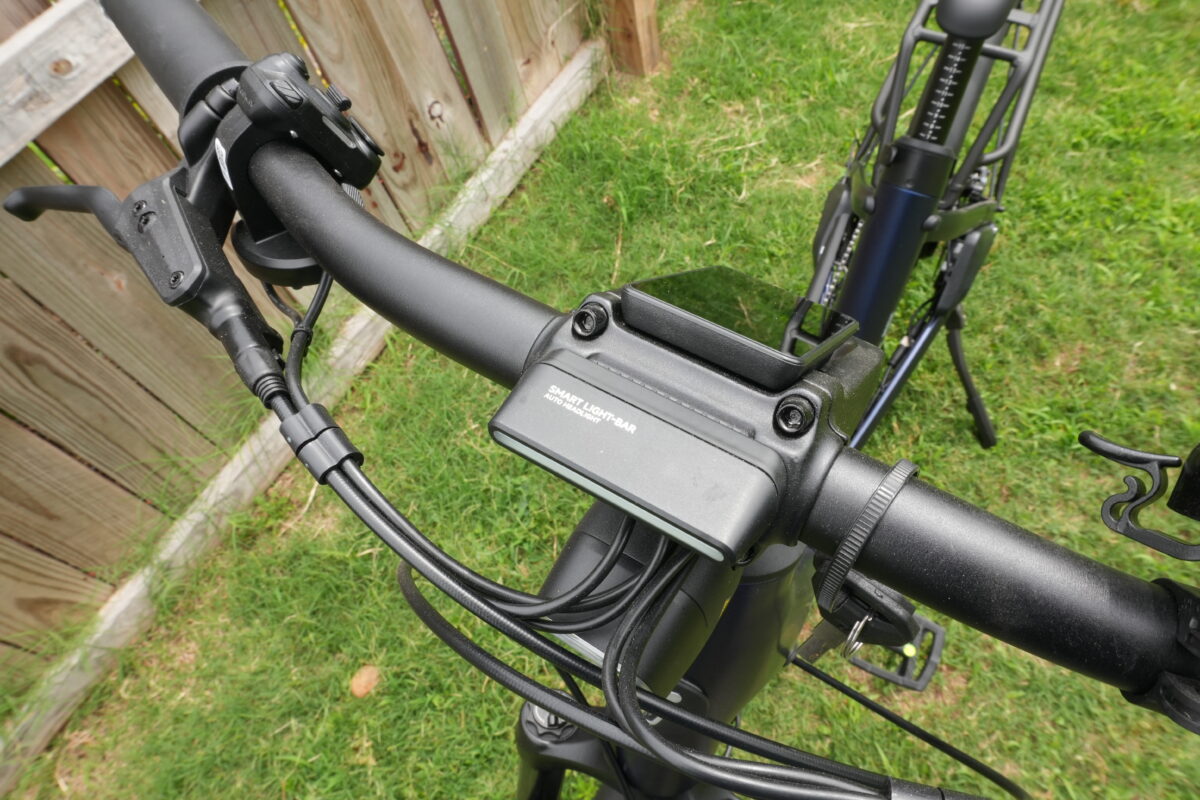
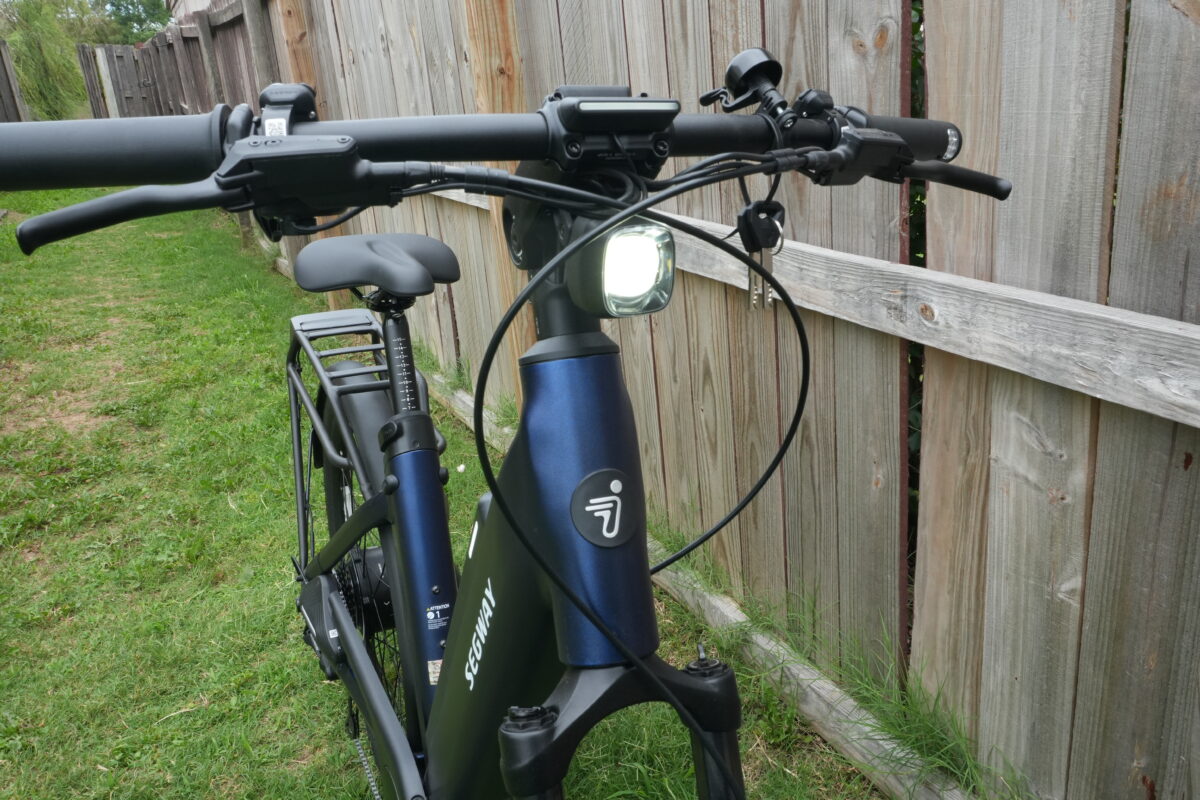
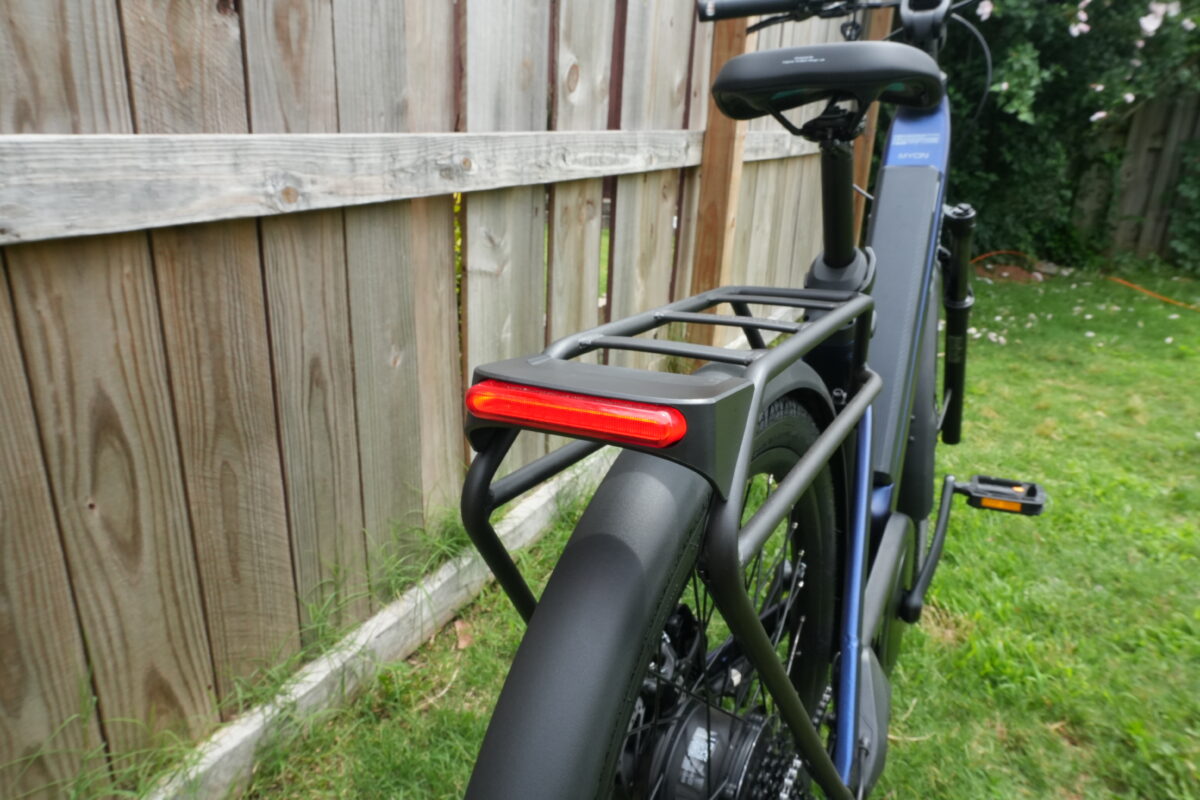
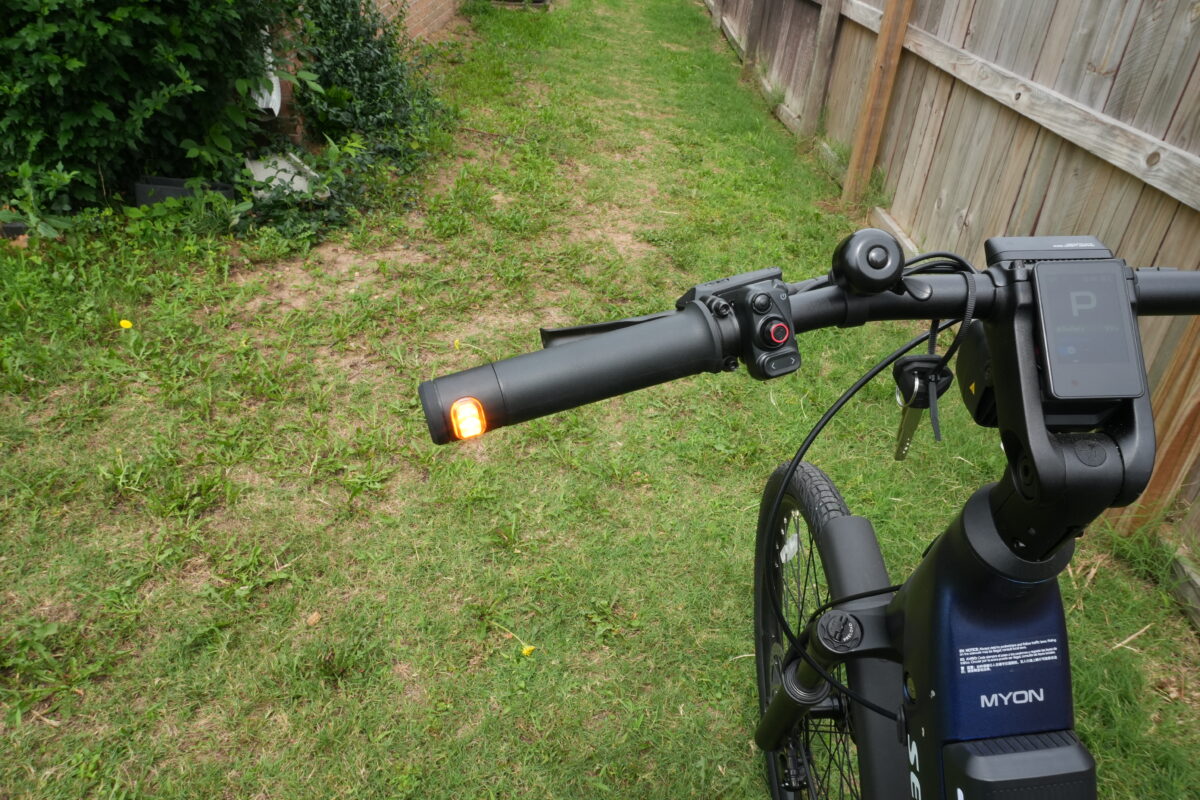
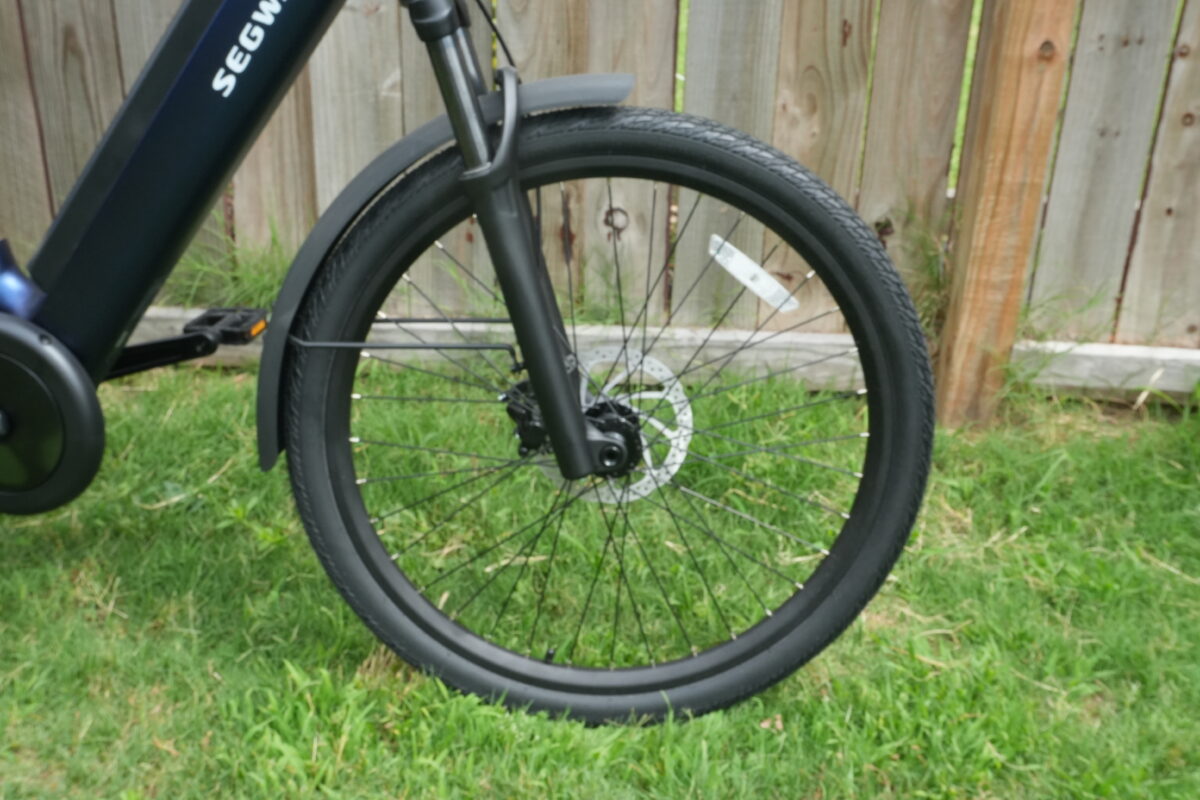
Segway sends the Myon out ready to commute. A smart light bar up top drives automatic lighting that adapts to conditions. A bright headlight sits below the handlebars and the rack-integrated taillight brightens the moment you pull the brake levers. Turn signals live in the ends of the grips, complete with a beeping reminder that you can turn off if you prefer and an automatic shutoff after about ten seconds. Plastic fenders front and rear, a 55 lb capacity rear rack, and IPX5-rated electronics and IPX7-rated battery round out the package.
Frame, Sizing, and Colors
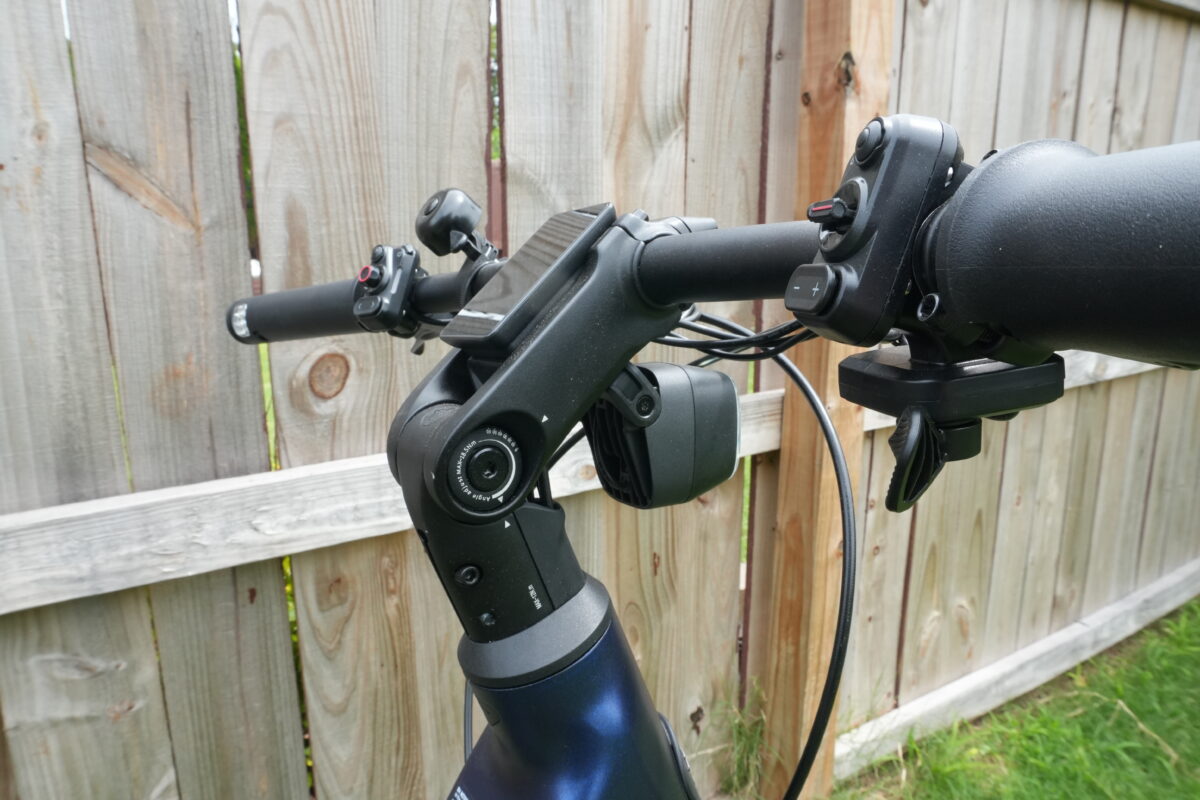
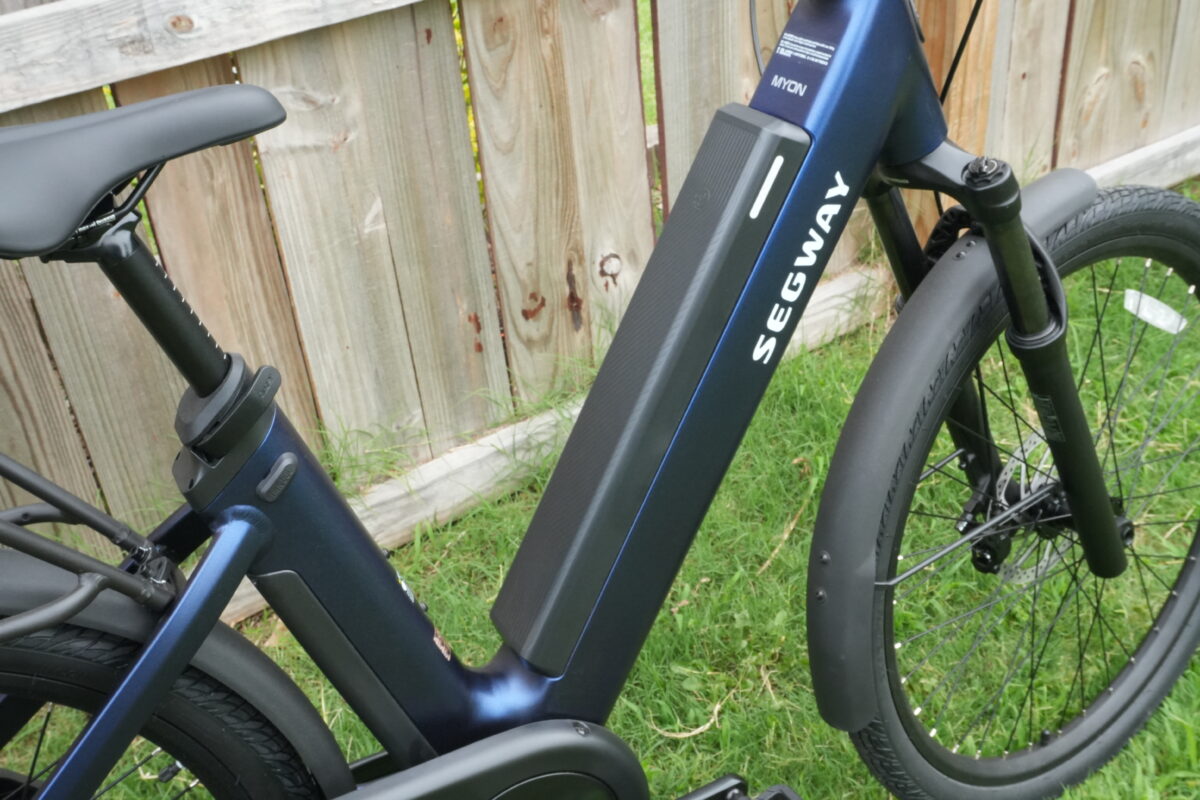
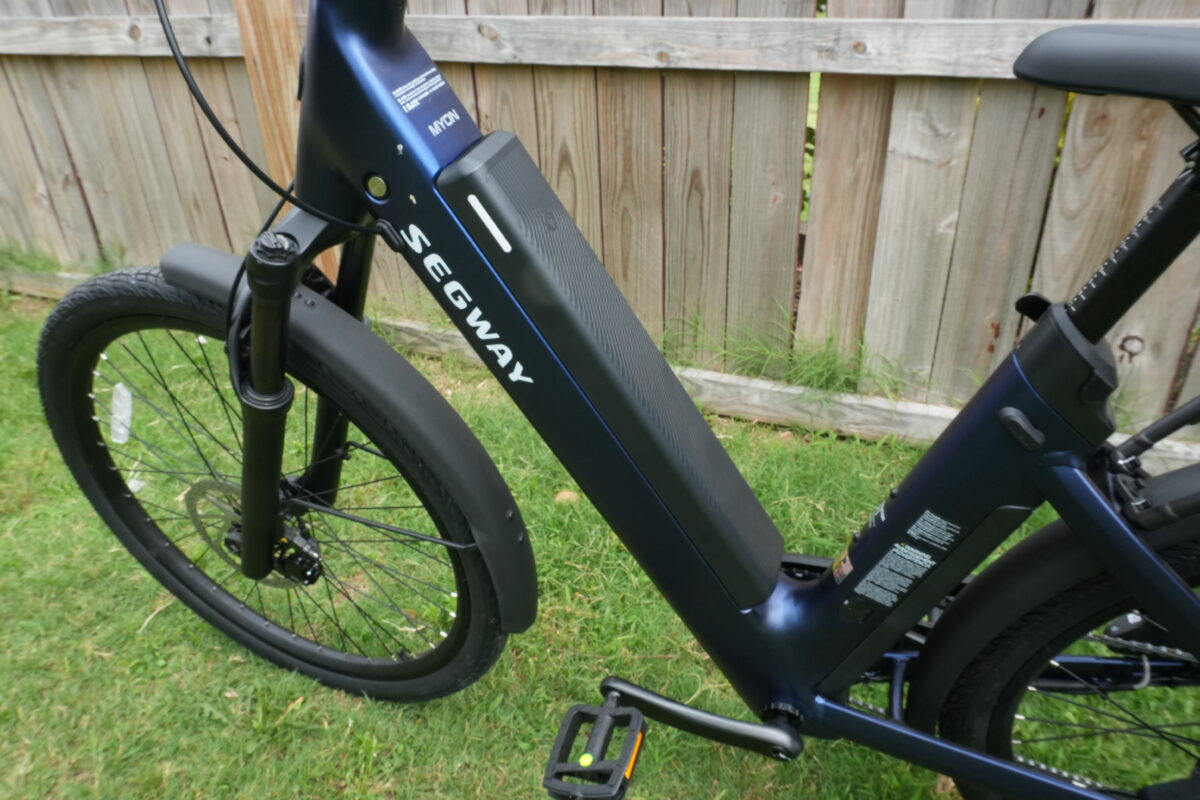
Segway offers the Myon in a single step-thru layout that comes in two frame sizes, which keeps it approachable across a wide range of riders. Standover height is a low 17 inches, so swinging a leg over is easy, and Segway rates the fit for riders from 5′ 3″ up to 6′ 2″. At 6′ 1″ with a 33-inch inseam, our tester reached full leg extension without trouble, and our 5′ 5″ tester settled into a comfortable position as well. The advertised weight is 72.5 pounds, on the heavier side but not unusual for a commuter carrying this much hardware. Total payload capacity is 300 pounds, with a maximum rider weight of 264 pounds. The regular frame is offered in Shoe Suede Blue, shown here, Gree, or Skyscraper Silver, while the smaller frame is offered as Green alongside the same blue.
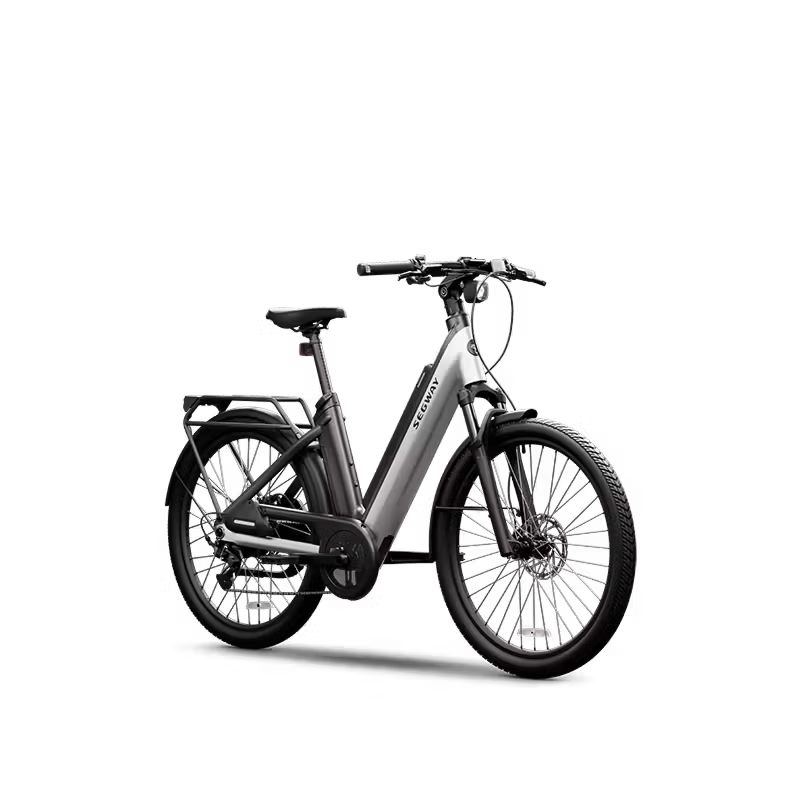
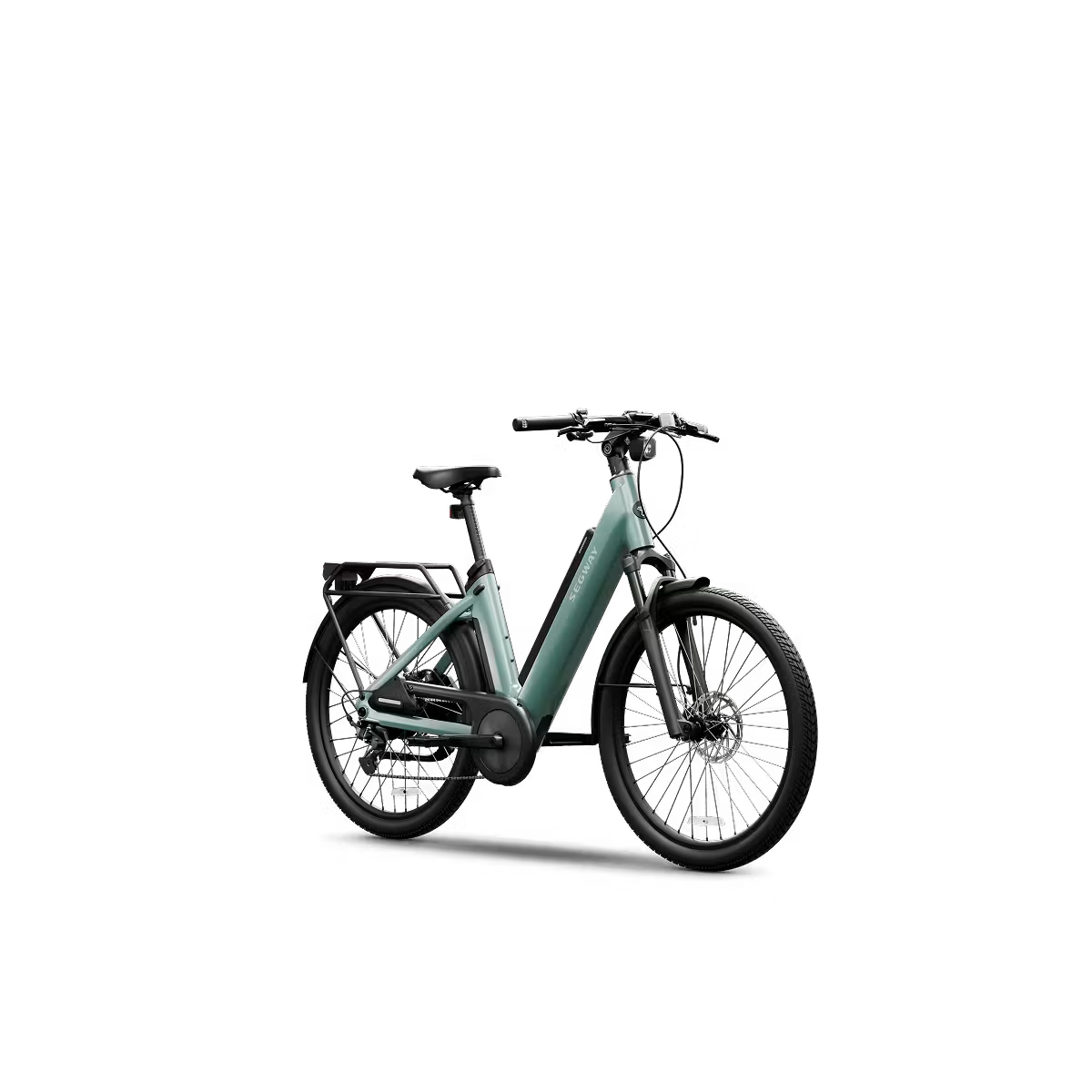
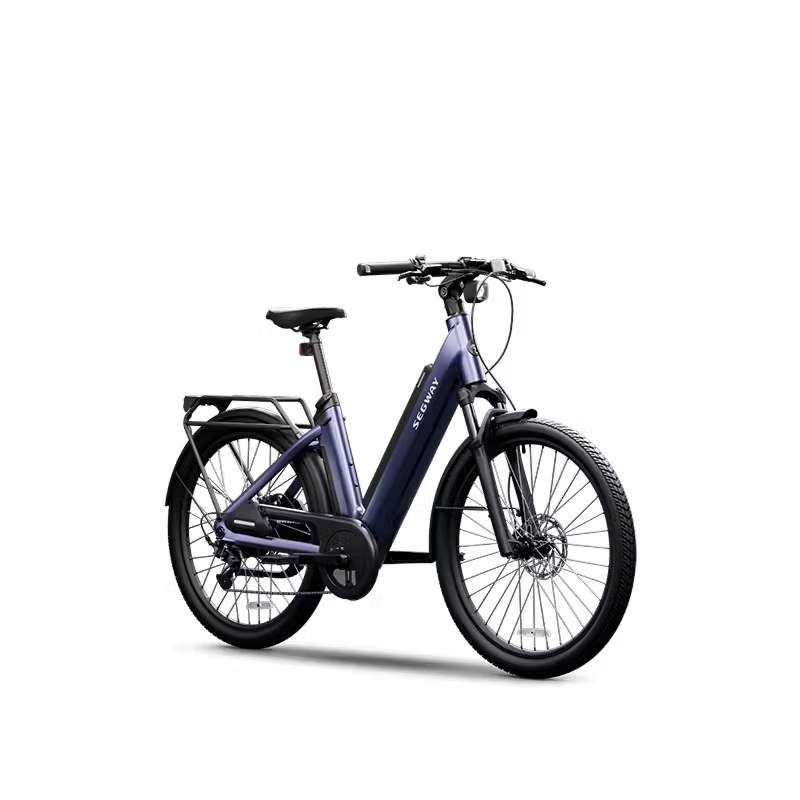
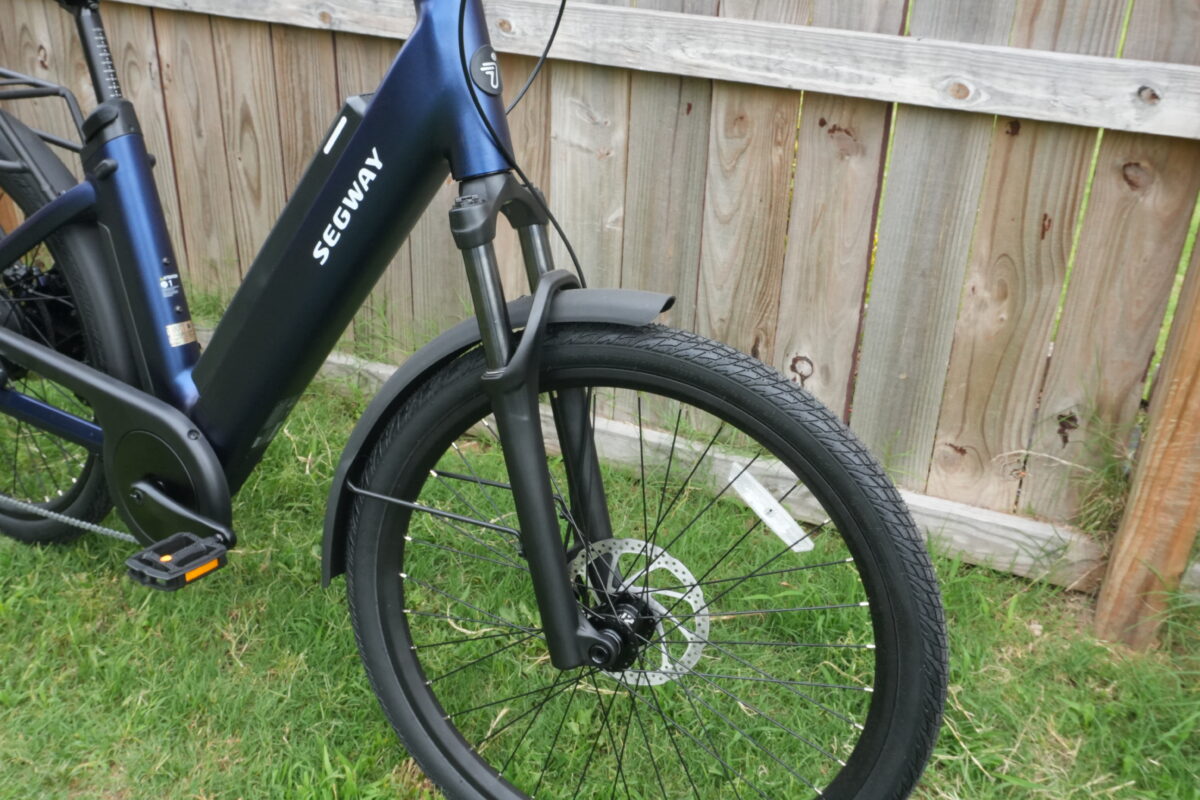
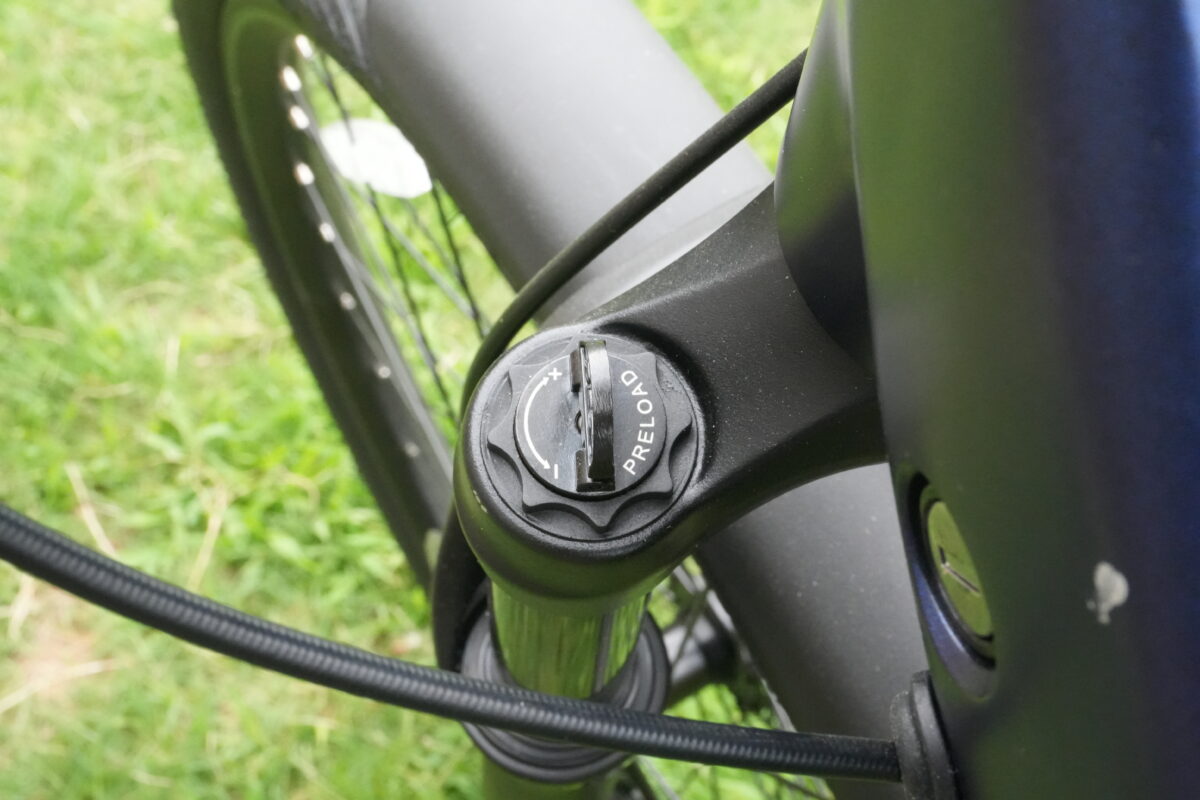
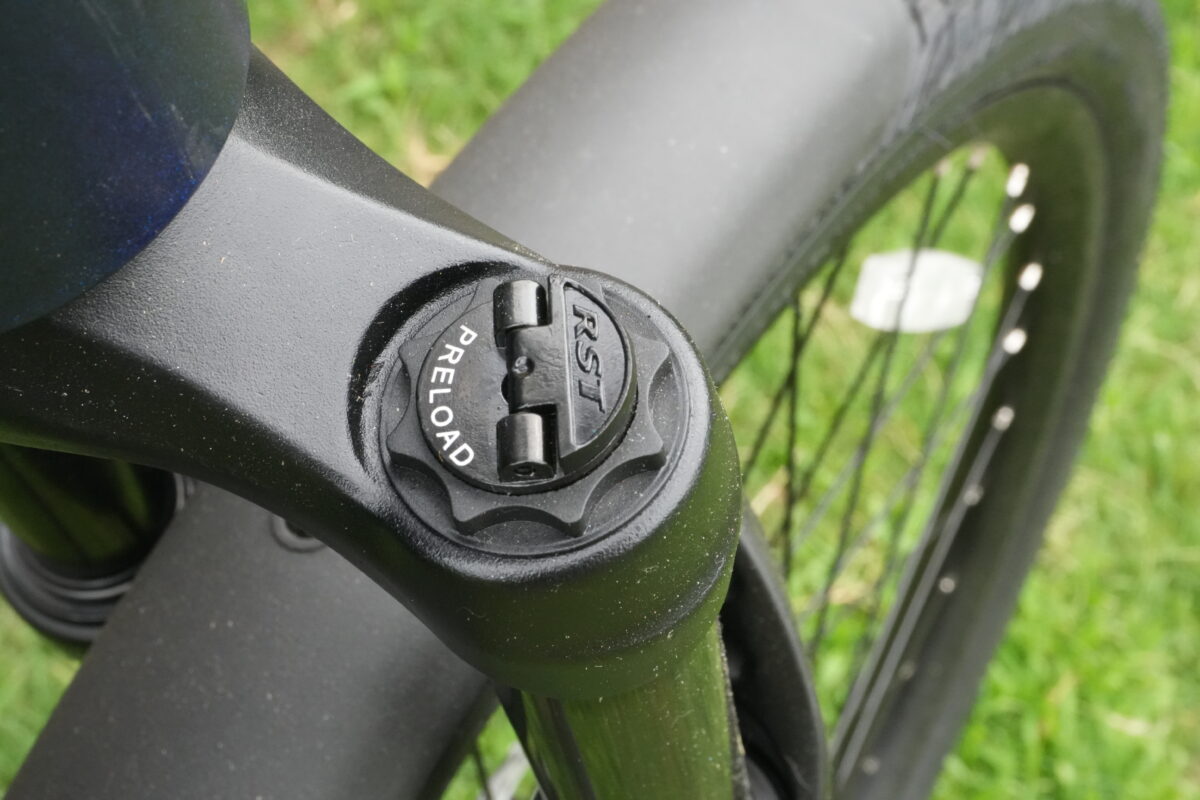
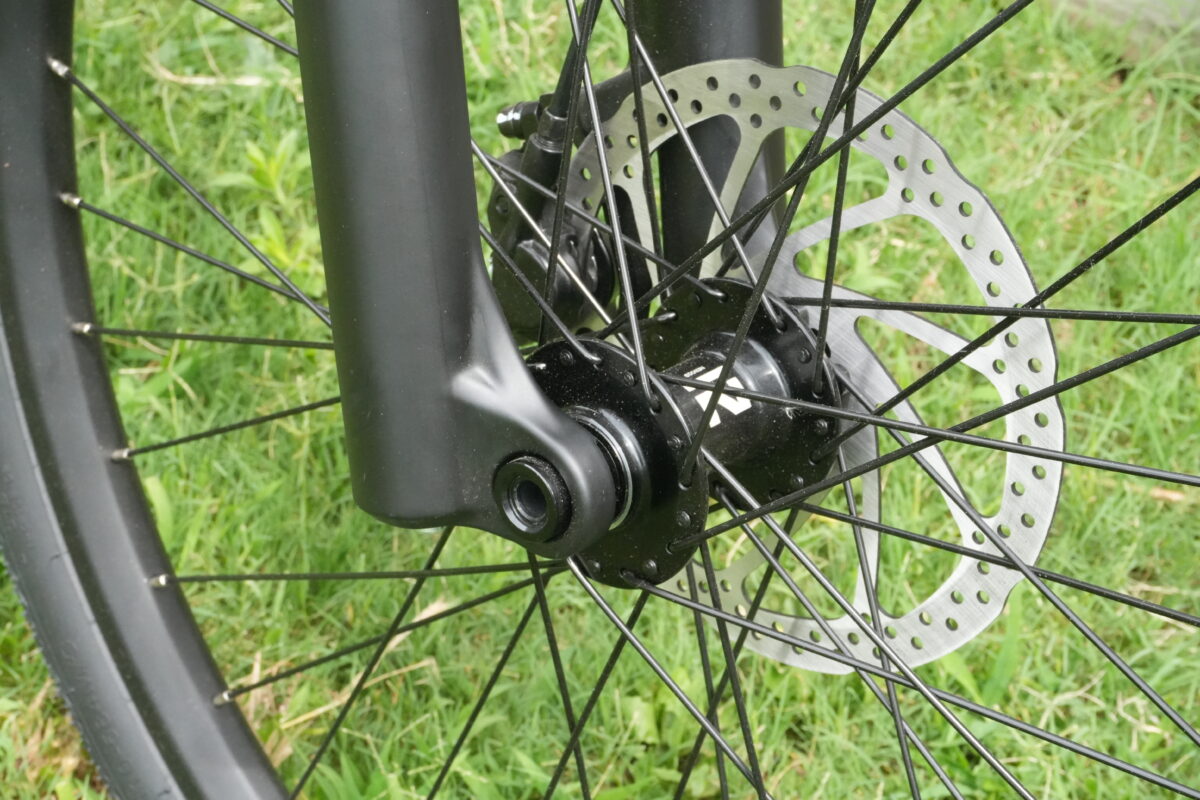
Up front, an RST suspension fork provides 80mm of travel with preload adjustment on both the left and right legs, and the front wheel mounts with a through axle for a bit more stiffness. The cockpit dials in through a stem with 60 degrees of adjustment paired with gently swept-back handlebars and rubber grips, and Segway includes a bell. Out back, the rack carries up to 55 pounds and offers two mounting points on the seat tube, which is also where the optional rearview radar attaches beneath the rack.
Segway Myon Specs
Here is the full component loadout, from the drivetrain to the safety certifications, laid out in the table below.
| Price | $1,999 (launch price) |
| Type | Commuter Ebike |
| Class | 1 / 2 / 3 / Hybrid |
| Weight | 72.5 lbs |
| Weight Capacity | 300 lbs (264 lb max rider) |
| Top Speed | 28 mph pedal assist, 20 mph throttle |
| Motor | In-house adaptive rear hub, 1,500W peak |
| Torque | 85 Nm |
| Sensors | Torque, cadence, and gyroscopic |
| Adaptive Power | Around 500W on flats, full 1,500W peak on climbs |
| Battery | 48V 15.4Ah (722 Wh) |
| Claimed Range | Up to 80 miles |
| Charger | 3.9A, about 3 to 4 hour full charge |
| Display | Full-color, four pages, auto-brightness |
| Throttle | Right-hand thumb (max 20 mph) |
| Shifting | Electronic 9-speed, manual or automatic |
| Derailleur | Shimano CUES |
| Chainring | 46T |
| Cassette | 11-39T |
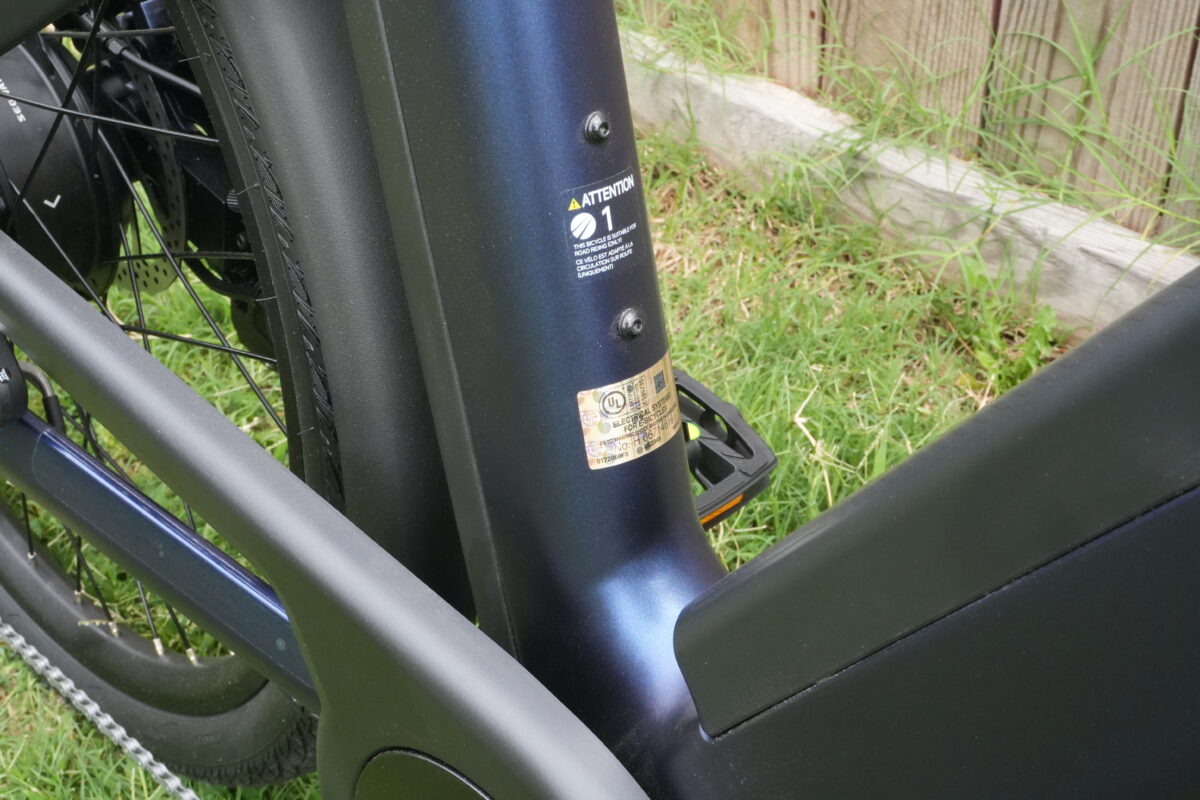
| UL Certifications | Certified to UL 2271 (battery) and UL 2849 (electronics) |
| Water/Dust Resistance | IPX5 (bike), IPX7 (battery) |
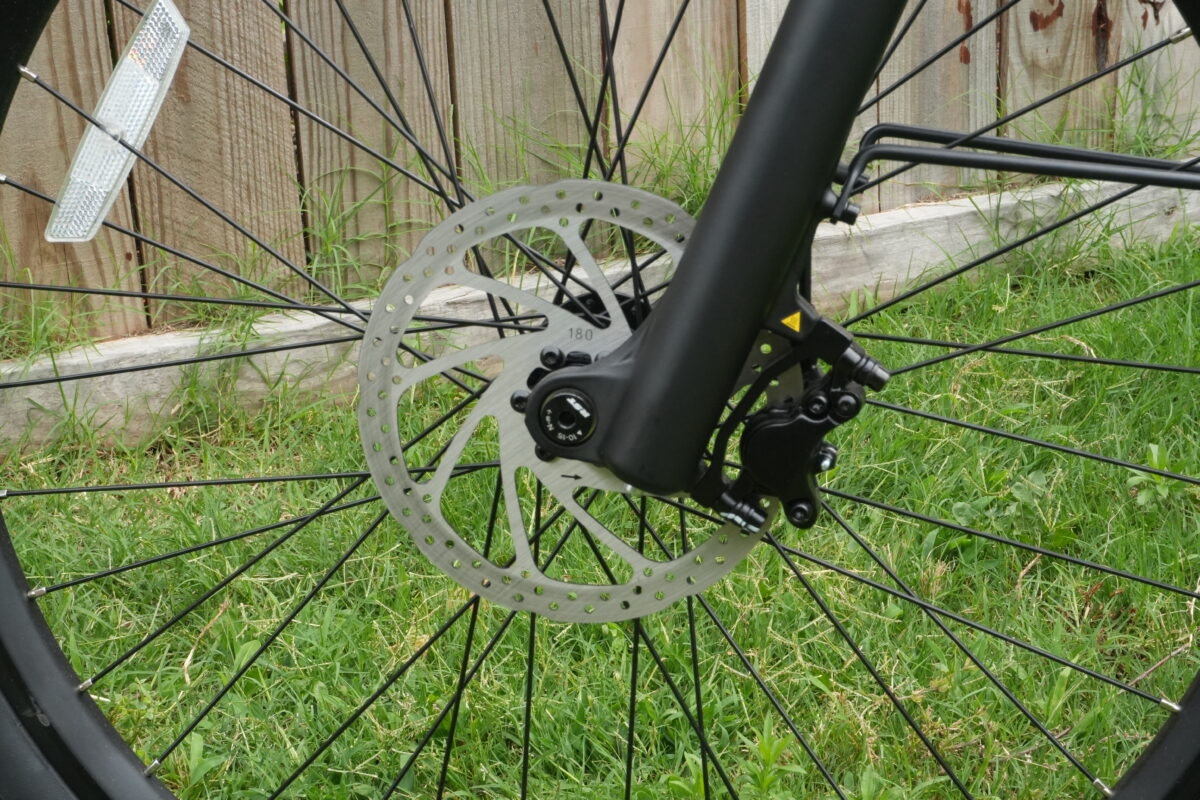
| Brakes | 2-piston hydraulic disc |
| Rotors | 180mm front and rear |
| Frame | Step-thru aluminum, two sizes |
| Fork | RST, 80mm travel, dual preload adjust |
| Axle | Front through axle |
| Tires | 27.5 x 1.95 in Chaoyang, street tread |
| Handlebars | Swept-back |
| Stem | Adjustable, 60 degrees |
| Grips | Rubber |
| Saddle | Segway |
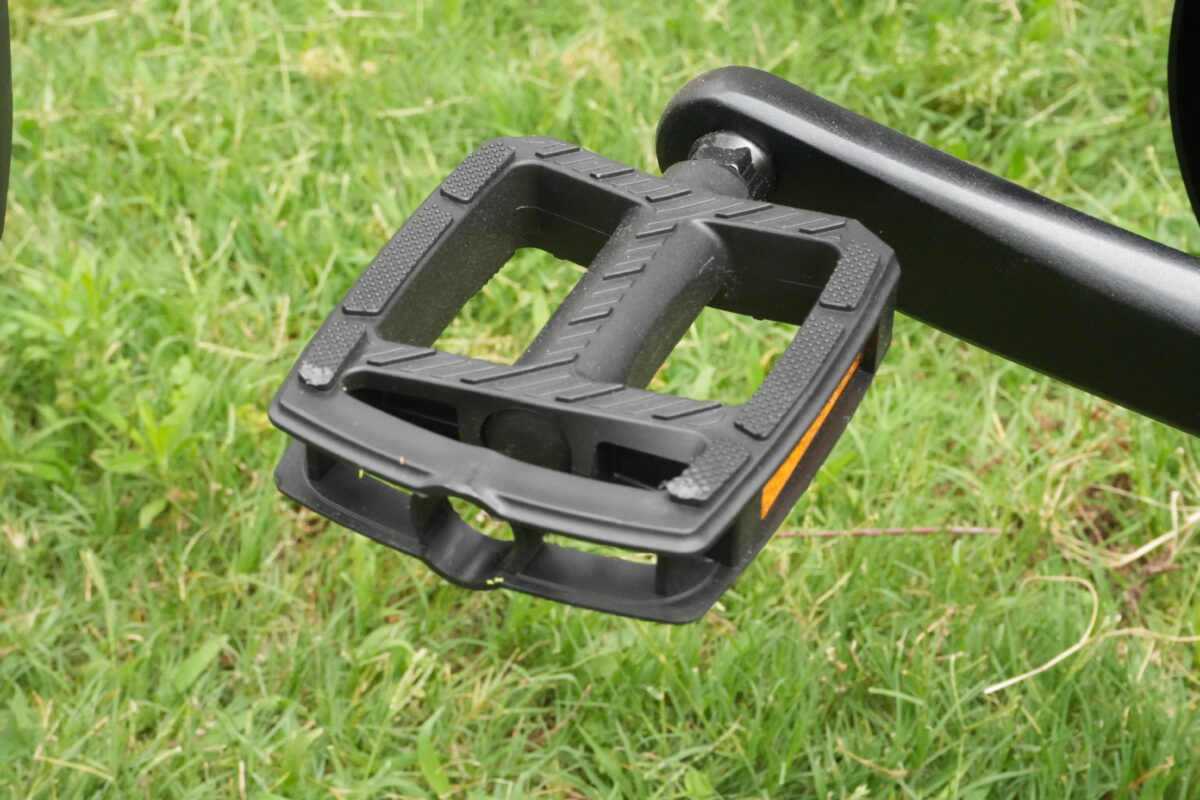
| Pedals | Plastic platform |
| Fenders | Included, front and rear |
| Rear Rack | Included, 55 lb capacity |
| Kickstand | Rear-mounted |
| Turn Signals | Integrated, grip ends |
| Security | Airlock, rear hub lock, alarm, Apple Find My, optional GPS |
Real-World Performance Testing | Segway Myon
For our testing, our 200-pound test rider set out on a day pushing 90 degrees, with the bike set to hybrid class, meaning the throttle caps at 20 mph and the pedal assist at 28 mph. We ran throttle pulls, worked through every pedal assist level, and took it up our standard hill climb twice.
Throttle-Only Acceleration
On flat ground with throttle alone, the Myon rolled away gently before the power curve steepened, settling in and holding between 19 and 20 mph, which is the legal throttle cap. Power delivery stayed smooth and steady, and the motor ran virtually transparent, quiet enough that we could barely hear it even when pulling peak power.
Pedal Assist at Every Level
Although the Myon blends torque, cadence, and gyroscopic inputs, the pedaling experience feels much like a good torque sensor: the harder you press into the pedals, the more the motor gives back. There are six assist levels, and here is roughly how each felt in our hybrid setting, using observed speeds rather than wattage.
- Level 1: Easy to hold around 10 mph at a relaxed spin, yet push harder and shift up and you can carry it past 20.
- Level 2: Settles comfortably north of 15 mph, and with real effort it will run close to the 28 mph ceiling.
- Level 3: The middle setting pulls you right up to 20 mph on its own, up to 28 mph with a moderate push.
- Levels 4 and 5: Strong, fast cruising levels where holding a quick pace asks very little of your legs.
- Level 6: The top setting held a steady 28 mph on the dot, almost feeling like a cadence sensor. It offers consistent power while keeping you connected with the pedals, and at max power, the motor was still remarkably quiet.
Hill Climb Test
Our standard climb has pitches that run steeper than the 12 percent grade Segway lists for the Myon, with the display showing stretches into the mid and upper teens and one reading near 19 percent. On throttle alone, the Myon kept climbing and never quit, dipping to about 7 mph at its lowest and holding near 8 mph up the steepest sections. It did, however, flash a high-temperature warning asking us to reduce intensive usage, and the motor kept pulling even as it warned. Pedaling up the same hill went a little better, with clean, even steps in power as we moved through the assist levels, but the high-temperature warning still appeared before the top.
A few things are worth putting in context. It was a hot day, this was a repeat run up a hill that is noticeably more severe than what Segway advertises, and the Myon still carried us to the top every time with power to spare. Our read is that this bike may simply carry more sensors watching for heat than most, and being told to ease off before a controller overheats is not the worst trait to have. Even so, other bikes we have run up this same hill with comparable peak power have done it without the warning, so if you live somewhere defined by long, steep climbs, the Myon’s heat management is worth weighing. For flat ground and moderate hills, it has more than enough muscle.
Range and Charging
We covered roughly 8 miles of hard testing and finished with 77 percent battery remaining, which is about what you would expect when a battery is not being babied. Segway advertises up to 80 miles from the 722Wh pack, and while aggressive riding like ours lands well short of that, moderate assist on flatter ground will stretch it much further. When it is time to plug in, the 3.9-amp charger brings a full charge in about three to four hours, quicker than the five to seven hours that are common at this price.
Buying and Owning the Segway Myon
Segway sells the Myon a little differently than most of the direct brands we cover. Rather than shipping a half-built bike in a box to your door, Segway routes the Myon through a growing network of local dealers it began building out in 2025. You can buy from a shop directly or order online and have the bike sent to a participating shop of your choice, where it is professionally assembled and tuned before you pick it up, and a dealer locator on Segway’s site helps you find the nearest option. If doorstep delivery is offered in your area, it runs an extra $99, and the bike still arrives fully built. The upside is that you are not left assembling a heavy, tech-dense bike yourself, and you have a local shop for future service. The tradeoff is a little less of the ships-straight-to-your-door convenience that defines a lot of online brands.
On price, the Myon carried a $1,999 launch price and has recently been selling closer to $1,799, so it is worth checking the current number before you buy.
Segway Myon vs Aventon Level 4 REC
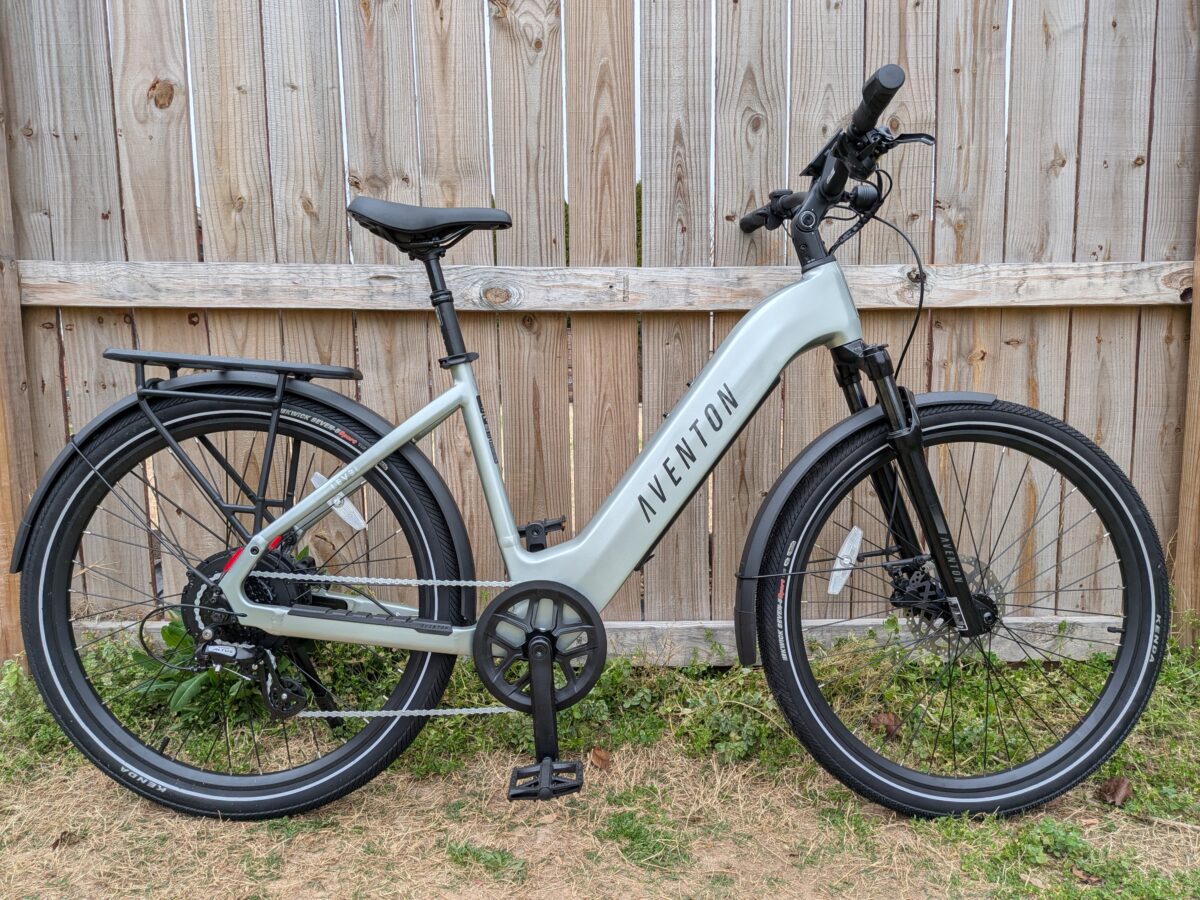
The closest rival to the Myon in spirit is the Aventon Level 4 REC, which sits just above it at $1,999 and chases the same tech-forward commuter buyer. The two overlap more than you might expect. Both carry batteries in the 720 watt-hour range, integrated turn signals, hydraulic disc brakes on 180mm rotors, 27.5-inch wheels, and a connected security suite that is free for a year and then runs about $20 annually. Where they part ways is philosophy.
Aventon leans on refinement and a proven track record. Now in its fourth generation, the Level 4 REC brings a 750W motor that peaks at 1,188 watts, or 1,440 watts and 96 Nm in a time-limited boost mode, along with regenerative braking that recovers a little range under braking and coasting. Its signature trick is Sensor Switch, which lets you choose between a torque and a cadence sensor, backed by Ride Tune settings that shape each mode. It also carries Aventon’s polished fit and finish, a lighter 68.5-pound curb weight, batteries that can be shared across newer Aventon models, and one of the largest dealer networks in the business at more than 1,800 shops.
The Myon answers with technology Aventon does not offer. Its shifting is fully electronic and can now shift automatically after a firmware update, where the Level 4 REC uses a traditional drivetrain. Its Airlock system unlocks the bike over Bluetooth as you walk up, with no card or code required, and its gyroscopic adaptive power reads the grade and reserves peak output for climbs. It also holds a higher 1,500-watt peak with no boost-mode cooldown, charges faster, and currently undercuts the Aventon on price. The catch is that Segway’s dealer network is newer and still filling in, and the Myon’s heat management on very steep hills is not quite as unflappable. Riders who want the most refined, proven package with the flexibility of dual sensors will lean Aventon, while those drawn to electronic shifting, novel security, and the lower price will find the Myon hard to ignore. For the full breakdown, read our complete Aventon Level 4 REC review.
Segway Myon Pros and Cons
Final Thoughts on the Segway Myon
Backed by years in micromobility and a deep engineering bench, Segway did not simply enter the commuter category, it set out to stretch what a commuter at this price can do. The Myon lands as one of the most tech-forward commuters we have tested, with electronic and automatic shifting, adaptive power that reads the road, and a security suite built around Bluetooth proximity unlocking that stands apart from anything else in its class.
It does ask a little more of you in return. The app takes patience and the remote features eventually become a modest subscription. For most riders though, this is a remarkable amount of capability for the money, and it rides like a preview of where Segway believes the commuter is heading. If a utility bike suits your needs better, Segway’s MUXI covers that end of the lineup.
If the Myon is the right ebike for you, buying through our affiliate link is a free way to support our reviews. Thank you for reading.
